Bowen Robert S, Knab Amy M, Hamilton Alicia Trynor, McCall Jennifer R, Moore-Harrison Trudy L, Lightfoot J Timothy
Science and Mathematics Division, Truett-McConnell College, Cleveland, GA 30528, USA ; Department of Kinesiology, University of North Carolina Charlotte, Charlotte, NC 28223, USA.
Department of Kinesiology, University of North Carolina Charlotte, Charlotte, NC 28223, USA ; Appalachian State University, Human Performance Laboratory, North Carolina Research Campus, Kannapolis, NC 28081, USA.
J Steroids Horm Sci. 2012 Nov 1;3(2):110. doi: 10.4172/2157-7536.1000110.
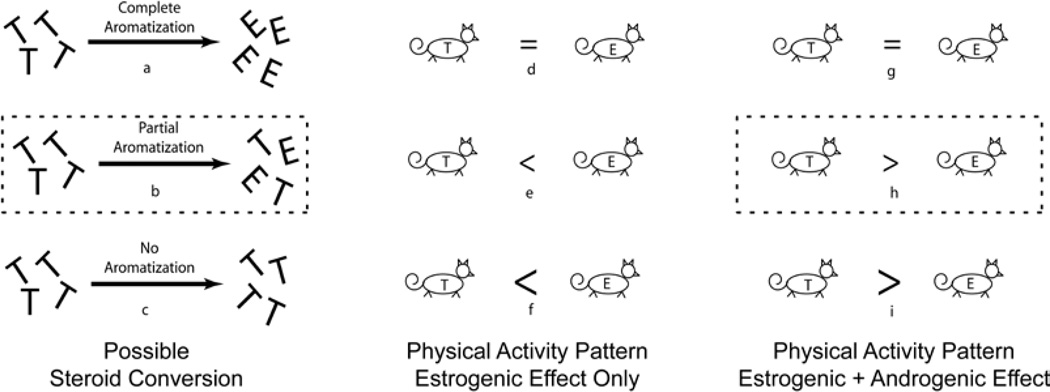
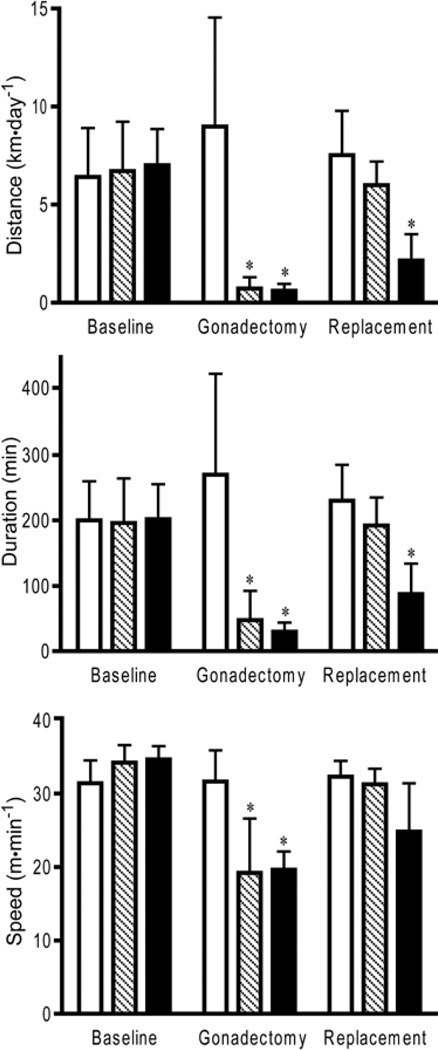
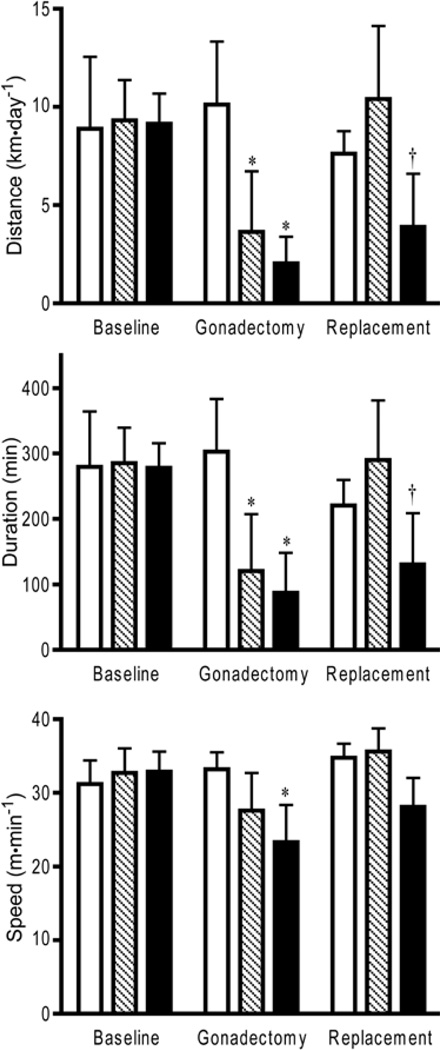
The regulatory mechanisms of physical activity are postulated to include environmental and biological/genetic factors. In particular, the sex steroids appear to have profound effects on wheel running in rodents. The purpose of this project was to investigate the effects of 17β-estradiol and testosterone on wheel running distance, duration, and speed in male and female C57BL/6J mice. The mice (N=46) were provided free access to running wheels interfaced with computers to track daily running distance, duration, and speed. Activity was assessed at baseline in intact mice, after surgical gonadectomy, and after replacement with either 17β-estradiol or testosterone. Upon removal of the gonads, physical activity levels were significantly reduced in both males and females. Distance (10-30% of baseline) and duration (20-47% of baseline) measures were most affected by the loss of endogenous steroids, while running speed (60-77% of baseline) though significantly reduced-decreased by a much lower magnitude. Testosterone replacement fully recovered running distance, duration, and speed to pre-surgical levels in both sexes (100% of baseline). Distance (30-42% of baseline) and duration (43-47% of baseline) were partially recovered by 17β-estradiol, but not to baseline levels. Speed (100% of baseline) was fully recovered by 17β-estradiol replacement in males and females. This study suggests that physical activity in mice is affected by endogenous steroids and can be altered by exogenous steroid replacement. The differences in the recovery abilities of 17β-estradiol and testosterone suggest that both estrogenic and androgenic pathways may be involved to variable degrees in activity regulation.
体育活动的调节机制据推测包括环境因素以及生物/遗传因素。特别是,性类固醇似乎对啮齿动物的转轮运动有深远影响。本项目的目的是研究17β-雌二醇和睾酮对雄性和雌性C57BL/6J小鼠转轮运动距离、持续时间和速度的影响。为46只小鼠提供了可自由使用的与计算机相连的转轮,以追踪每日的跑步距离、持续时间和速度。在完整小鼠的基线期、手术去势后以及用17β-雌二醇或睾酮替代后评估活动情况。去除性腺后,雄性和雌性小鼠的身体活动水平均显著降低。距离(降至基线的10 - 30%)和持续时间(降至基线的20 - 47%)指标受内源性类固醇缺失的影响最大,而跑步速度(降至基线的60 - 77%)虽显著降低,但下降幅度要小得多。睾酮替代使两性的跑步距离、持续时间和速度完全恢复到手术前水平(达到基线的100%)。17β-雌二醇使距离(达到基线的30 - 42%)和持续时间(达到基线的43 - 47%)部分恢复,但未恢复到基线水平。17β-雌二醇替代使雄性和雌性的速度完全恢复(达到基线的100%)。本研究表明,小鼠的身体活动受内源性类固醇影响,并且可通过外源性类固醇替代而改变。17β-雌二醇和睾酮恢复能力的差异表明,雌激素和雄激素途径可能在不同程度上参与活动调节。