Tamási Viola, Petschner Peter, Adori Csaba, Kirilly Eszter, Ando Romeo D, Tothfalusi Laszlo, Juhasz Gabriella, Bagdy Gyorgy
Department of Genetics, Cell- and Immunobiology, Semmelweis University, Budapest, Hungary; MTA-SE Neuropsychopharmacology and Neurochemistry Research Group, Budapest, Hungary.
Department of Pharmacodynamics, Semmelweis University, Budapest, Hungary; MTA-SE Neuropsychopharmacology and Neurochemistry Research Group, Budapest, Hungary.
PLoS One. 2014 Nov 25;9(11):e113662. doi: 10.1371/journal.pone.0113662. eCollection 2014.
Venlafaxine (VLX), a serotonine-noradrenaline reuptake inhibitor, is one of the most commonly used antidepressant drugs in clinical practice for the treatment of major depressive disorder (MDD). Despite being more potent than its predecessors, similarly to them, the therapeutical effect of VLX is visible only 3-4 weeks after the beginning of treatment. Furthermore, recent papers show that antidepressants, including also VLX, enhance the motor recovery after stroke even in non depressed persons. In the present, transcriptomic-based study we looked for changes in gene expressions after a long-term VLX administration.
Osmotic minipumps were implanted subcutaneously into Dark Agouti rats providing a continuous (40 mg/kg/day) VLX delivery for three weeks. Frontal regions of the cerebral cortex were isolated and analyzed using Illumina bead arrays to detect genes showing significant chances in expression. Gene set enrichment analysis was performed to identify specific regulatory networks significantly affected by long term VLX treatment.
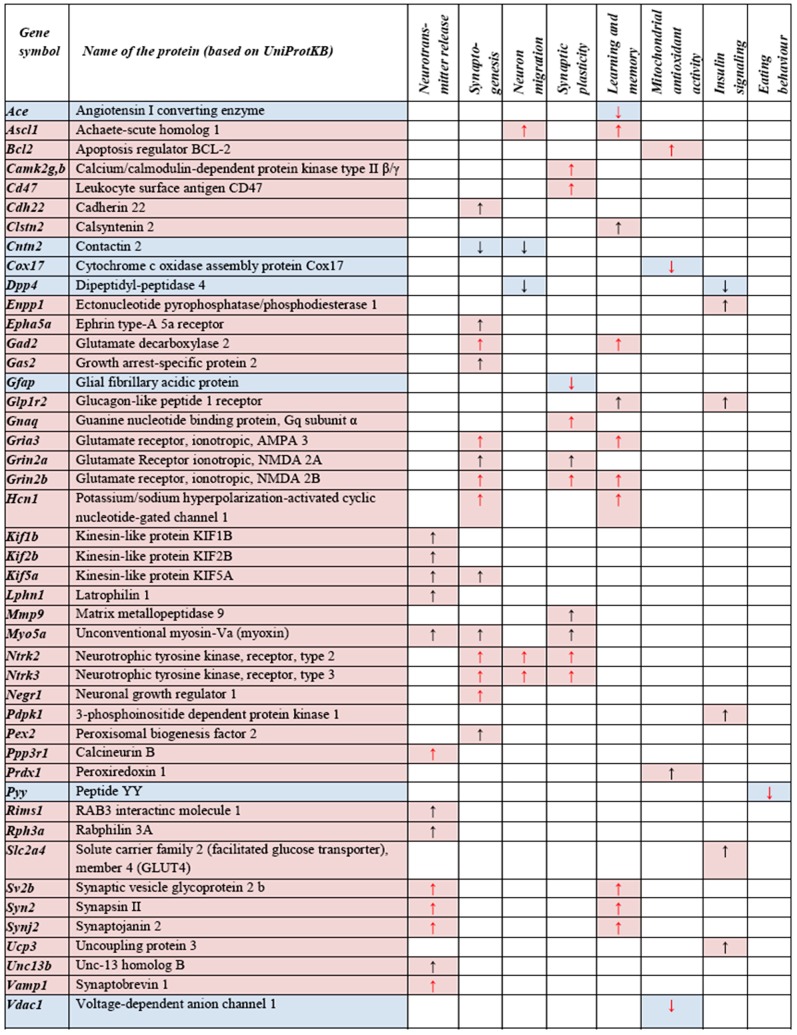
Chronic VLX administration may have an effect on neurotransmitter release via the regulation of genes involved in vesicular exocytosis and receptor endocytosis (such as Kif proteins, Myo5a, Sv2b, Syn2 or Synj2). Simultaneously, VLX activated the expression of genes involved in neurotrophic signaling (Ntrk2, Ntrk3), glutamatergic transmission (Gria3, Grin2b and Grin2a), neuroplasticity (Camk2g/b, Cd47), synaptogenesis (Epha5a, Gad2) and cognitive processes (Clstn2). Interestingly, VLX increased the expression of genes involved in mitochondrial antioxidant activity (Bcl2 and Prdx1). Additionally, VLX administration also modulated genes related to insulin signaling pathway (Negr1, Ppp3r1, Slc2a4 and Enpp1), a mechanism that has recently been linked to neuroprotection, learning and memory.
Our results strongly suggest that chronic VLX treatment improves functional reorganization and brain plasticity by influencing gene expression in regulatory networks of motor cortical areas. These results are consonant with the synaptic (network) hypothesis of depression and antidepressant-induced motor recovery after stroke.
文拉法辛(VLX)是一种5-羟色胺-去甲肾上腺素再摄取抑制剂,是临床实践中治疗重度抑郁症(MDD)最常用的抗抑郁药物之一。尽管它比其前身更有效,但与它们类似,VLX的治疗效果仅在治疗开始3-4周后才可见。此外,最近的论文表明,包括VLX在内的抗抑郁药,即使在非抑郁症患者中也能促进中风后的运动恢复。在目前这项基于转录组学的研究中,我们探寻长期给予VLX后基因表达的变化。
将渗透微型泵皮下植入深色刺豚鼠体内,持续(40毫克/千克/天)输送VLX三周。分离大脑皮质的额叶区域,使用Illumina微珠阵列进行分析,以检测表达有显著变化的基因。进行基因集富集分析,以识别受长期VLX治疗显著影响的特定调控网络。
长期给予VLX可能通过调节参与囊泡胞吐作用和受体内吞作用的基因(如驱动蛋白家族蛋白、肌球蛋白Va、突触囊泡蛋白2B、突触结合蛋白2或突触素结合蛋白2)来影响神经递质释放。同时,VLX激活了参与神经营养信号传导(神经营养酪氨酸激酶2、神经营养酪氨酸激酶3)、谷氨酸能传递(离子型谷氨酸受体3、谷氨酸受体亚基2B和谷氨酸受体亚基2A)、神经可塑性(钙/钙调蛋白依赖性蛋白激酶2γ/β、分化簇47)、突触形成(红细胞生成素受体5A、谷氨酸脱羧酶2)和认知过程(窖蛋白2)的基因表达。有趣的是,VLX增加了参与线粒体抗氧化活性的基因(B细胞淋巴瘤-2、过氧化物还原酶1)的表达。此外,给予VLX还调节了与胰岛素信号通路相关的基因(神经生长调控蛋白1、蛋白磷酸酶2B调节亚基Bα、溶质载体家族2成员4、核苷酸焦磷酸酶/磷酸二酯酶1),这一机制最近与神经保护、学习和记忆相关联。
我们的结果强烈表明,长期VLX治疗通过影响运动皮质区域调控网络中的基因表达来改善功能重组和脑可塑性。这些结果与抑郁症的突触(网络)假说以及抗抑郁药诱导的中风后运动恢复相一致。