Lapmanee Sarawut, Supkamonseni Nattapon, Bhubhanil Sakkarin, Treesaksrisakul Nattakan, Sirithanakorn Chaiyos, Khongkow Mattaka, Namdee Katawut, Surinlert Piyaporn, Tipbunjong Chittipong, Wongchitrat Prapimpun
Department of Basic Medical Sciences, Faculty of Medicine, Siam University, Bangkok, Thailand.
Faculty of Medicine, King Mongkut's Institute of Technology Ladkrabang, Bangkok, Thailand.
PeerJ. 2024 Feb 28;12:e17033. doi: 10.7717/peerj.17033. eCollection 2024.
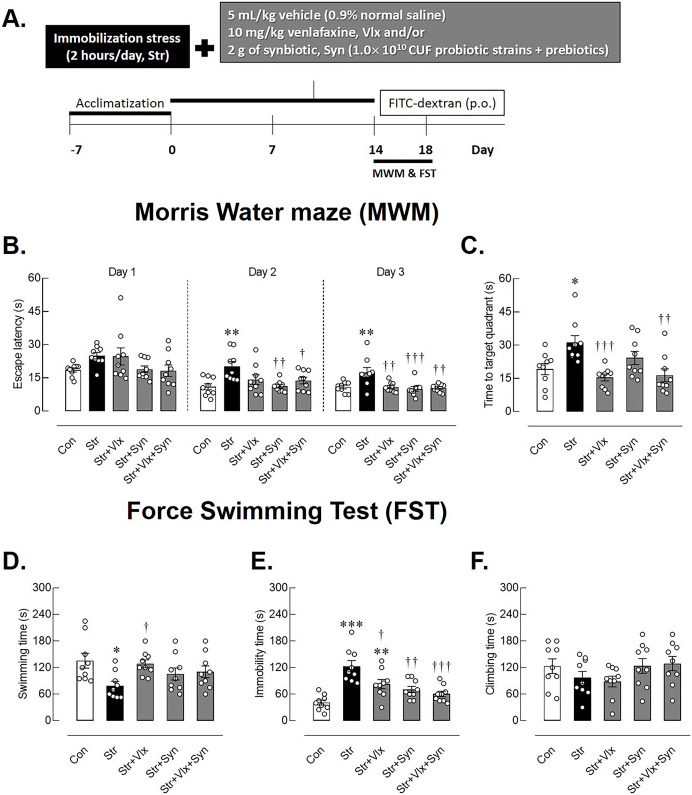
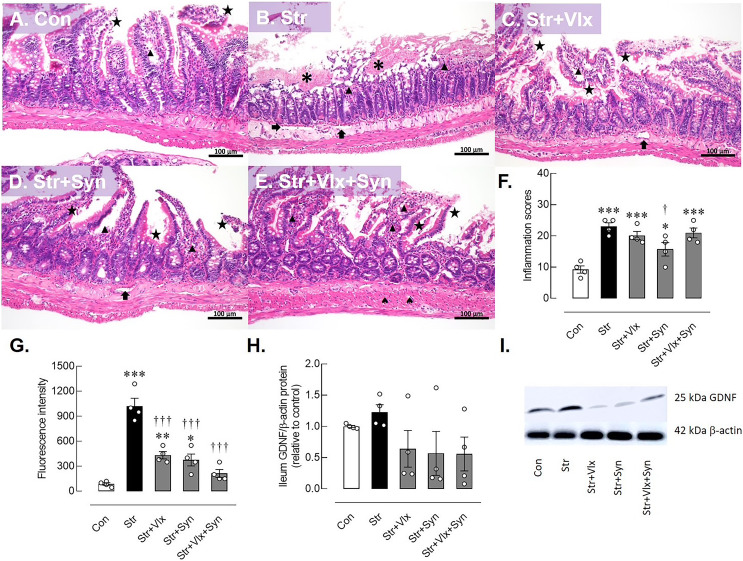
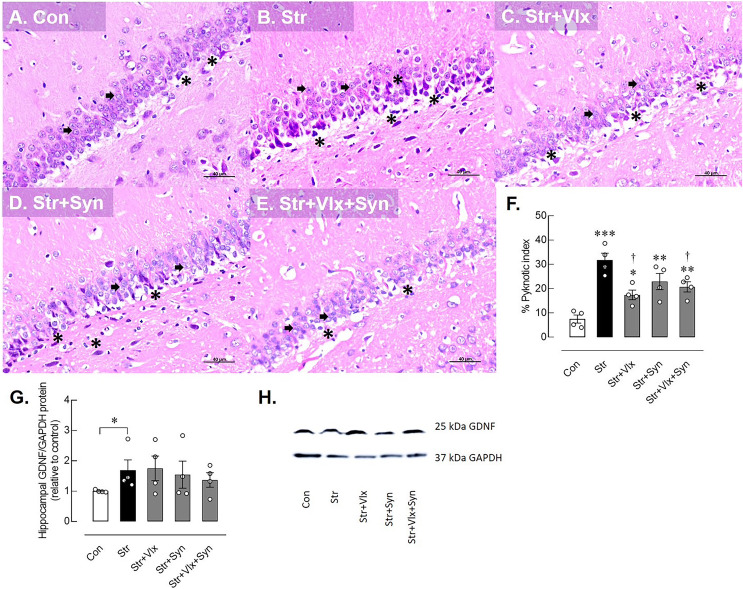
Stress profoundly impacts various aspects of both physical and psychological well-being. Our previous study demonstrated that venlafaxine (Vlx) and synbiotic (Syn) treatment attenuated learned fear-like behavior and recognition memory impairment in immobilized-stressed rats. In this study, we further investigated the physical, behavior, and cellular mechanisms underlying the effects of Syn and/or Vlx treatment on brain and intestinal functions in stressed rats. Adult male Wistar rats, aged 8 weeks old were subjected to 14 days of immobilization stress showed a decrease in body weight gain and food intake as well as an increase in water consumption, urinary corticosterone levels, and adrenal gland weight. Supplementation of Syn and/or Vlx in stressed rats resulted in mitigation of weight loss, restoration of normal food and fluid intake, and normalization of corticosterone levels. Behavioral analysis showed that treatment with Syn and/or Vlx enhanced depressive-like behaviors and improved spatial learning-memory impairment in stressed rats. Hippocampal dentate gyrus showed stress-induced neuronal cell death, which was attenuated by Syn and/or Vlx treatment. Stress-induced ileum inflammation and increased intestinal permeability were both effectively reduced by the supplementation of Syn. In addition, Syn and Vlx partly contributed to affecting the expression of the glial cell-derived neurotrophic factor in the hippocampus and intestines of stressed rats, suggesting particularly protective effects on both the gut barrier and the brain. This study highlights the intricate interplay between stress physiological responses in the brain and gut. Syn intervention alleviate stress-induced neuronal cell death and modulate depression- and memory impairment-like behaviors, and improve stress-induced gut barrier dysfunction which were similar to those of Vlx. These findings enhance our understanding of stress-related health conditions and suggest the synbiotic intervention may be a promising approach to ameliorate deleterious effects of stress on the gut-brain axis.
应激对身心健康的各个方面都有深远影响。我们之前的研究表明,文拉法辛(Vlx)和合生元(Syn)治疗可减轻固定应激大鼠的习得性恐惧样行为和认知记忆损伤。在本研究中,我们进一步探究了Syn和/或Vlx治疗对应激大鼠脑和肠道功能影响的生理、行为及细胞机制。8周龄成年雄性Wistar大鼠接受14天的固定应激后,体重增加和食物摄入量减少,同时水消耗量、尿皮质酮水平及肾上腺重量增加。给应激大鼠补充Syn和/或Vlx可减轻体重减轻,恢复正常食物和液体摄入量,并使皮质酮水平正常化。行为分析表明,Syn和/或Vlx治疗可增强应激大鼠的抑郁样行为并改善空间学习记忆损伤。海马齿状回出现应激诱导的神经元细胞死亡,而Syn和/或Vlx治疗可使其减轻。补充Syn可有效减轻应激诱导的回肠炎症和肠道通透性增加。此外,Syn和Vlx部分有助于影响应激大鼠海马和肠道中胶质细胞源性神经营养因子的表达,表明对肠道屏障和大脑均具有特别的保护作用。本研究突出了大脑和肠道应激生理反应之间复杂的相互作用。Syn干预可减轻应激诱导的神经元细胞死亡,调节抑郁样和记忆损伤样行为,并改善应激诱导的肠道屏障功能障碍,其作用与Vlx相似。这些发现加深了我们对应激相关健康状况的理解,并表明合生元干预可能是改善应激对肠-脑轴有害影响的一种有前景的方法。