Prensner John R, Chen Wei, Han Sumin, Iyer Matthew K, Cao Qi, Kothari Vishal, Evans Joseph R, Knudsen Karen E, Paulsen Michelle T, Ljungman Mats, Lawrence Theodore S, Chinnaiyan Arul M, Feng Felix Y
Michigan Center for Translational Pathology, University of Michigan Medical School, Ann Arbor, MI, USA.
Department of Radiation Oncology, University of Michigan Medical School, Ann Arbor, MI, USA.
Neoplasia. 2014 Nov 20;16(11):900-8. doi: 10.1016/j.neo.2014.09.001. eCollection 2014 Nov.
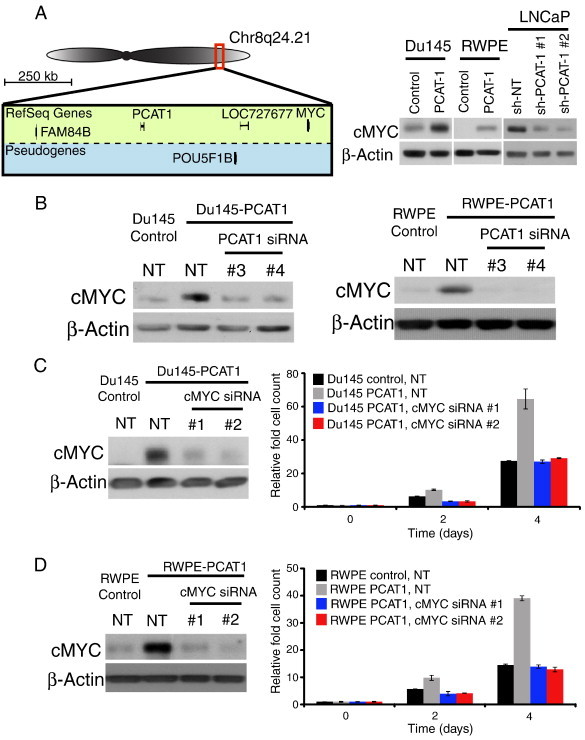
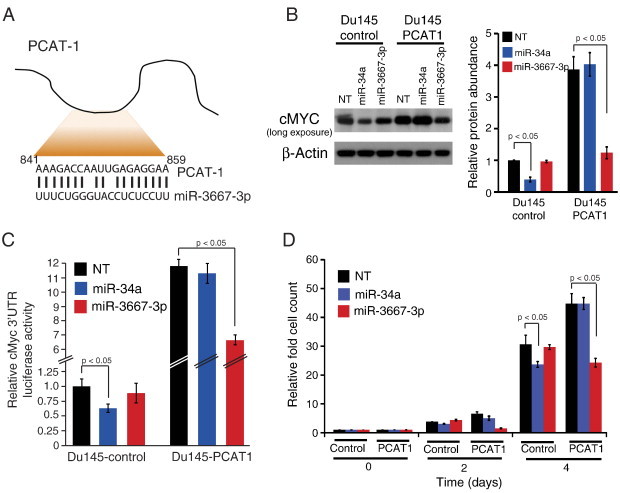
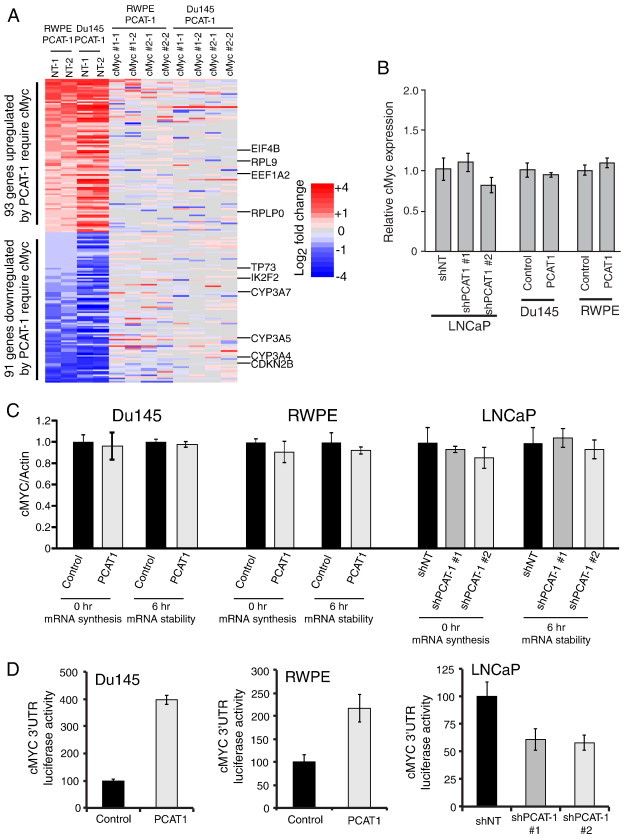
Long non-coding RNAs (lncRNAs) represent an emerging layer of cancer biology, contributing to tumor proliferation, invasion, and metastasis. Here, we describe a role for the oncogenic lncRNA PCAT-1 in prostate cancer proliferation through cMyc. We find that PCAT-1-mediated proliferation is dependent on cMyc protein stabilization, and using expression profiling, we observed that cMyc is required for a subset of PCAT-1-induced expression changes. The PCAT-1-cMyc relationship is mediated through the post-transcriptional activity of the MYC 3' untranslated region, and we characterize a role for PCAT-1 in the disruption of MYC-targeting microRNAs. To further elucidate a role for post-transcriptional regulation, we demonstrate that targeting PCAT-1 with miR-3667-3p, which does not target MYC, is able to reverse the stabilization of cMyc by PCAT-1. This work establishes a basis for the oncogenic role of PCAT-1 in cancer cell proliferation and is the first study to implicate lncRNAs in the regulation of cMyc in prostate cancer.
长链非编码RNA(lncRNAs)代表了癌症生物学中一个新出现的层面,对肿瘤的增殖、侵袭和转移都有影响。在此,我们描述了致癌性lncRNA PCAT-1通过cMyc在前列腺癌增殖中所起的作用。我们发现PCAT-1介导的增殖依赖于cMyc蛋白的稳定,并且通过表达谱分析,我们观察到cMyc是PCAT-1诱导的一部分表达变化所必需的。PCAT-1与cMyc的关系是通过MYC 3'非翻译区的转录后活性介导的,并且我们确定了PCAT-1在破坏靶向MYC的微小RNA中的作用。为了进一步阐明转录后调控的作用,我们证明用不靶向MYC的miR-3667-3p靶向PCAT-1能够逆转PCAT-1对cMyc的稳定作用。这项工作为PCAT-1在癌细胞增殖中的致癌作用奠定了基础,并且是首次表明lncRNAs参与前列腺癌中cMyc调控的研究。