School of Psychology and Speech Pathology, Curtin University Perth, WA, Australia.
Front Psychol. 2014 Nov 12;5:1312. doi: 10.3389/fpsyg.2014.01312. eCollection 2014.
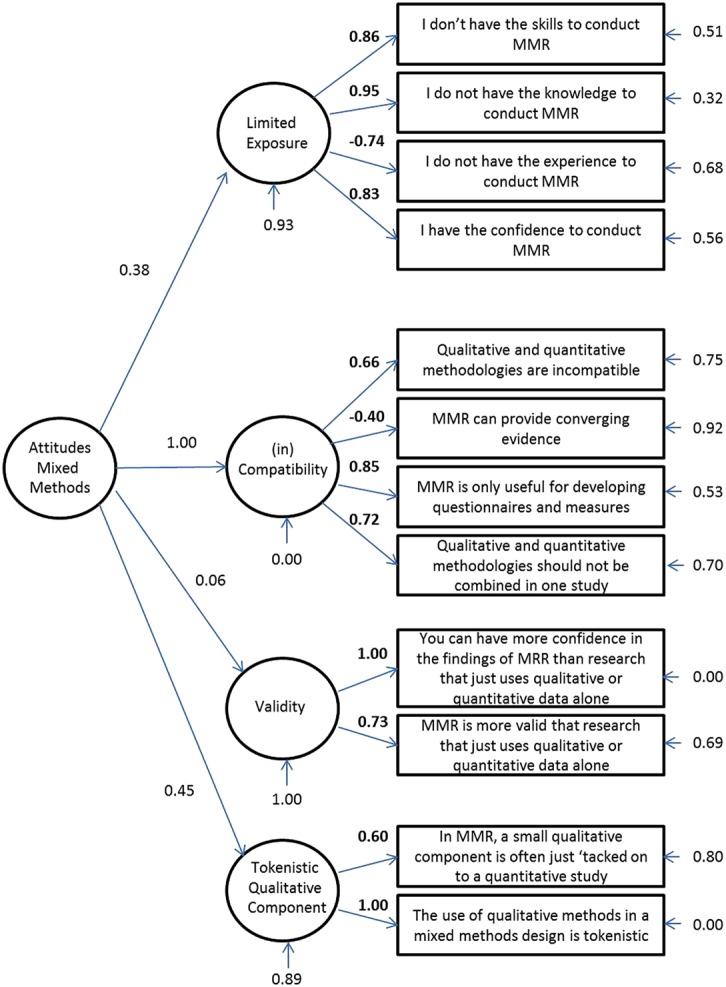
The adoption of mixed methods research in psychology has trailed behind other social science disciplines. Teaching psychology students, academics, and practitioners about mixed methodologies may increase the use of mixed methods within the discipline. However, tailoring and evaluating education and training in mixed methodologies requires an understanding of, and way of measuring, attitudes toward mixed methods research in psychology. To date, no such measure exists. In this article we present the development and initial validation of a new measure: Attitudes toward Mixed Methods Research in Psychology. A pool of 42 items developed from previous qualitative research on attitudes toward mixed methods research along with validation measures was administered via an online survey to a convenience sample of 274 psychology students, academics and psychologists. Principal axis factoring with varimax rotation on a subset of the sample produced a four-factor, 12-item solution. Confirmatory factor analysis on a separate subset of the sample indicated that a higher order four factor model provided the best fit to the data. The four factors; 'Limited Exposure,' '(in)Compatibility,' 'Validity,' and 'Tokenistic Qualitative Component'; each have acceptable internal reliability. Known groups validity analyses based on preferred research orientation and self-rated mixed methods research skills, and convergent and divergent validity analyses based on measures of attitudes toward psychology as a science and scientist and practitioner orientation, provide initial validation of the measure. This brief, internally reliable measure can be used in assessing attitudes toward mixed methods research in psychology, measuring change in attitudes as part of the evaluation of mixed methods education, and in larger research programs.
心理学领域混合方法研究的采用落后于其他社会科学学科。向心理学学生、学者和从业者教授混合方法学可能会增加该学科中混合方法的使用。然而,定制和评估混合方法学的教育和培训需要了解和衡量心理学中对混合方法研究的态度。迄今为止,还没有这样的衡量标准。在本文中,我们提出了一种新的衡量标准的开发和初步验证:对心理学中混合方法研究的态度。从以前关于对混合方法研究的态度的定性研究中开发的 42 个项目池以及验证措施通过在线调查在 274 名心理学学生、学者和心理学家的便利样本中进行了管理。在样本的子集上进行的主成分因子分析与方差极大旋转产生了一个四因素、12 项的解决方案。在样本的另一个子集上进行的验证性因素分析表明,高阶四因素模型为数据提供了最佳拟合。四个因素;“有限的暴露”、“(不)兼容性”、“有效性”和“象征性的定性成分”;每个都具有可接受的内部可靠性。基于首选研究方向和自我评估的混合方法研究技能的已知群体有效性分析,以及基于对心理学作为一门科学和科学家和从业者取向的态度的测量的收敛和发散有效性分析,为该测量提供了初步验证。这种简短、内部可靠的衡量标准可用于评估心理学中对混合方法研究的态度,衡量作为混合方法教育评估一部分的态度变化,以及在更大的研究计划中。