Owusu Jocelynn T, Prapasiri Prabda, Ditsungnoen Darunee, Leetongin Grit, Yoocharoen Pornsak, Rattanayot Jarowee, Olsen Sonja J, Muangchana Charung
ASPPH/CDC Allan Rosenfield Global Health Fellow, Atlanta, GA, USA; Influenza Program, Thailand Ministry of Public Health-U.S. Centers for Disease Control and Prevention Collaboration, Nonthaburi, Thailand.
Influenza Program, Thailand Ministry of Public Health-U.S. Centers for Disease Control and Prevention Collaboration, Nonthaburi, Thailand.
Vaccine. 2015 Jan 29;33(5):742-7. doi: 10.1016/j.vaccine.2014.10.029. Epub 2014 Nov 7.
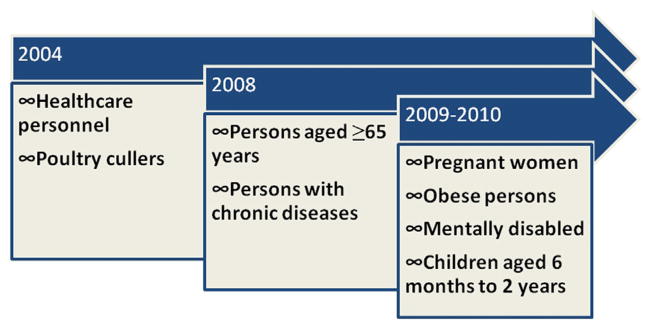
The Advisory Committee on Immunization Practice of Thailand prioritizes seasonal influenza vaccinations for populations who are at highest risk for serious complications (pregnant women, children 6 months-2 years, persons ≥65 years, persons with chronic diseases, obese persons), and healthcare personnel and poultry cullers. The Thailand government purchases seasonal influenza vaccine for these groups. We assessed vaccination coverage among high-risk groups in Thailand from 2010 to 2012.
National records on persons who received publicly purchased vaccines from 2010 to 2012 were analyzed by high-risk category. Denominator data from multiple sources were compared to calculate coverage. Vaccine coverage was defined as the proportion of individuals in each category who received the vaccine. Vaccine wastage was defined as the proportion of publicly purchased vaccines that were not used.
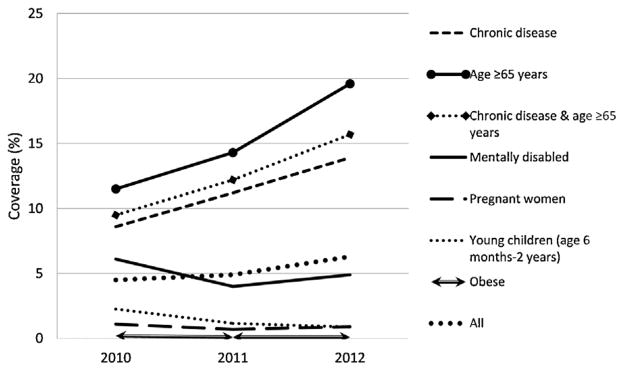
From 2010 to 2012, 8.18 million influenza vaccines were publicly purchased (range, 2.37-3.29 million doses/year), and vaccine purchases increased 39% over these years. Vaccine wastage was 9.5%. Approximately 5.7 million (77%) vaccine doses were administered to persons ≥65 years and persons with chronic diseases, 1.4 million (19%) to healthcare personnel/poultry cullers, 82,570 (1.1%) to children 6 months-2 years, 78,885 (1.1%) to obese persons, 26,481 (0.4%) to mentally disabled persons, and 17,787 (0.2%) to pregnant women. Between 2010 and 2012, coverage increased among persons with chronic diseases (8.6% versus 14%; p<0.01) and persons ≥65 years (12%, versus 20%; p<0.01); however, coverage decreased for mentally disabled persons (6.1% versus 4.9%; p<0.01), children 6 months-2 years (2.3% versus 0.9%; p<0.01), pregnant women (1.1% versus 0.9%; p<0.01), and obese persons (0.2% versus 0.1%; p<0.01).
From 2010 to 2012, the availability of publicly purchased vaccines increased. While coverage remained low for all target groups, coverage was highest among persons ≥65 years and persons with chronic diseases. Annual coverage assessments are necessary to promote higher coverage among high-risk groups in Thailand.
泰国免疫实践咨询委员会将季节性流感疫苗接种的重点放在有严重并发症高风险的人群(孕妇、6个月至2岁儿童、65岁及以上人群、慢性病患者、肥胖者)、医护人员和家禽扑杀人员身上。泰国政府为这些群体采购季节性流感疫苗。我们评估了2010年至2012年泰国高风险群体的疫苗接种覆盖率。
按高风险类别分析2010年至2012年接受公共采购疫苗人员的国家记录。比较多个来源的分母数据以计算覆盖率。疫苗接种覆盖率定义为各类别中接种疫苗的个体比例。疫苗浪费定义为未使用的公共采购疫苗的比例。
2010年至2012年,共公共采购了818万剂流感疫苗(范围为每年237万至329万剂),这些年疫苗采购量增加了39%。疫苗浪费率为9.5%。约570万剂(77%)疫苗接种给了65岁及以上人群和慢性病患者,140万剂(19%)接种给了医护人员/家禽扑杀人员,82570剂(1.1%)接种给了6个月至2岁儿童,78885剂(1.1%)接种给了肥胖者,26481剂(0.4%)接种给了精神残疾者,17787剂(0.2%)接种给了孕妇。2010年至2012年期间,慢性病患者(8.6%对14%;p<0.01)和65岁及以上人群(12%对20%;p<0.01)的接种覆盖率有所上升;然而,精神残疾者(6.1%对4.9%;p<0.01)、6个月至2岁儿童(2.3%对0.9%;p<0.01)、孕妇(1.1%对0.9%;p<0.01)和肥胖者(0.2%对0.1%;p<0.01)的接种覆盖率下降。
2010年至2012年,公共采购疫苗的可得性有所增加。虽然所有目标群体的接种覆盖率仍然较低,但65岁及以上人群和慢性病患者的接种覆盖率最高。有必要进行年度覆盖率评估,以提高泰国高风险群体的接种覆盖率。