Li Ya, Shi Bingyin, Li Sheli
Department of endocrinology, The First Hospital Affiliated to Xi'an Jiaotong University, Xi'an 710061, China; Department of endocrinology, Yan'an University Affiliated Hospital, Yan'an 716000, China.
Department of endocrinology, The First Hospital Affiliated to Xi'an Jiaotong University, Xi'an 710061, China.
PLoS One. 2014 Dec 3;9(12):e113915. doi: 10.1371/journal.pone.0113915. eCollection 2014.
Chemerin is a novel adipokine. Previous research has investigated the association between chemerin and clinical indices in patients with obesity or metabolic syndrome (MS), although the results obtained have been inconsistent. We conducted a meta-analysis to investigate the association between chemerin and clinical indicators of diabetes, MS and obesity with obesity or MS subjects.
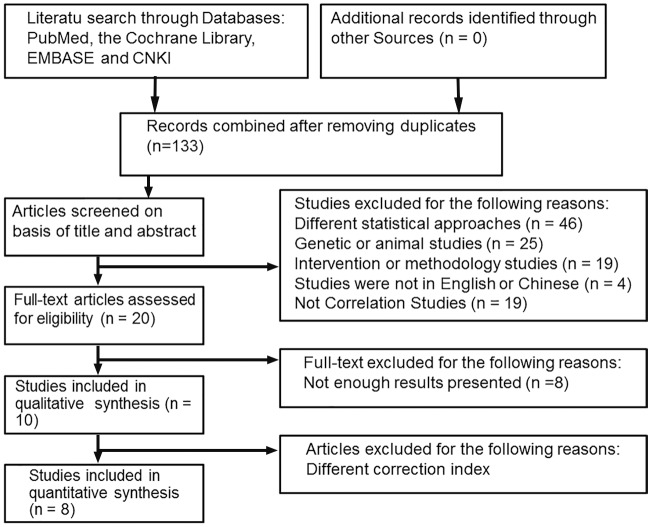
Studies were identified by searching the PubMed, the Cochrane Library, EMBASE and CNKI, databases beginning with the original report in July 2007 until the end of May 2013. For each variable, summary correlation coefficients were estimated using random-effects or fixed-effect meta-analysis with 95% confidence interval (CI) performed by STATA software.
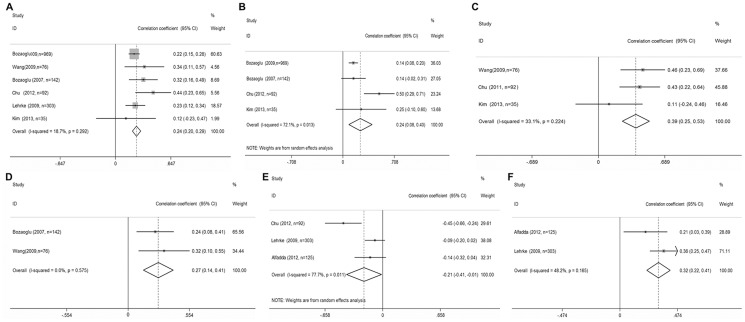
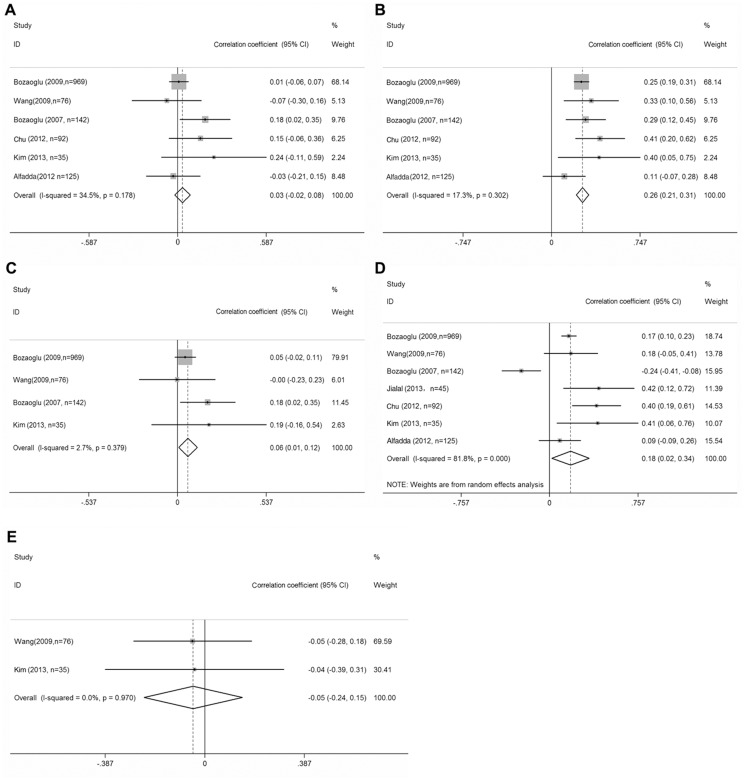
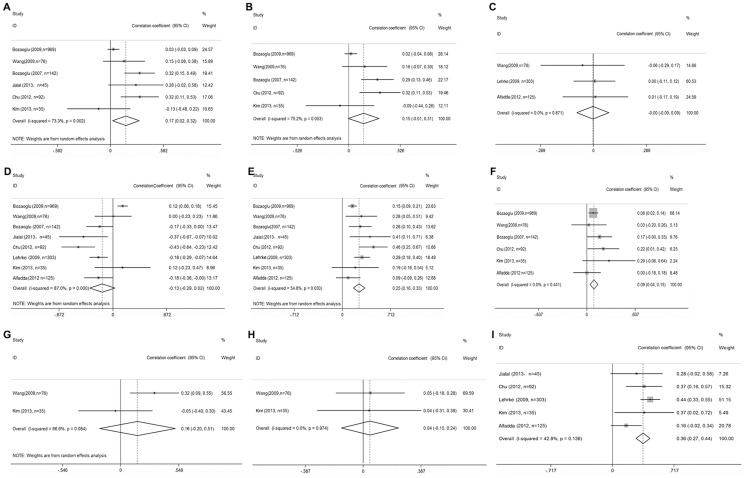
A total of eight studies with 20 clinical variables (total n = 1787) met the inclusion criteria. The meta-analyse of diabetes markers showed that FSI (rs = 0.26; 95% CI = 0.21-0.31; P = 0.000), 2HPG (rs = 0.06; 95% CI = 0.01-0.12; P = 0.030) and HOMA-IR (rs = 0.178; 95% CI = 0.019-0.337; P = 0.028) were positively correlated with chemerin, however, FPG (rs = 0.03, 95% CI = -0.02 to 0.08, P = 0.240) and HbA1c (rs = -0.05; 95% CI = -0.24-0.15; P = 0.641) were not significantly correlated with chemerin. The meta-analyses of MS and obesity markers indicated that TG, TC, CRP BMI, TBF%, WC, WHR and Leptin were positively correlated with chemerin, nevertheless, SBP, DBP, LDL-C, HDL-C, ALT and r-GT were not significantly correlated, adiponectin was negatively correlated. Sensitivity analysis was performed and the summary results did not change significantly.
The results suggest that chemerin in patients with obesity or MS may be associated with obesity, imbalances in lipid and diabetes metabolism and insulin resistance. Chemerin played an important role in the pathophysiology of obesity and MS.
chemerin是一种新型脂肪因子。先前的研究调查了chemerin与肥胖或代谢综合征(MS)患者临床指标之间的关联,尽管所得结果并不一致。我们进行了一项荟萃分析,以研究chemerin与肥胖或MS受试者的糖尿病、MS及肥胖临床指标之间的关联。
通过检索PubMed、Cochrane图书馆、EMBASE和中国知网数据库来确定研究,检索起始于2007年7月的原始报告,截止至2013年5月底。对于每个变量,使用随机效应或固定效应荟萃分析估计汇总相关系数,并通过STATA软件计算95%置信区间(CI)。
共有八项研究涉及20个临床变量(总计n = 1787)符合纳入标准。糖尿病标志物的荟萃分析显示,空腹血糖胰岛素抵抗指数(FSI,rs = 0.26;95% CI = 0.21 - 0.31;P = 0.000)、餐后2小时血糖(2HPG,rs = 0.06;95% CI = 0.01 - 0.12;P = 0.030)和稳态模型评估胰岛素抵抗(HOMA - IR,rs = 0.178;95% CI = 0.019 - 0.337;P = 0.028)与chemerin呈正相关,然而,空腹血糖(FPG,rs = 0.03,95% CI = -0.02至0.08,P = 0.240)和糖化血红蛋白(HbA1c,rs = -0.05;95% CI = -0.24 - 0.15;P = 0.641)与chemerin无显著相关性。MS和肥胖标志物的荟萃分析表明,甘油三酯(TG)、总胆固醇(TC)、C反应蛋白(CRP)、体重指数(BMI)、体脂肪率(TBF%)、腰围(WC)、腰臀比(WHR)和瘦素与chemerin呈正相关,然而,收缩压(SBP)、舒张压(DBP)、低密度脂蛋白胆固醇(LDL - C)、高密度脂蛋白胆固醇(HDL - C)、谷丙转氨酶(ALT)和γ-谷氨酰转肽酶(r - GT)无显著相关性,脂联素呈负相关。进行了敏感性分析,汇总结果无显著变化。
结果表明,肥胖或MS患者体内的chemerin可能与肥胖、脂质和糖尿病代谢失衡及胰岛素抵抗有关。Chemerin在肥胖和MS的病理生理学中起重要作用。