Kanellopoulos Anastasios John, Asimellis George, Karabatsas Costas
LaserVision.gr Clinical and Research Eye Institute, Athens, Greece ; New York University Medical School, New York, NY, USA.
LaserVision.gr Clinical and Research Eye Institute, Athens, Greece.
Clin Ophthalmol. 2014 Nov 27;8:2373-81. doi: 10.2147/OPTH.S68372. eCollection 2014.
To compare 1-year results: safety, efficacy, refractive and keratometric stability, of femtosecond myopic laser-assisted in situ keratomileusis (LASIK) with and without concurrent prophylactic high-fluence cross-linking (CXL) (LASIK-CXL).
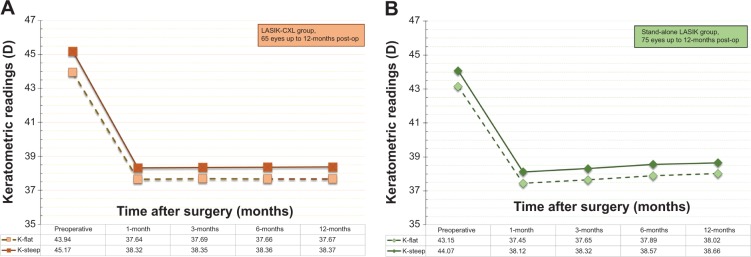
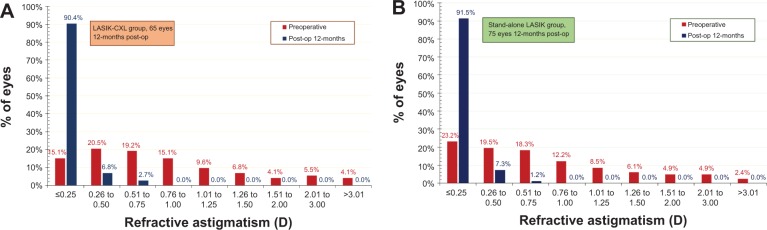
We studied a total of 155 consecutive eyes planned for LASIK myopic correction. Group A represented 73 eyes that were treated additionally with concurrent prophylactic high-fluence CXL; group B included 82 eyes subjected to the stand-alone LASIK procedure. The following parameters were evaluated preoperatively and up to 1-year postoperatively: manifest refractive spherical equivalent (MRSE), refractive astigmatism, visual acuity, corneal keratometry, and endothelial cell counts. We plotted keratometry measurements pre-operatively and its change in the early, interim and later post-operative time for the two groups, as a means of keratometric stability comparison.
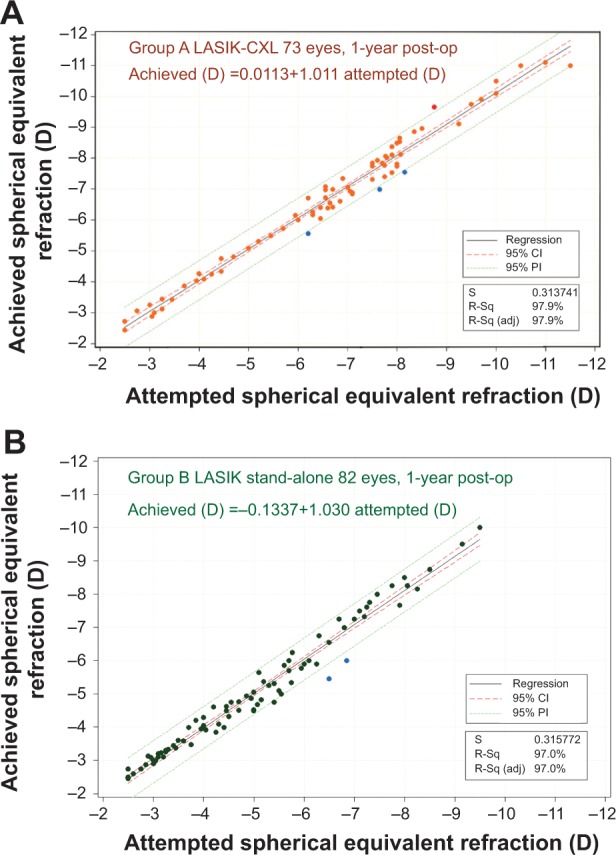
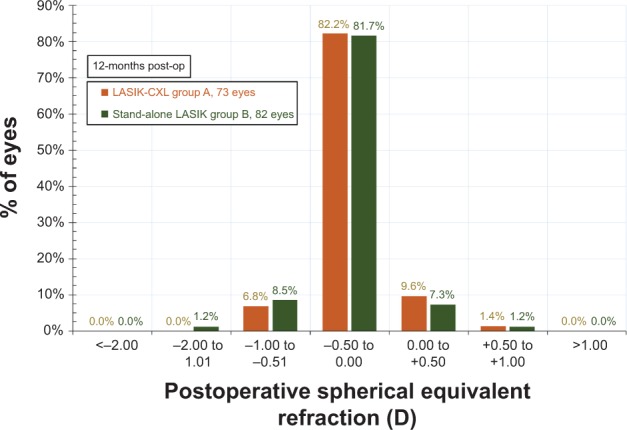
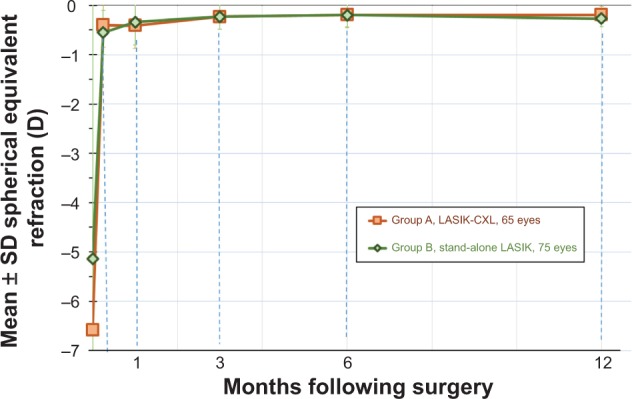
Group A (LASIK-CXL) had an average postoperative MRSE of -0.23, -0.19, and -0.19 D for the 3-, 6-, and 12-month period, respectively, compared to -6.58±1.98 D preoperatively. Flat keratometry was 37.69, 37.66, and 37.67 D, compared to 43.94 D preoperatively, and steep keratometry was 38.35, 38.36, and 38.37 D, compared to 45.17 D preoperatively. The predictability of Manifest Refraction Spherical Equivalent (MRSE) correction showed a correlation coefficient of 0.979. Group B (stand-alone LASIK) had an average postoperative MRSE of -0.23, -0.20, and -0.27 D for the 3-, 6-, and 12-month period, respectively, compared with -5.14±2.34 D preoperatively. Flat keratometry was 37.65, 37.89, and 38.02 D, compared with 43.15 D preoperatively, and steep keratometry was 38.32, 38.57, and 38.66 D, compared with 44.07 D preoperatively. The predictability of MRSE correction showed a correlation coefficient of 0.970. The keratometric stability plots were stable for the LASIK CXL group and slightly regressing in the standard LASIK group, a novel stability evaluation metric that may escape routine acuity and refraction measurements.
Application of prophylactic CXL concurrently with myopic LASIK surgery appears to contribute to improved refractive and keratometric stability compared to standard LASIK. The procedure appears safe and provides a new potential for LASIK correction.
比较飞秒激光制瓣准分子原位角膜磨镶术(LASIK)联合与不联合预防性高能量交联术(CXL)(LASIK-CXL)的1年结果:安全性、有效性、屈光和角膜曲率稳定性。
我们共研究了155只计划接受LASIK近视矫正的连续眼睛。A组为73只额外接受预防性高能量CXL的眼睛;B组包括82只接受单纯LASIK手术的眼睛。术前及术后1年内评估以下参数:显微微分球镜当量(MRSE)、屈光性散光、视力、角膜曲率测量以及内皮细胞计数。我们绘制了两组术前的角膜曲率测量值及其术后早期、中期和后期的变化,作为角膜曲率稳定性比较的一种方法。
A组(LASIK-CXL)术后3个月、6个月和12个月的平均MRSE分别为-0.23D、-0.19D和-0.19D,术前为-6.58±1.98D。平坦角膜曲率分别为37.69D、37.66D和37.67D,术前为43.94D;陡峭角膜曲率分别为38.35D、38.36D和38.37D,术前为45.17D。显微微分球镜当量(MRSE)矫正的可预测性显示相关系数为0.979。B组(单纯LASIK)术后3个月、6个月和12个月的平均MRSE分别为-0.23D、-0.20D和-0.27D,术前为-5.14±2.34D。平坦角膜曲率分别为37.65D、37.89D和38.02D,术前为43.15D;陡峭角膜曲率分别为38.32D、38.57D和38.66D,术前为44.07D。MRSE矫正的可预测性显示相关系数为0.970。LASIK CXL组的角膜曲率稳定性图稳定,而标准LASIK组略有回退,这是一种可能避开常规视力和屈光测量的新型稳定性评估指标。
与标准LASIK相比,近视LASIK手术同时应用预防性CXL似乎有助于提高屈光和角膜曲率稳定性。该手术似乎是安全的,并为LASIK矫正提供了新的潜力。