Kanellopoulos Anastasios John, Asimellis George
LaserVision.gr Clinical and Research Eye Institute, Athens, Greece ; New York University Medical School, New York, NY, USA.
LaserVision.gr Clinical and Research Eye Institute, Athens, Greece.
Clin Ophthalmol. 2015 Feb 5;9:245-52. doi: 10.2147/OPTH.S68371. eCollection 2015.
To investigate repeatability of steep and flat keratometry measurements, as well as astigmatism axis in cohorts with normal range and regular astigmatic such as: eyes following laser-assisted in situ keratomileusis (LASIK) and normal population, as well as cohorts of high and irregular astigmatism such as keratoconic eyes, and keratoconic eyes following corneal collagen cross-linking, employing a novel corneal reflection topography device.
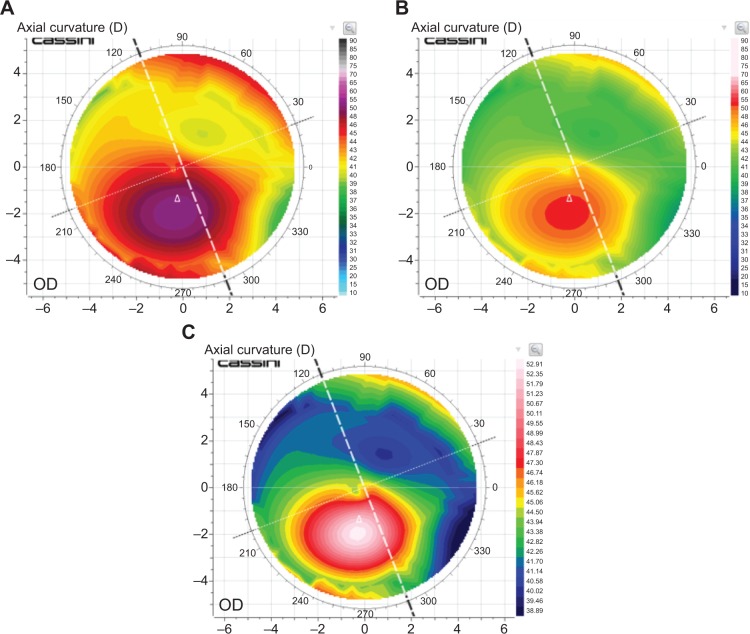
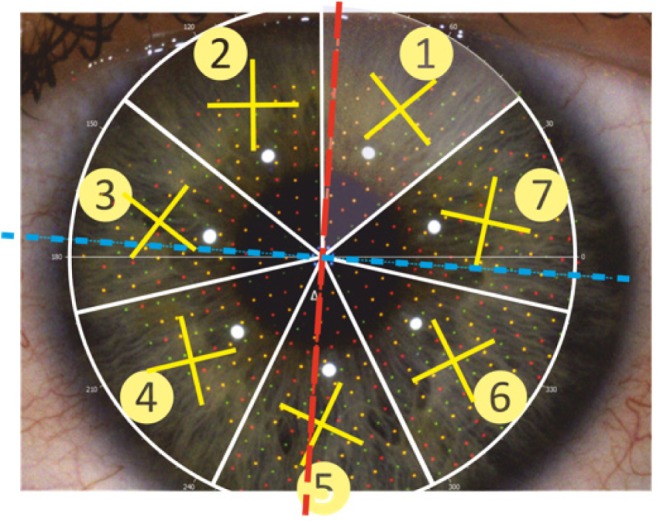
Steep and flat keratometry and astigmatism axis measurement repeatability was investigated employing a novel multicolored-spot reflection topographer (Cassini) in four study groups, namely a post myopic LASIK-treated Group A, a keratoconus Group B, a post-CXL keratoconus Group C, and a control Group D of routine healthy patients. Three separate, maps were obtained employing the Cassini, enabling investigation of the intra-individual repeatability by standard deviation. Additionally we investigated in all groups,the Klyce surface irregularity indices for keratoconus, the SAI (surface asymmetry index) and the SRI (surface regularity index).
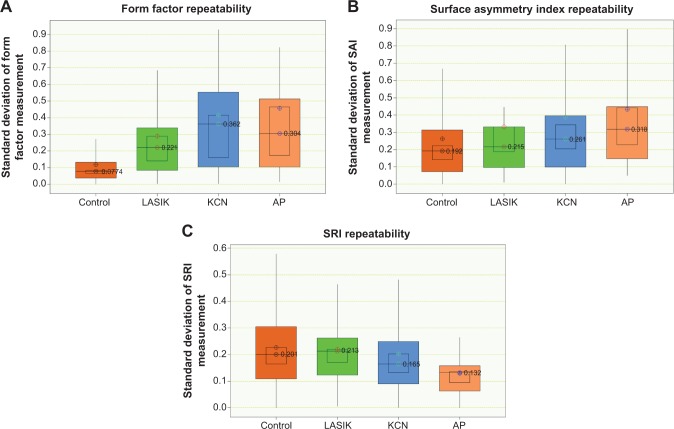
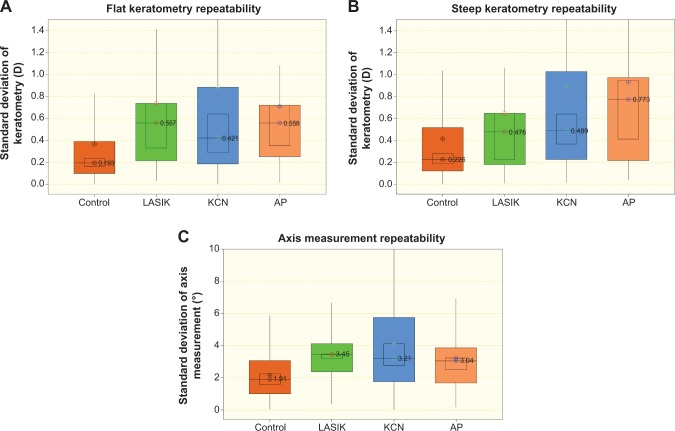
Flat keratometry repeatability was 0.74±0.89 (0.03 to 5.26) diopters (D) in the LASIK Group A, 0.88±1.45 (range minimum to maximum, 0.00 to 7.84) D in the keratoconic Group B, and 0.71±0.94 (0.02 to 6.23) D in the cross-linked Group C. The control Group D had flat keratometry repeatability 0.36±0.46 (0.00 to 2.71) D. Steep keratometry repeatability was 0.64±0.82 (0.01 to 4.81) D in the LASIK Group A, 0.89±1.22 (0.02 to 7.85) D in the keratoconic Group B, and 0.93±1.12 (0.04 to 5.93) D in the cross-linked Group C. The control Group D had steep keratometry repeatability 0.41±0.50 (0.00 to 3.51) D. Axis repeatability was 3.45±1.62° (0.38 to 7.78°) for the LASIK Group A, 4.12±3.17° (0.02 to 12.13°) for the keratoconic Group B, and 3.20±1.99° (0.17 to 8.61°) for the cross-linked Group C. The control Group D had axis repeatability 2.16±1.39° (0.05 to 5.86°). The SAI index measurement repeatability was 0.33±0.40 (0.01 to 2.31) in the post-LASIK Group A, 0.39±0.75 (0.00 to 7.15) in the keratoconic Group B, and 0.43±0.56 (0.05 to 3.50) in the keratoconus post-CXL Group C. The control group had SAI measurement repeatability of 0.26±0.30 (0.00 to 2.39). The SRI index repeatability was 0.22±0.17 (0.01 to 0.96) for post-LASIK Group A, 0.20±0.18 (0.00 to 1.07) in keratoconic Group B, and 0.13±0.09 (0.00 to 0.45) in the keratoconus post-CXL Group C. The control Group D had SRI measurement repeatability of 0.23±0.16 (0.00 to 0.75).
This novel corneal topography device appears to offer very high specificity in estimating corneal keratometry and specific corneal irregularity indices, even in topographically challenging corneas such as LASIK treated, keratoconic, and cross-linked.
使用一种新型角膜反射地形图设备,研究正常范围和规则散光人群(如接受准分子激光原位角膜磨镶术[LASIK]后的眼睛和正常人群)以及高度和不规则散光人群(如圆锥角膜患者以及角膜胶原交联术后的圆锥角膜患者)中陡峭和扁平角膜曲率测量的可重复性以及散光轴的可重复性。
在四个研究组中使用新型多色点反射地形图仪(卡西尼)研究陡峭和扁平角膜曲率以及散光轴测量的可重复性,这四个研究组分别为近视LASIK术后A组、圆锥角膜B组、角膜胶原交联术后圆锥角膜C组以及常规健康患者对照组D。使用卡西尼获得三张独立的地图,通过标准差研究个体内的可重复性。此外,我们在所有组中研究了圆锥角膜的Klyce表面不规则指数、表面不对称指数(SAI)和表面规则指数(SRI)。
A组LASIK术后扁平角膜曲率测量的可重复性为0.74±0.89(0.03至5.26)屈光度(D),B组圆锥角膜患者为0.88±1.45(最小值至最大值范围,0.00至7.84)D,C组交联术后患者为0.71±0.94(0.02至6.23)D。对照组D扁平角膜曲率测量的可重复性为0.36±0.46(0.00至2.71)D。A组LASIK术后陡峭角膜曲率测量的可重复性为0.64±0.82(0.01至4.81)D,B组圆锥角膜患者为0.89±1.22(0.02至7.85)D,C组交联术后患者为0.93±1.12(0.04至5.93)D。对照组D陡峭角膜曲率测量的可重复性为0.41±0.50(0.00至3.51)D。A组LASIK术后散光轴的可重复性为3.45±1.62°(0.38至7.78°),B组圆锥角膜患者为4.12±3.17°(0.02至12.13°),C组交联术后患者为3.20±1.99°(0.17至8.61°)。对照组D散光轴的可重复性为2.16±1.39°(0.05至5.86°)。A组LASIK术后SAI指数测量的可重复性为0.33±0.40(0.01至2.31),B组圆锥角膜患者为0.39±0.75(0.00至7.15),C组角膜胶原交联术后圆锥角膜患者为0.43±0.56(0.05至3.50)。对照组SAI测量的可重复性为0.26±0.30(0.00至2.39)。A组LASIK术后SRI指数的可重复性为0.22±0.17(0.01至0.96),B组圆锥角膜患者为0.20±0.18(0.00至1.07),C组角膜胶原交联术后圆锥角膜患者为0.13±0.09(0.00至0.45)。对照组D SRI测量的可重复性为0.23±0.16(0.00至0.75)。
这种新型角膜地形图设备在估计角膜曲率和特定角膜不规则指数方面似乎具有非常高的特异性,即使在地形复杂的角膜中,如接受LASIK治疗的角膜、圆锥角膜和交联角膜。