Medema Marnix H, Cimermancic Peter, Sali Andrej, Takano Eriko, Fischbach Michael A
Department of Microbial Physiology, Groningen Biomolecular Sciences and Biotechnology Institute, University of Groningen, Groningen, The Netherlands; Groningen Bioinformatics Centre, Groningen Biomolecular Sciences and Biotechnology Institute, University of Groningen, Groningen, The Netherlands.
Department of Bioengineering and Therapeutic Sciences, University of California, San Francisco, San Francisco, California, United States of America; California Institute for Quantitative Biosciences, San Francisco, California, United States of America.
PLoS Comput Biol. 2014 Dec 4;10(12):e1004016. doi: 10.1371/journal.pcbi.1004016. eCollection 2014 Dec.
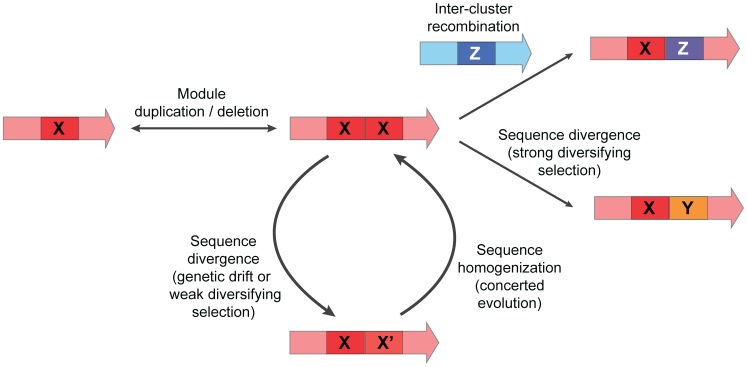
Bacterial secondary metabolites are widely used as antibiotics, anticancer drugs, insecticides and food additives. Attempts to engineer their biosynthetic gene clusters (BGCs) to produce unnatural metabolites with improved properties are often frustrated by the unpredictability and complexity of the enzymes that synthesize these molecules, suggesting that genetic changes within BGCs are limited by specific constraints. Here, by performing a systematic computational analysis of BGC evolution, we derive evidence for three findings that shed light on the ways in which, despite these constraints, nature successfully invents new molecules: 1) BGCs for complex molecules often evolve through the successive merger of smaller sub-clusters, which function as independent evolutionary entities. 2) An important subset of polyketide synthases and nonribosomal peptide synthetases evolve by concerted evolution, which generates sets of sequence-homogenized domains that may hold promise for engineering efforts since they exhibit a high degree of functional interoperability, 3) Individual BGC families evolve in distinct ways, suggesting that design strategies should take into account family-specific functional constraints. These findings suggest novel strategies for using synthetic biology to rationally engineer biosynthetic pathways.
细菌次级代谢产物被广泛用作抗生素、抗癌药物、杀虫剂和食品添加剂。试图对其生物合成基因簇(BGCs)进行工程改造以产生具有改良特性的非天然代谢产物,往往因合成这些分子的酶的不可预测性和复杂性而受挫,这表明BGCs内的基因变化受到特定限制。在此,通过对BGC进化进行系统的计算分析,我们得出了三项发现的证据,这些发现揭示了尽管存在这些限制,自然界仍能成功创造新分子的方式:1)复杂分子的BGCs通常通过较小亚簇的连续合并而进化,这些亚簇作为独立的进化实体发挥作用。2)聚酮合酶和非核糖体肽合成酶的一个重要子集通过协同进化而进化,这产生了一组序列同质化的结构域,由于它们表现出高度的功能互操作性,可能为工程努力带来希望。3)各个BGC家族以不同的方式进化,这表明设计策略应考虑家族特异性功能限制。这些发现为利用合成生物学合理设计生物合成途径提出了新策略。