de Vet Henrica C W, Ostelo Raymond W J G, Terwee Caroline B, van der Roer Nicole, Knol Dirk L, Beckerman Heleen, Boers Maarten, Bouter Lex M
EMGO Institute, VU University Medical Center, Amsterdam, The Netherlands.
Qual Life Res. 2007 Feb;16(1):131-42. doi: 10.1007/s11136-006-9109-9. Epub 2006 Oct 11.
Minimally important changes (MIC) in scores help interpret results from health status instruments. Various distribution-based and anchor-based approaches have been proposed to assess MIC.
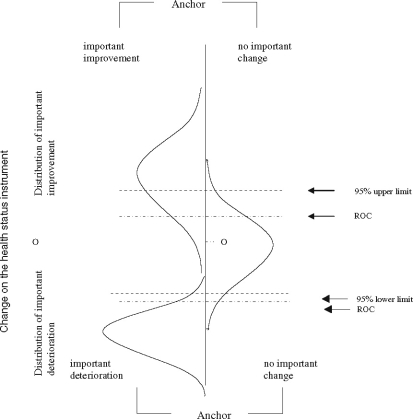
To describe and apply a visual method, called the anchor-based MIC distribution method, which integrates both approaches.
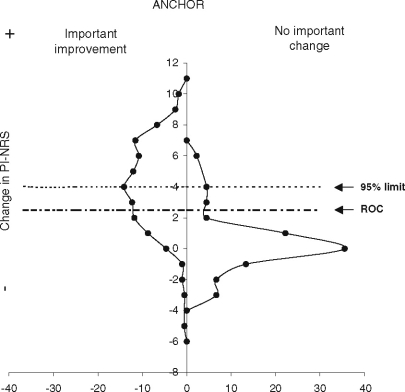
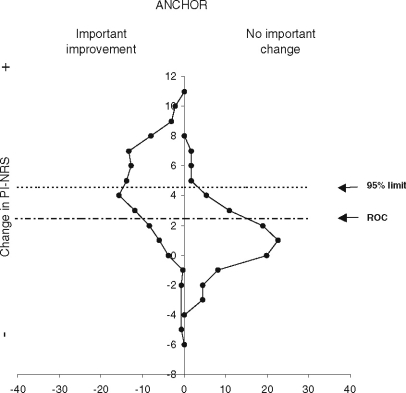
Using an anchor, patients are categorized as persons with an important improvement, an important deterioration, or without important change. For these three groups the distribution of the change scores on the health status instrument are depicted in a graph. We present two cut-off points for an MIC: the ROC cut-off point and the 95% limit cut-off point.
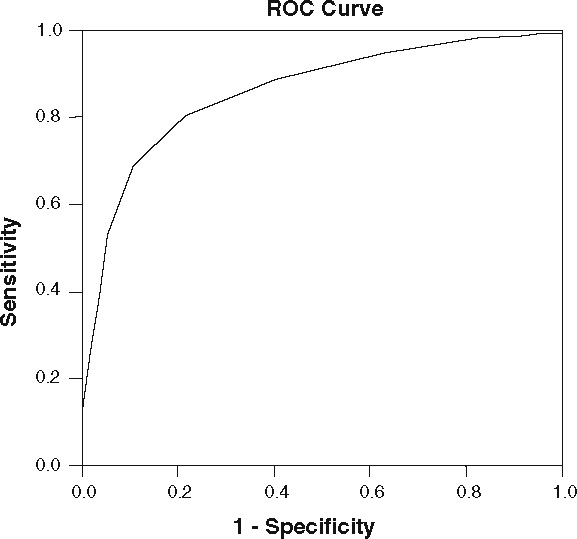
We illustrate our anchor-based MIC distribution method determining the MIC for the Pain Intensity Numerical Rating Scale in patients with low back pain, using two conceivable definitions of minimal important change on the anchor. The graph shows the distribution of the scores of the health status instrument for the relevant categories on the anchor, and also the consequences of choosing the ROC cut-off point or the 95% limit cut-off point.
The anchor-based MIC distribution method provides a general framework, applicable to all kind of anchors. This method forces researchers to choose and justify their choice of an appropriate anchor and to define minimal importance on that anchor. The MIC is not an invariable characteristic of a measurement instrument, but may depend, among other things, on the perspective from which minimal importance is considered and the baseline values on the measurement instrument under study. A balance needs to be struck between the practicality of a single MIC value and the validity of a range of MIC values.
评分中的最小重要变化(MIC)有助于解释健康状况评估工具的结果。已提出各种基于分布和基于锚定的方法来评估MIC。
描述并应用一种称为基于锚定的MIC分布法的直观方法,该方法整合了上述两种方法。
利用一个锚定,将患者分为有重要改善、有重要恶化或无重要变化的人群。针对这三组人群,在图表中描绘健康状况评估工具上变化分数的分布情况。我们给出了MIC的两个截断点:ROC截断点和95%界限截断点。
我们举例说明基于锚定的MIC分布法,使用关于锚定的最小重要变化的两种可设想定义,来确定腰痛患者疼痛强度数字评定量表的MIC。该图表显示了锚定上相关类别健康状况评估工具分数的分布情况,以及选择ROC截断点或95%界限截断点的结果。
基于锚定的MIC分布法提供了一个通用框架,适用于所有类型的锚定。该方法促使研究人员选择并说明其对合适锚定的选择理由,并在该锚定上定义最小重要性。MIC并非测量工具的固定特征,而是可能尤其取决于考虑最小重要性的视角以及所研究测量工具的基线值。需要在单一MIC值的实用性和一系列MIC值的有效性之间取得平衡。