Department of Respiratory Medicine , Kobe City Medical Center West Hospital , Kobe, Hyogo , Japan.
Department of Pharmacy , Kobe City Medical Center West Hospital , Kobe, Hyogo , Japan.
BMJ Open Respir Res. 2014 Aug 28;1(1):e000047. doi: 10.1136/bmjresp-2014-000047. eCollection 2014.
Smoking is associated with poor health-related quality of life (HRQL); however, there are few data regarding effects of smoking cessation treatment on HRQL. The purpose of this study was to describe changes in HRQL after smoking cessation treatment and to elucidate factors influencing this improvement in HRQL.
Smoking cessation clinic at a 358-bed community teaching hospital in Japan.
We conducted a prospective cohort study of cigarette smokers who participated in a 3-month smoking cessation programme. HRQL was assessed at baseline and at the end of the programme using the St. George's Respiratory Questionnaire (SGRQ). The abstinence was subjected to verification by an exhaled CO level of ≤10 ppm.
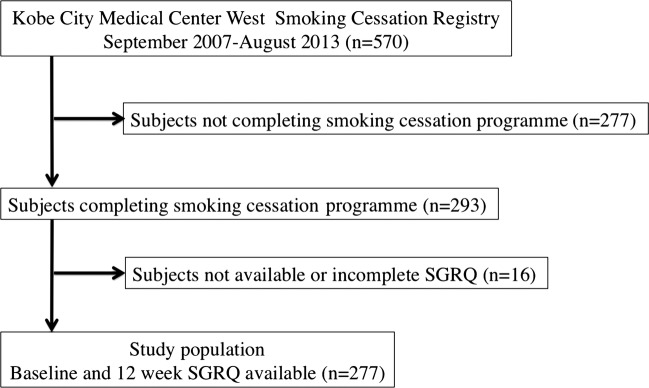
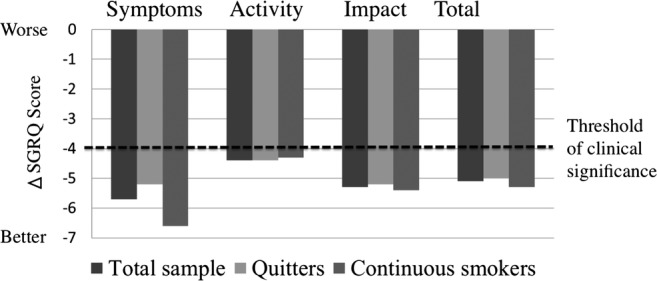
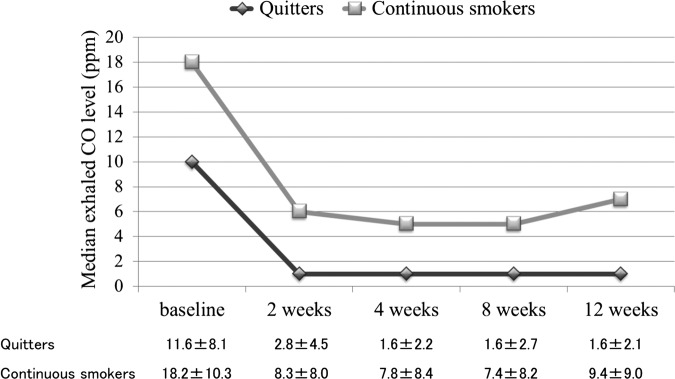
Of 570 participants in the programme, 277 (mean age: 60.9±12.2 y, male/female=180/97) were eligible; excluded were 277 participants who dropped out of the programme and 16 for whom SGRQs were not available or were incomplete. Initial prescribed pharmacotherapy was transdermal nicotine patches in 160 participants and varenicline in 117. At 12 weeks, SGRQ scores improved significantly as follows (mean±SD): Δ symptoms score, -5.7±16.0; Δ activity score, -4.4±18.3; Δ impact score, -5.3±13.5 and Δ total score, -5.1±12.2 (p<0.0001 in all cases). There were no significant differences in changes in SGRQ scores between quitters (n=183) and continuous smokers (n=94). In a multivariate analysis, only the average nicotine addiction level according to the Tobacco Dependence Screener test was associated with a clinically significant improvement in the SGRQ (OR 1.35 (95% CI 1.15 to 1.59)). Marked reduction in number of cigarettes smoked with a corresponding low median exhaled CO level of 7 ppm in continuous smokers following therapy was observed.
Smoking cessation treatment improved HRQL regardless of quit status. Baseline nicotine addiction level was predictive of that improvement.
吸烟与较差的健康相关生活质量(HRQL)有关;然而,关于戒烟治疗对 HRQL 的影响的数据很少。本研究的目的是描述戒烟治疗后 HRQL 的变化,并阐明影响这种 HRQL 改善的因素。
日本一家拥有 358 张病床的社区教学医院的戒烟诊所。
我们对参加为期 3 个月的戒烟计划的吸烟者进行了前瞻性队列研究。使用圣乔治呼吸问卷(SGRQ)在基线和计划结束时评估 HRQL。通过呼气 CO 水平≤10 ppm 来验证是否戒烟。
在参加该计划的 570 名参与者中,有 277 名(平均年龄:60.9±12.2 岁,男/女=180/97)符合条件;排除了 277 名退出该计划的参与者和 16 名没有或不完整的 SGRQ 报告的参与者。最初规定的药物治疗为 160 名参与者使用透皮尼古丁贴片和 117 名使用伐尼克兰。12 周时,SGRQ 评分显著改善,如下所示(平均值±标准差):症状评分变化Δ,-5.7±16.0;活动评分变化Δ,-4.4±18.3;影响评分变化Δ,-5.3±13.5;总分变化Δ,-5.1±12.2(所有情况下 p<0.0001)。在戒烟者(n=183)和持续吸烟者(n=94)之间,SGRQ 评分变化无显著差异。在多变量分析中,只有根据烟草依赖筛查器测试的平均尼古丁成瘾水平与 SGRQ 的临床显著改善相关(OR 1.35(95%CI 1.15 至 1.59))。在治疗后,连续吸烟者的吸烟量显著减少,呼气 CO 中位数相应降低至 7 ppm。
戒烟治疗改善了 HRQL,无论戒烟状态如何。基线尼古丁成瘾水平预测了这种改善。