Kim Hye Yun, Kim Hyunjin V, Yoon Jin H, Kang Bo Ram, Cho Soo Min, Lee Sejin, Kim Ji Yoon, Kim Joo Won, Cho Yakdol, Woo Jiwan, Kim YoungSoo
1] Center for Neuro-Medicine, Brain Science Institute, Korea Institute of Science and Technology, Seoul, Republic of Korea [2] Biological Chemistry Program, Korea University of Science and Technology, Daejeon, Republic of Korea [3] Department of Biochemistry and Biomedical Sciences, Seoul National University, College of Medicine, Seoul, Republic of Korea.
1] Center for Neuro-Medicine, Brain Science Institute, Korea Institute of Science and Technology, Seoul, Republic of Korea [2] Biological Chemistry Program, Korea University of Science and Technology, Daejeon, Republic of Korea.
Sci Rep. 2014 Dec 12;4:7467. doi: 10.1038/srep07467.
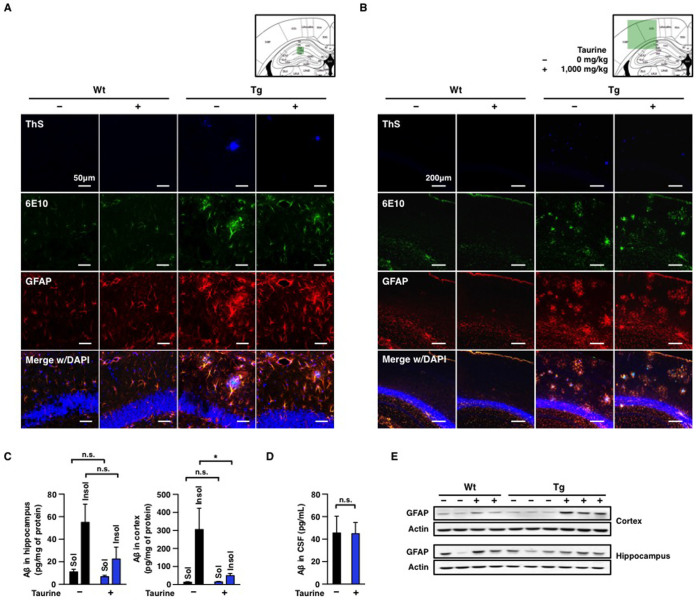
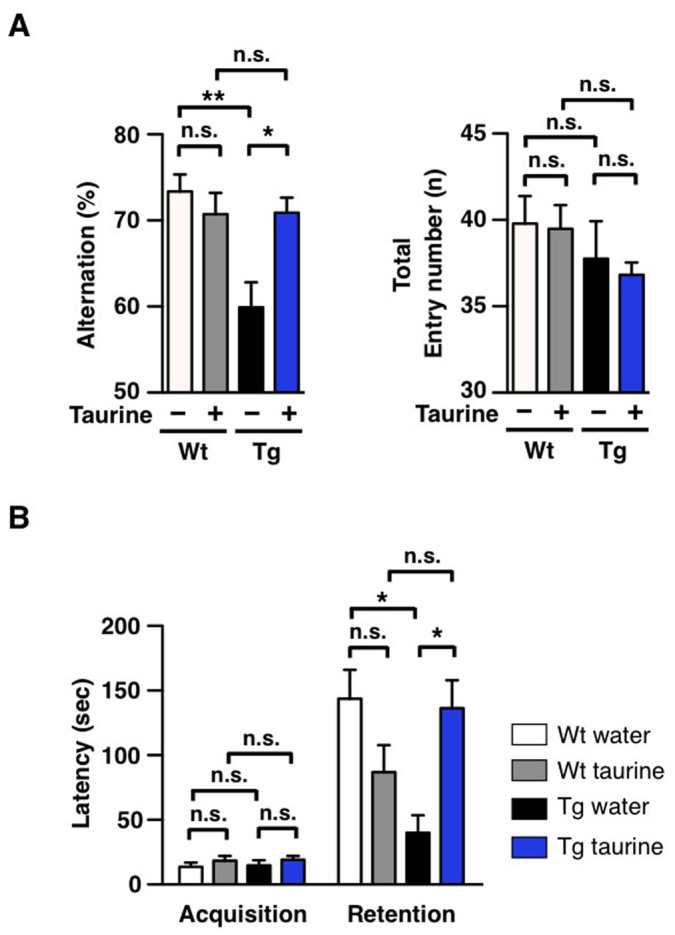
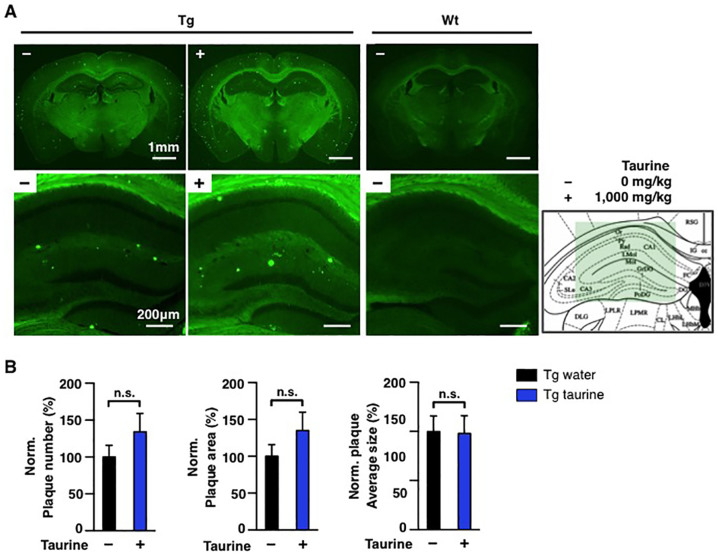
Alzheimer's disease (AD) is a lethal progressive neurological disorder affecting the memory. Recently, US Food and Drug Administration mitigated the standard for drug approval, allowing symptomatic drugs that only improve cognitive deficits to be allowed to accelerate on to clinical trials. Our study focuses on taurine, an endogenous amino acid found in high concentrations in humans. It has demonstrated neuroprotective properties against many forms of dementia. In this study, we assessed cognitively enhancing property of taurine in transgenic mouse model of AD. We orally administered taurine via drinking water to adult APP/PS1 transgenic mouse model for 6 weeks. Taurine treatment rescued cognitive deficits in APP/PS1 mice up to the age-matching wild-type mice in Y-maze and passive avoidance tests without modifying the behaviours of cognitively normal mice. In the cortex of APP/PS1 mice, taurine slightly decreased insoluble fraction of Aβ. While the exact mechanism of taurine in AD has not yet been ascertained, our results suggest that taurine can aid cognitive impairment and may inhibit Aβ-related damages.
阿尔茨海默病(AD)是一种影响记忆的致命性进行性神经疾病。最近,美国食品药品监督管理局放宽了药物批准标准,允许仅改善认知缺陷的对症药物加速进入临床试验。我们的研究聚焦于牛磺酸,一种在人体内高浓度存在的内源性氨基酸。它已被证明对多种形式的痴呆具有神经保护特性。在本研究中,我们评估了牛磺酸在AD转基因小鼠模型中的认知增强特性。我们通过饮用水对成年APP/PS1转基因小鼠模型口服给予牛磺酸,持续6周。在Y迷宫和被动回避试验中,牛磺酸治疗使APP/PS1小鼠的认知缺陷恢复到与年龄匹配的野生型小鼠水平,且未改变认知正常小鼠的行为。在APP/PS1小鼠的皮质中,牛磺酸使Aβ的不溶性部分略有减少。虽然牛磺酸在AD中的确切机制尚未确定,但我们的结果表明,牛磺酸可以改善认知障碍,并可能抑制与Aβ相关的损伤。