
2014年7月9日至11月15日美国疾病控制与预防中心收到的关于埃博拉病毒病的临床咨询
Clinical inquiries regarding Ebola virus disease received by CDC--United States, July 9-November 15, 2014.
作者信息
Karwowski Mateusz P, Meites Elissa, Fullerton Kathleen E, Ströher Ute, Lowe Luis, Rayfield Mark, Blau Dianna M, Knust Barbara, Gindler Jacqueline, Van Beneden Chris, Bialek Stephanie R, Mead Paul, Oster Alexandra M
出版信息
MMWR Morb Mortal Wkly Rep. 2014 Dec 12;63(49):1175-9.
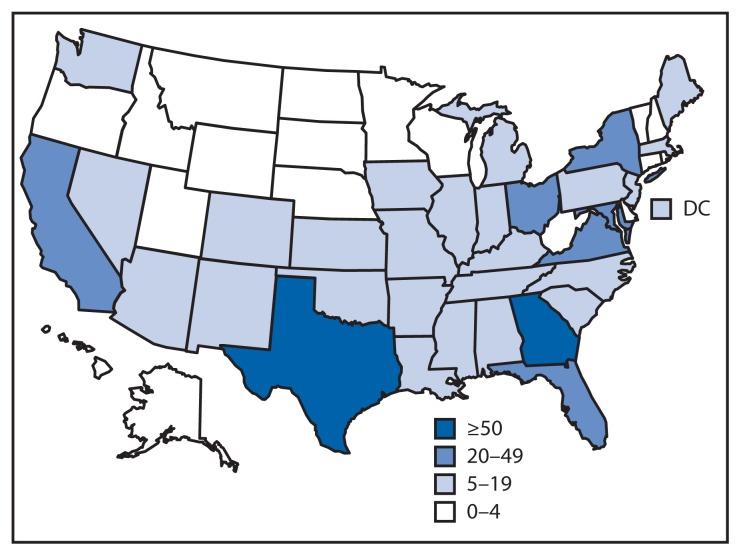
Since early 2014, there have been more than 6,000 reported deaths from Ebola virus disease (Ebola), mostly in Guinea, Liberia, and Sierra Leone. On July 9, 2014, CDC activated its Emergency Operations Center for the Ebola outbreak response and formalized the consultation service it had been providing to assist state and local public health officials and health care providers evaluate persons in the United States thought to be at risk for Ebola. During July 9-November 15, CDC responded to clinical inquiries from public health officials and health care providers from 49 states and the District of Columbia regarding 650 persons thought to be at risk. Among these, 118 (18%) had initial signs or symptoms consistent with Ebola and epidemiologic risk factors placing them at risk for infection, thereby meeting the definition of persons under investigation (PUIs). Testing was not always performed for PUIs because alternative diagnoses were made or symptoms resolved. In total, 61 (9%) persons were tested for Ebola virus, and four, all of whom met PUI criteria, had laboratory-confirmed Ebola. Overall, 490 (75%) inquiries concerned persons who had neither traveled to an Ebola-affected country nor had contact with an Ebola patient. Appropriate medical evaluation and treatment for other conditions were noted in some instances to have been delayed while a person was undergoing evaluation for Ebola. Evaluating and managing persons who might have Ebola is one component of the overall approach to domestic surveillance, the goal of which is to rapidly identify and isolate Ebola patients so that they receive appropriate medical care and secondary transmission is prevented. Health care providers should remain vigilant and consult their local and state health departments and CDC when assessing ill travelers from Ebola-affected countries. Most of these persons do not have Ebola; prompt diagnostic assessments, laboratory testing, and provision of appropriate care for other conditions are essential for appropriate patient care and reflect hospital preparedness.
自2014年初以来,已有6000多人报告死于埃博拉病毒病(埃博拉),其中大多数死亡病例发生在几内亚、利比里亚和塞拉利昂。2014年7月9日,美国疾病控制与预防中心(CDC)启动了其埃博拉疫情应急行动中心,并将其一直在提供的咨询服务正式化,以协助州和地方公共卫生官员及医疗服务提供者评估在美国被认为有感染埃博拉风险的人员。在7月9日至11月15日期间,美国疾病控制与预防中心回应了来自49个州和哥伦比亚特区的公共卫生官员及医疗服务提供者就650名被认为有风险人员提出的临床咨询。其中,118人(18%)最初的体征或症状与埃博拉相符,且有使其面临感染风险的流行病学危险因素,因此符合受调查者(PUI)的定义。并非总是对受调查者进行检测,因为做出了其他诊断或症状已缓解。总共有61人(9%)接受了埃博拉病毒检测,其中4人实验室确诊为埃博拉,这4人都符合受调查者标准。总体而言,490次(75%)咨询涉及既未前往埃博拉疫区国家也未接触过埃博拉患者的人员。在某些情况下,人们在接受埃博拉评估时,对其他病症的适当医疗评估和治疗被延误。评估和管理可能感染埃博拉的人员是国内监测总体方法的一个组成部分,其目标是迅速识别和隔离埃博拉患者,以便他们得到适当的医疗护理并防止二代传播。医疗服务提供者在评估来自埃博拉疫区国家的患病旅行者时应保持警惕,并咨询当地和州卫生部门以及美国疾病控制与预防中心。这些人中大多数没有感染埃博拉;及时进行诊断评估、实验室检测以及为其他病症提供适当护理对于恰当的患者护理至关重要,也反映了医院的准备情况。

 Zotero 插件