Gupta Subash C, Singh Ramesh, Pochampally Radhika, Watabe Kounosuke, Mo Yin-Yuan
Cancer Institute, University of Mississippi Medical Center, Jackson, MS. Department of Biochemistry, University of Mississippi Medical Center, Jackson, MS.
Cancer Institute, University of Mississippi Medical Center, Jackson, MS. Department of Microbiology, University of Mississippi Medical Center, Jackson, MS.
Oncotarget. 2014 Dec 15;5(23):12070-82. doi: 10.18632/oncotarget.2514.
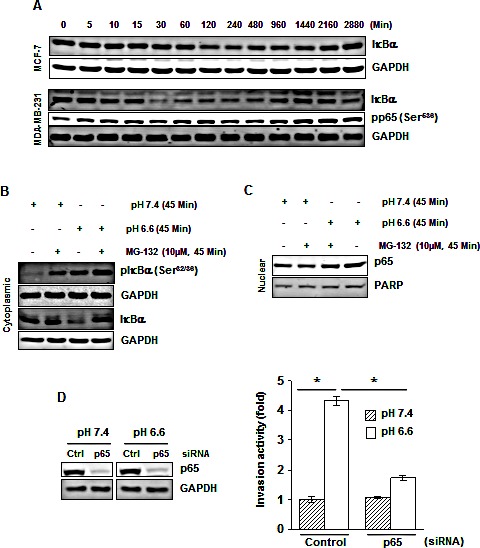
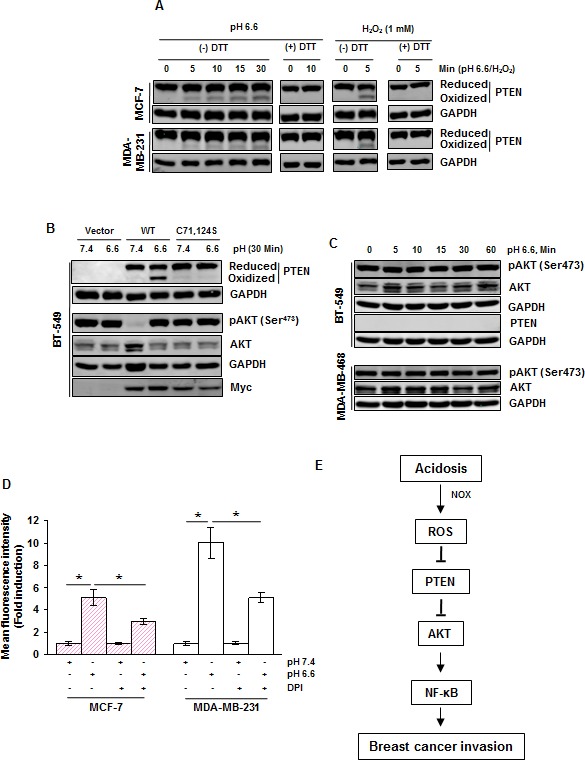
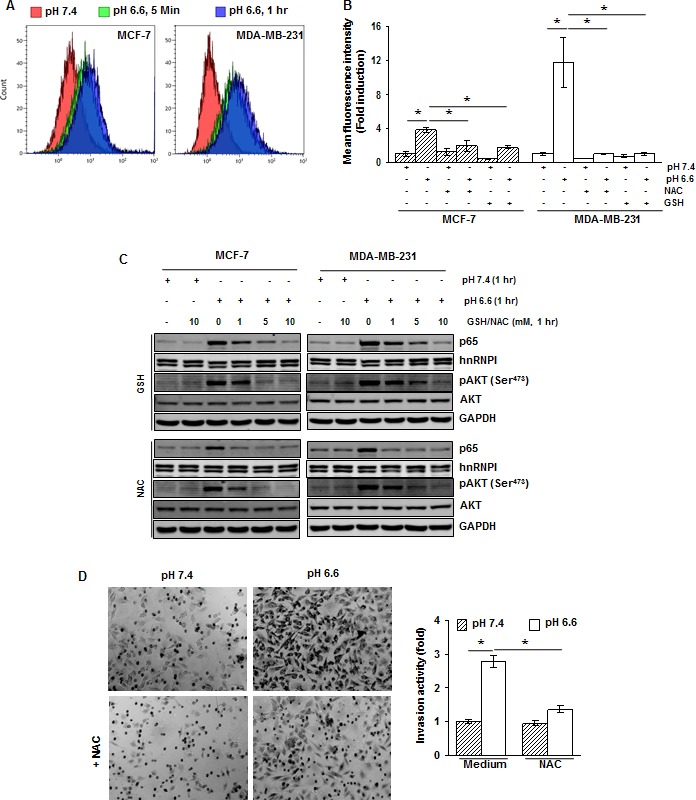
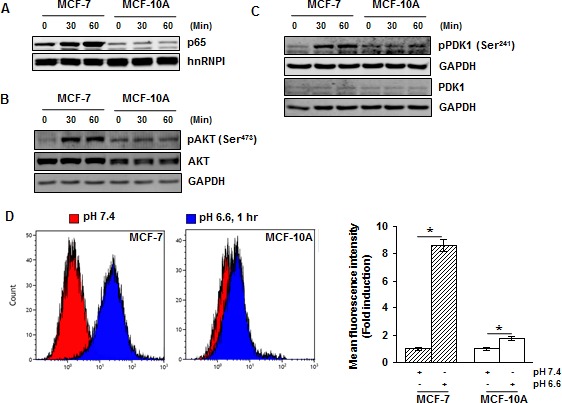
It is well known that acidic microenvironment promotes tumorigenesis, however, the underlying mechanism remains largely unknown. In the present study, we show that acidosis promotes invasiveness of breast cancer cells through a series of signaling events. First, our study indicates that NF-κB is a key factor for acidosis-induced cell invasion. Acidosis activates NF-κB without affecting STAT3 activity; knockdown of NF-κB p65 abrogates the acidosis-induced invasion activity. Next, we show that the activation of NF-κB is mediated through phosphorylation and degradation of IκBα; and phosphorylation and nuclear translocation of p65. Upstream to NF-κB signaling, AKT is activated under acidic conditions. Moreover, acidosis induces generation of reactive oxygen species (ROS) which can be suppressed by ROS scavengers, reversing the acidosis-induced activation of AKT and NF-κB, and invasiveness. As a negative regulator of AKT, PTEN is oxidized and inactivated by the acidosis-induced ROS. Finally, inhibition of NADPH oxidase (NOX) suppresses acidosis-induced ROS production, suggesting involvement of NOX in acidosis-induced signaling cascade. Of considerable interest, acidosis-induced ROS production and activation of AKT and NF-κB can be only detected in cancer cells, but not in non-malignant cells. Together, these results demonstrate a cancer specific acidosis-induced signaling cascade in breast cancer cells, leading to cell invasion.
众所周知,酸性微环境促进肿瘤发生,然而其潜在机制仍 largely 未知。在本研究中,我们表明酸中毒通过一系列信号事件促进乳腺癌细胞的侵袭性。首先,我们的研究表明 NF-κB 是酸中毒诱导细胞侵袭的关键因素。酸中毒激活 NF-κB 而不影响 STAT3 活性;敲低 NF-κB p65 可消除酸中毒诱导的侵袭活性。接下来,我们表明 NF-κB 的激活是通过 IκBα 的磷酸化和降解以及 p65 的磷酸化和核转位介导的。在 NF-κB 信号上游,AKT 在酸性条件下被激活。此外,酸中毒诱导活性氧(ROS)的产生,ROS 清除剂可抑制这种产生,从而逆转酸中毒诱导的 AKT 和 NF-κB 的激活以及侵袭性。作为 AKT 的负调节因子,PTEN 被酸中毒诱导的 ROS 氧化并失活。最后,抑制 NADPH 氧化酶(NOX)可抑制酸中毒诱导的 ROS 产生,表明 NOX 参与酸中毒诱导的信号级联反应。值得注意的是,酸中毒诱导的 ROS 产生以及 AKT 和 NF-κB 的激活仅在癌细胞中可检测到,而在非恶性细胞中则检测不到。总之,这些结果证明了乳腺癌细胞中一种癌症特异性的酸中毒诱导信号级联反应,导致细胞侵袭。