Yang Yi-Long, Sui Guo-Yuan, Liu Guang-Cong, Huang De-Sheng, Wang Si-Meng, Wang Lie
Department of Social Medicine, China Medical University, 92 North 2nd Road, Heping District, Shenyang 110001, PR China.
BMC Cancer. 2014 Dec 15;14:956. doi: 10.1186/1471-2407-14-956.
Our previous studies found the high prevalence of depression and anxiety among Chinese cancer patients, and many empirical studies have been conducted to evaluate the effects of psychological interventions on depression and anxiety among Chinese cancer patients. This study aimed to conduct a meta-analysis in order to assess the effects of psychological interventions on depression and anxiety in Chinese adults with cancer.
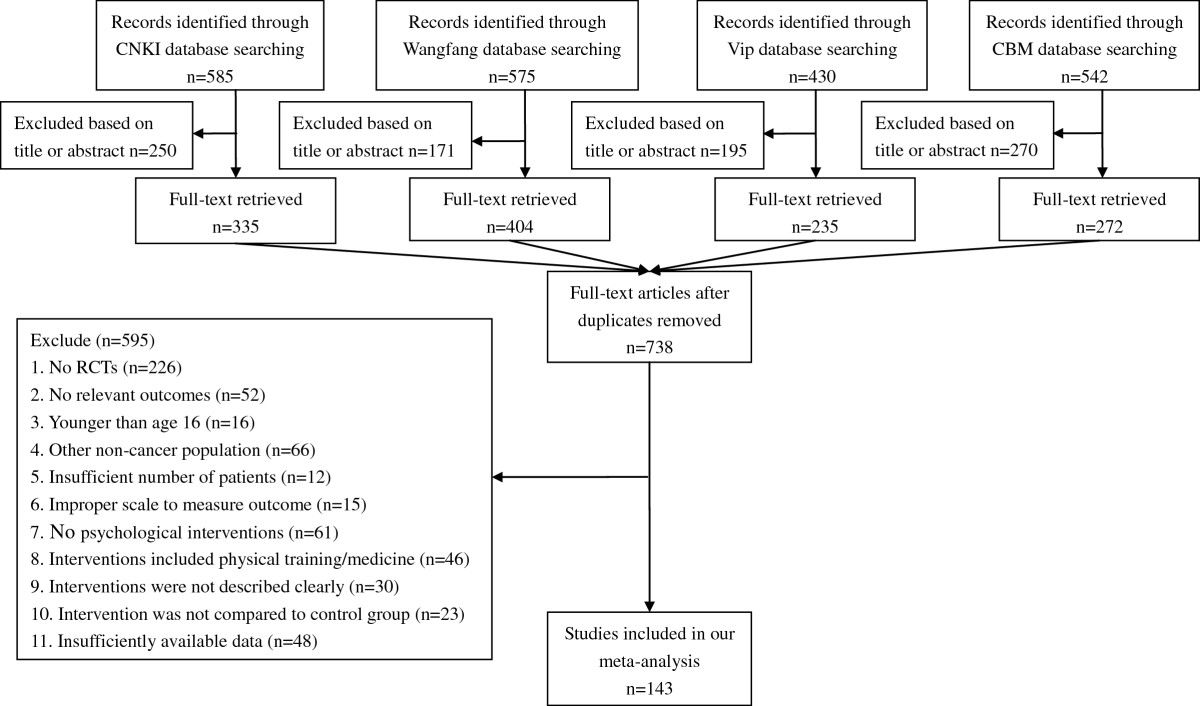
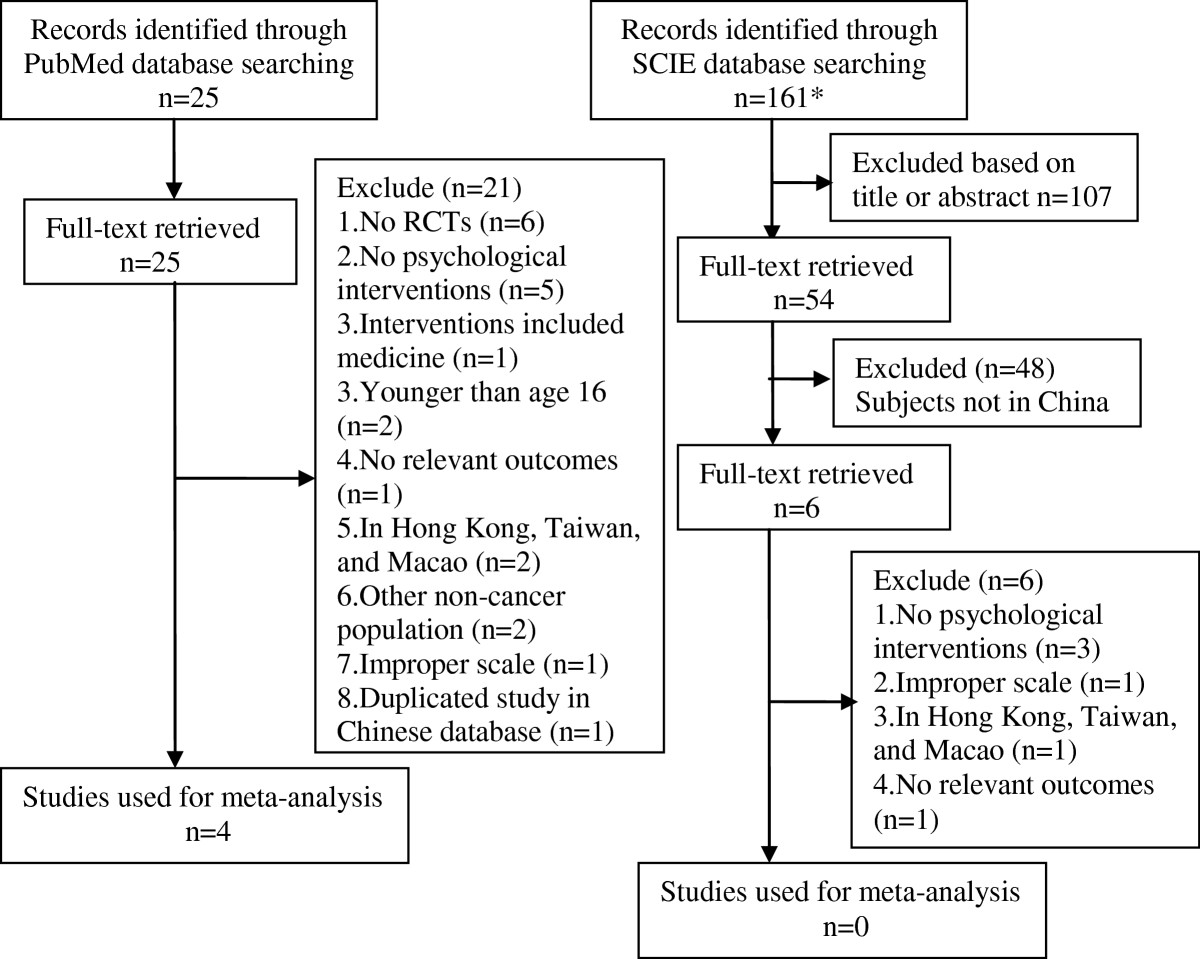
The four most comprehensive Chinese academic database- CNKI, Wanfang, Vip and CBM databases-were searched from their inception until January 2014. PubMed and Web of Science (SCIE) were also searched from their inception until January 2014 without language restrictions, and an internet search was used. Randomized controlled studies assessing the effects of psychological interventions on depression and anxiety among Chinese adults with cancer were analyzed. Study selection and appraisal were conducted independently by three authors. The pooled random-effects estimates of standardized mean difference (SMD) and 95% confidence intervals (CI) were calculated. Moderator analysis (meta-regression and subgroup analysis) was used to explore reasons for heterogeneity.
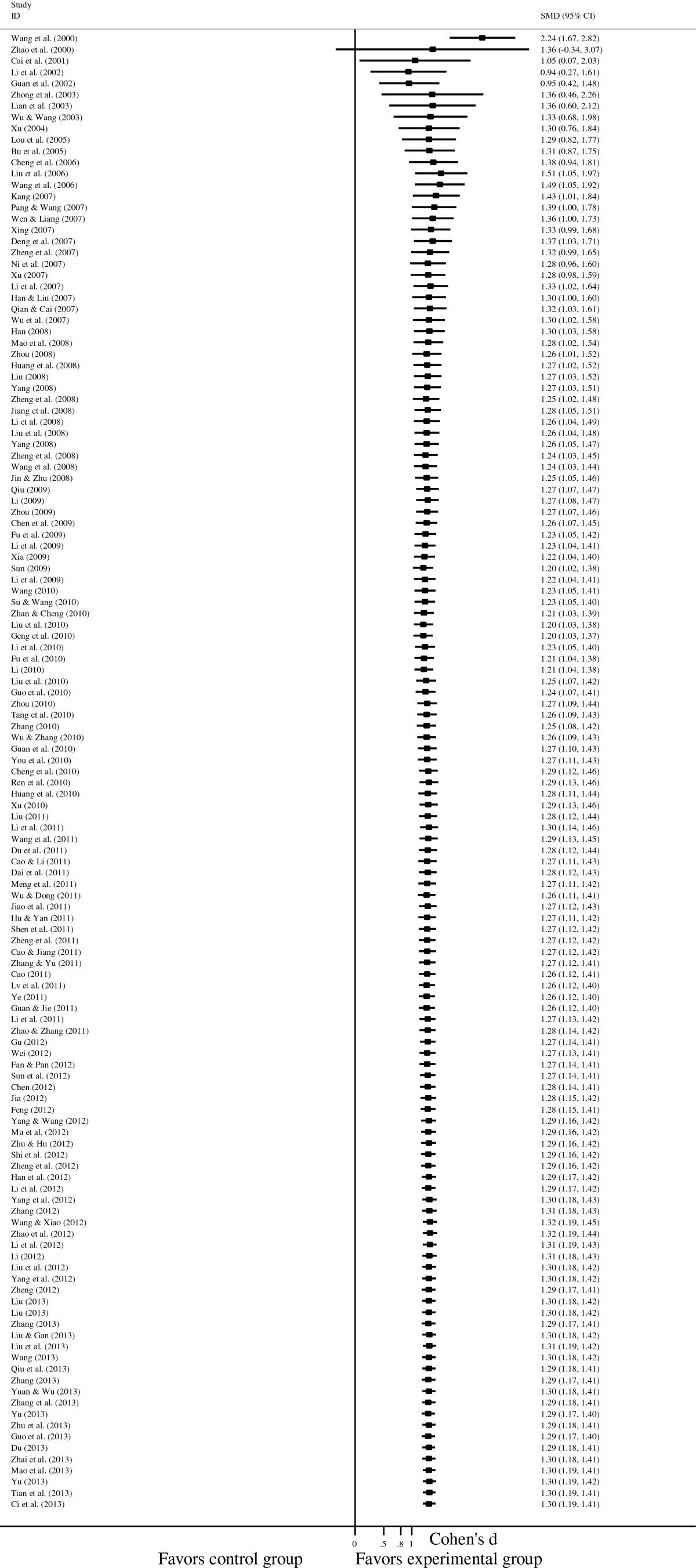
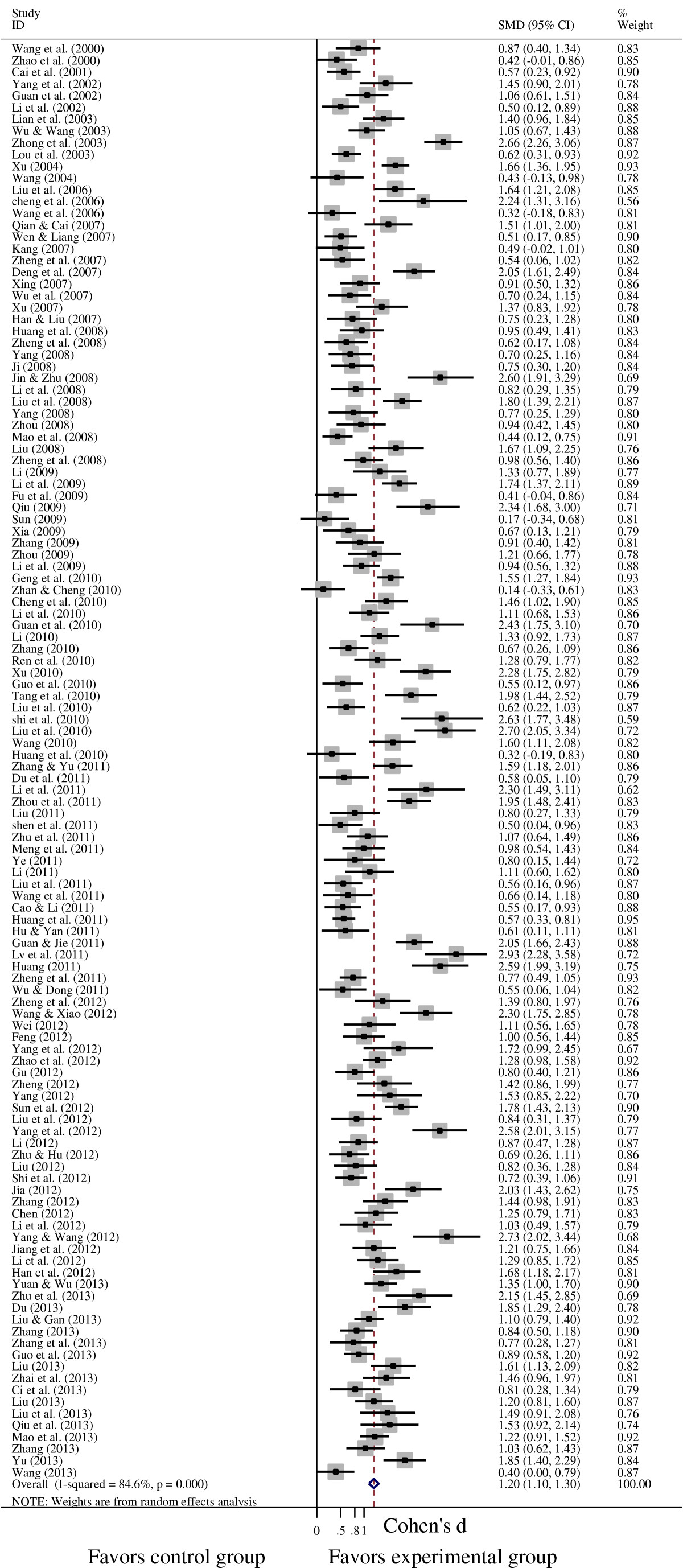
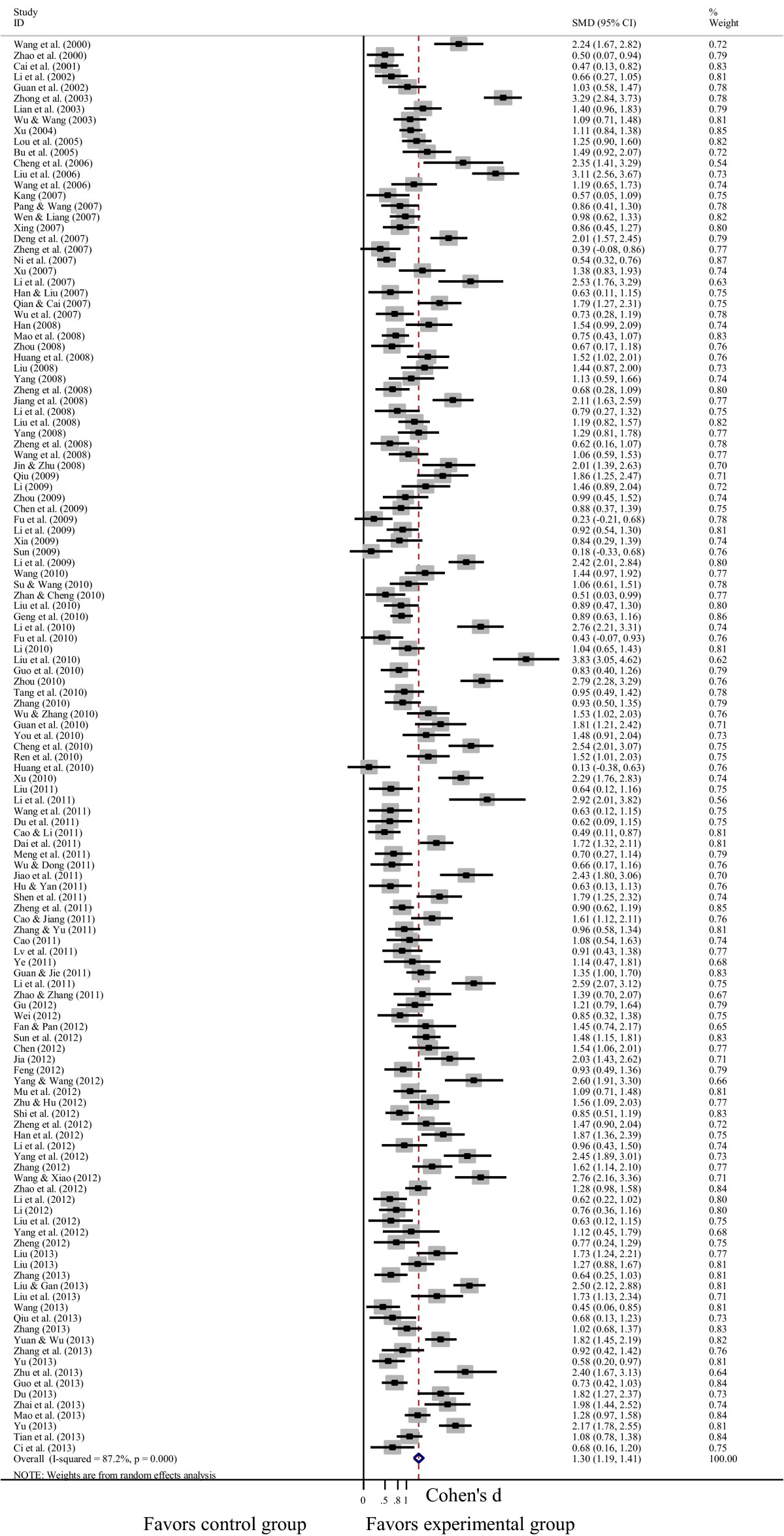
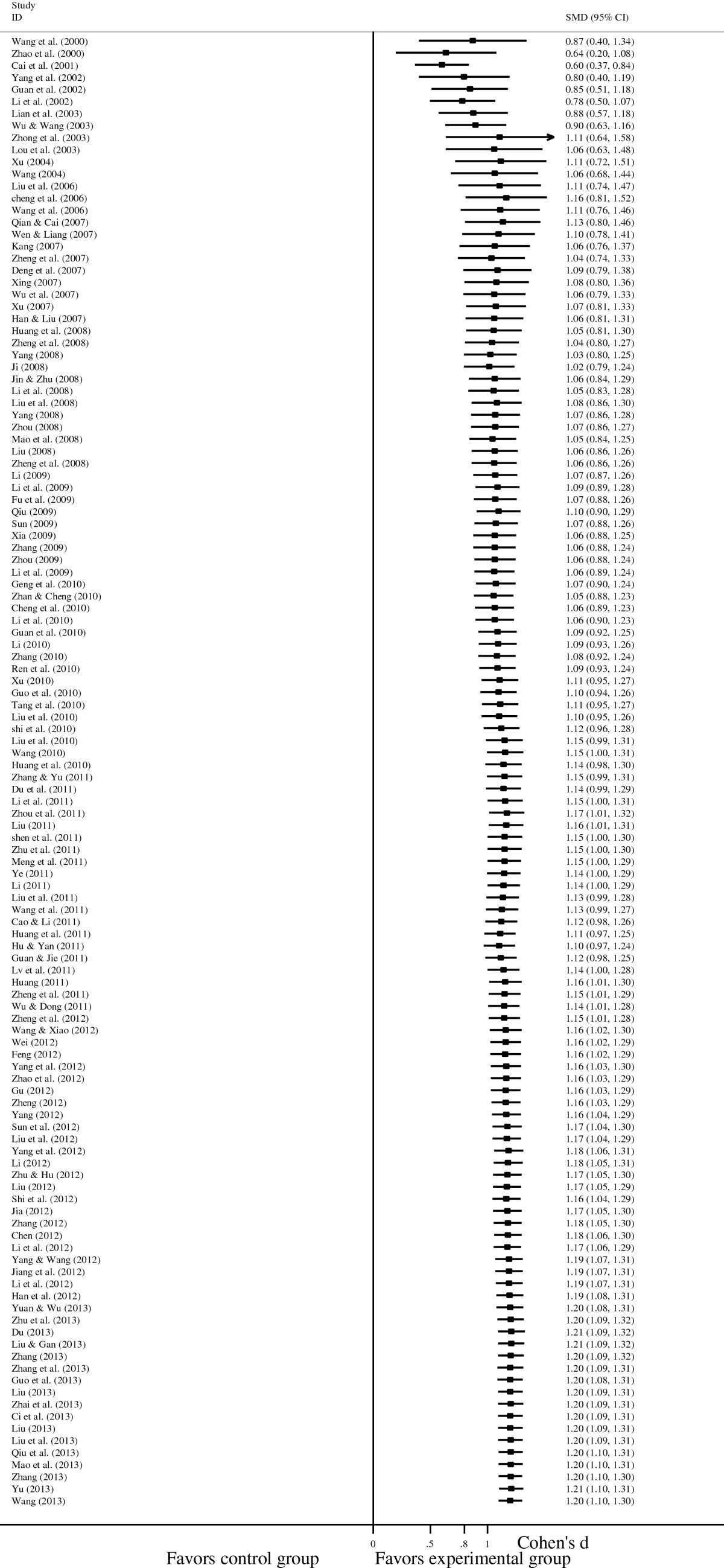
We retrieved 147 studies (covering 14,039 patients) that reported 253 experimental-control comparisons. The random effects model showed a significant large effect size for depression (SMD = 1.199, p < 0.001; 95% CI = 1.095-1.303) and anxiety (SMD = 1.298, p < 0.001; 95% CI = 1.187-1.408). Cumulative meta-analysis indicated that sufficient evidence had accumulated since 2000-2001 to confirm the statistically significant effectiveness of psychological interventions on depression and anxiety in Chinese cancer patients. Moderating effects were found for caner type, patients' selection, intervention format and questionnaires used. In studies that included lung cancer, preselected patients with clear signs of depression/anxiety, adopted individual intervention and used State-Trait Anxiety Inventory (STAI), the effect sizes were larger.
We concluded that psychological interventions in Chinese cancer patients have large effects on depression and anxiety. The findings support that an adequate system should be set up to provide routine psychological interventions for cancer patients in Chinese medical settings. However, because of some clear limitations (heterogeneity and publication bias), these results should be interpreted with caution.
我们之前的研究发现中国癌症患者中抑郁和焦虑的患病率很高,并且已经开展了许多实证研究来评估心理干预对中国癌症患者抑郁和焦虑的影响。本研究旨在进行一项荟萃分析,以评估心理干预对中国成年癌症患者抑郁和焦虑的影响。
检索了四个最全面的中文学术数据库——中国知网、万方、维普和中国生物医学文献数据库,检索时间从建库至2014年1月。还检索了PubMed和科学引文索引(SCIE),检索时间从建库至2014年1月,无语言限制,并进行了网络搜索。对评估心理干预对中国成年癌症患者抑郁和焦虑影响的随机对照研究进行分析。由三位作者独立进行研究选择和评估。计算标准化均数差(SMD)的合并随机效应估计值和95%置信区间(CI)。采用调节分析(荟萃回归和亚组分析)来探究异质性的原因。
我们检索到147项研究(涵盖14039名患者),报告了253项实验对照比较。随机效应模型显示,抑郁(SMD = 1.199,p < 0.001;95%CI = 1.095 - 1.303)和焦虑(SMD = 1.298,p < 0.001;95%CI = 1.187 - 1.408)的效应量显著且较大。累积荟萃分析表明,自2000 - 2001年以来已积累了充分的证据,证实心理干预对中国癌症患者的抑郁和焦虑具有统计学上的显著效果。发现癌症类型、患者选择、干预形式和所使用的问卷存在调节效应。在纳入肺癌患者、预先选择有明显抑郁/焦虑迹象的患者、采用个体干预并使用状态 - 特质焦虑量表(STAI)的研究中,效应量更大。
我们得出结论,心理干预对中国癌症患者的抑郁和焦虑有很大影响。研究结果支持应建立一个适当的系统,在中国医疗环境中为癌症患者提供常规心理干预。然而,由于存在一些明显的局限性(异质性和发表偏倚),这些结果应谨慎解读。