Mohd Abd Razak Mohd Ridzuan, Afzan Adlin, Ali Rosnani, Amir Jalaluddin Nur Fasihah, Wasiman Mohd Isa, Shiekh Zahari Siti Habsah, Abdullah Noor Rain, Ismail Zakiah
Herbal Medicine Research Centre, Institute for Medical Research, Jalan Pahang, 50588 Kuala Lumpur, Malaysia.
BMC Complement Altern Med. 2014 Dec 15;14:492. doi: 10.1186/1472-6882-14-492.
The development of resistant to current antimalarial drugs is a major challenge in achieving malaria elimination status in many countries. Therefore there is a need for new antimalarial drugs. Medicinal plants have always been the major source for the search of new antimalarial drugs. The aim of this study was to screen selected Malaysian medicinal plants for their antiplasmodial properties.
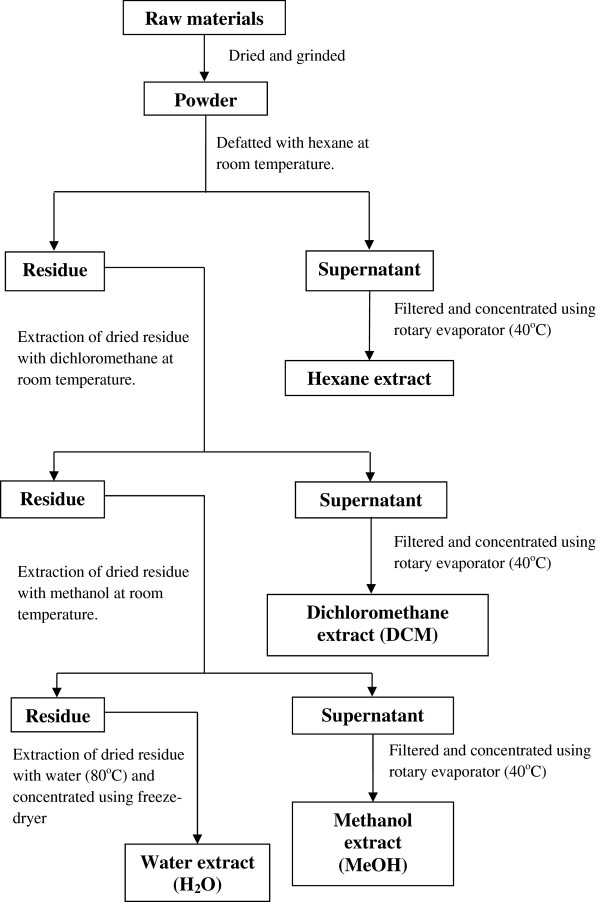
Each part of the plants were processed, defatted by hexane and sequentially extracted with dichloromethane, methanol and water. The antiplasmodial activities of 54 plant extracts from 14 species were determined by Plasmodium falciparum Histidine Rich Protein II ELISA technique. In order to determine the selectivity index (SI), all plant extracts demonstrating a good antiplasmodial activity were tested for their cytotoxicity activity against normal Madin-Darby Bovine Kidney (MDBK) cell lines by 3-(4, 5-Dimethylthiazol-2-yl)-2, 5-diphenyltetrazolium bromide (MTT) assay.
Twenty three extracts derived from Curcuma zedoaria (rhizome), Curcuma aeruginosa (rhizome), Alpinia galanga (rhizome), Morinda elliptica (leaf), Curcuma mangga (rhizome), Elephantopus scaber (leaf), Vitex negundo (leaf), Brucea javanica (leaf, root and seed), Annona muricata (leaf), Cinnamomun iners (leaf) and Vernonia amygdalina (leaf) showed promising antiplasmodial activities against the blood stage chloroquine resistant P. falciparum (EC50 < 10 μg/ml) with negligible toxicity effect to MDBK cells in vitro (SI ≥10).
The extracts belonging to eleven plant species were able to perturb the growth of chloroquine resistant P. falciparum effectively. The findings justified the bioassay guided fractionation on these plants for the search of potent antimalarial compounds or formulation of standardized extracts which may enhance the antimalarial effect in vitro and in vivo.
对当前抗疟药物产生耐药性是许多国家实现疟疾消除目标面临的一项重大挑战。因此,需要新型抗疟药物。药用植物一直是寻找新型抗疟药物的主要来源。本研究的目的是筛选选定的马来西亚药用植物的抗疟特性。
将植物的各个部分进行处理,用己烷脱脂,然后依次用二氯甲烷、甲醇和水进行提取。采用恶性疟原虫富含组氨酸蛋白II酶联免疫吸附测定技术,测定了14种植物的54种提取物的抗疟活性。为了确定选择性指数(SI),对所有表现出良好抗疟活性的植物提取物,通过3-(4,5-二甲基噻唑-2-基)-2,5-二苯基四氮唑溴盐(MTT)法检测其对正常的马-达二氏牛肾(MDBK)细胞系的细胞毒性活性。
源自莪术(根茎)、郁金(根茎)、高良姜(根茎)、椭圆叶巴戟(叶)、芒果姜(根茎)、地胆草(叶)、黄荆(叶)、鸦胆子(叶、根和种子)、番荔枝(叶)、阴香(叶)和扁桃斑鸠菊(叶)的23种提取物,对耐氯喹的恶性疟原虫血液期表现出有前景的抗疟活性(半数有效浓度<10μg/ml),且在体外对MDBK细胞的毒性作用可忽略不计(选择性指数≥10)。
属于11种植物的提取物能够有效干扰耐氯喹恶性疟原虫的生长。这些发现证明了对这些植物进行生物测定导向的分级分离,以寻找有效的抗疟化合物或制备标准化提取物是合理的,这可能会增强体外和体内的抗疟效果。