Zhang Ji, Ormälä-Odegrip Anni-Maria, Mappes Johanna, Laakso Jouni
Centre of Excellence in Biological Interactions, Department of Biological and Environmental Science, University of Jyväskylä P.O. Box 35, 40014, Jyväskylä, Finland ; Department of Biosciences, University of Helsinki P.O. Box 65, 00014, Helsinki, Finland.
Centre of Excellence in Biological Interactions, Department of Biological and Environmental Science, University of Jyväskylä P.O. Box 35, 40014, Jyväskylä, Finland.
Ecol Evol. 2014 Dec;4(23):4444-53. doi: 10.1002/ece3.1302. Epub 2014 Nov 10.
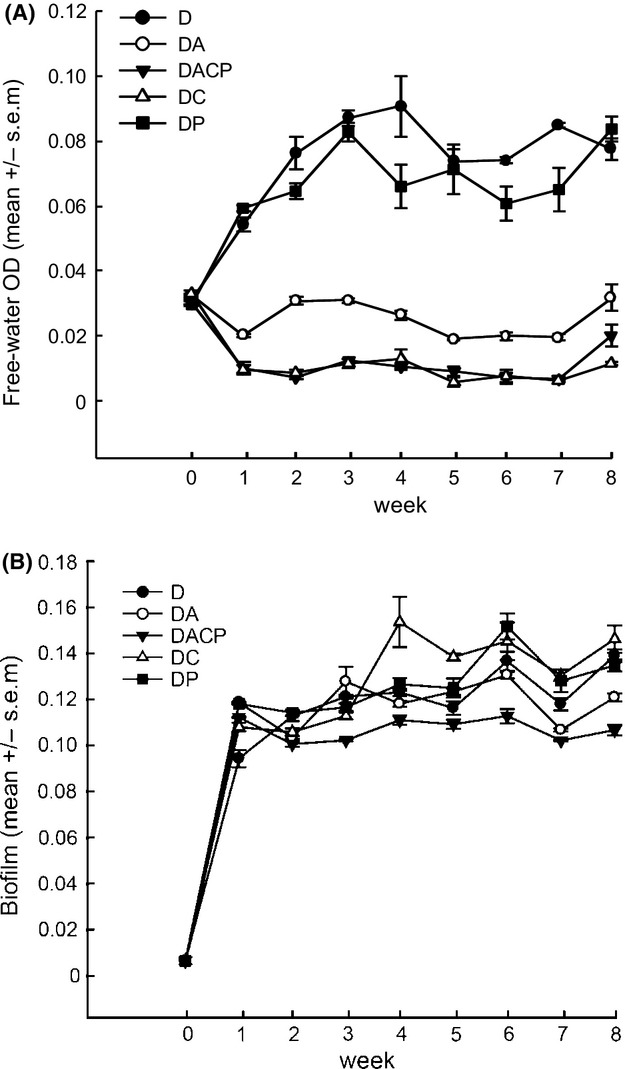
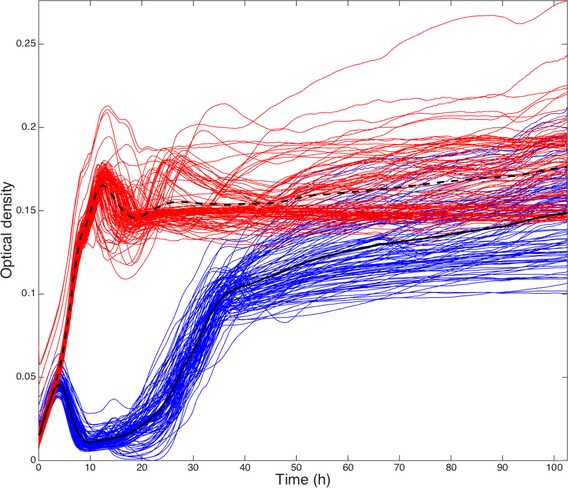
Lytic bacteriophages and protozoan predators are the major causes of bacterial mortality in natural microbial communities, which also makes them potential candidates for biological control of bacterial pathogens. However, little is known about the relative impact of bacteriophages and protozoa on the dynamics of bacterial biomass in aqueous and biofilm phases. Here, we studied the temporal and spatial dynamics of bacterial biomass in a microcosm experiment where opportunistic pathogenic bacteria Serratia marcescens was exposed to particle-feeding ciliates, surface-feeding amoebas, and lytic bacteriophages for 8 weeks, ca. 1300 generations. We found that ciliates were the most efficient enemy type in reducing bacterial biomass in the open water, but least efficient in reducing the biofilm biomass. Biofilm was rather resistant against bacterivores, but amoebae had a significant long-term negative effect on bacterial biomass both in the open-water phase and biofilm. Bacteriophages had only a minor long-term effect on bacterial biomass in open-water and biofilm phases. However, separate short-term experiments with the ancestral bacteriophages and bacteria revealed that bacteriophages crash the bacterial biomass dramatically in the open-water phase within the first 24 h. Thereafter, the bacteria evolve phage-resistance that largely prevents top-down effects. The combination of all three enemy types was most effective in reducing biofilm biomass, whereas in the open-water phase the ciliates dominated the trophic effects. Our results highlight the importance of enemy feeding mode on determining the spatial distribution and abundance of bacterial biomass. Moreover, the enemy type can be crucially important predictor of whether the rapid defense evolution can significantly affect top-down regulation of bacteria.
裂解性噬菌体和原生动物捕食者是自然微生物群落中细菌死亡的主要原因,这也使它们成为控制细菌病原体的潜在生物制剂。然而,关于噬菌体和原生动物对水相和生物膜相中细菌生物量动态的相对影响,我们知之甚少。在此,我们在一个微观实验中研究了细菌生物量的时空动态,在该实验中,机会致病菌粘质沙雷氏菌暴露于以颗粒为食的纤毛虫、以表面为食的变形虫和裂解性噬菌体中8周,约1300代。我们发现,纤毛虫是减少开放水体中细菌生物量最有效的敌害类型,但在减少生物膜生物量方面效率最低。生物膜对食细菌者相当有抗性,但变形虫对开放水相和生物膜中的细菌生物量都有显著的长期负面影响。噬菌体对开放水相和生物膜相中细菌生物量的长期影响较小。然而,用原始噬菌体和细菌进行的单独短期实验表明,噬菌体在最初24小时内会使开放水相中的细菌生物量急剧下降。此后,细菌进化出噬菌体抗性,这在很大程度上阻止了自上而下的影响。所有三种敌害类型的组合在减少生物膜生物量方面最有效,而在开放水相中,纤毛虫主导了营养效应。我们的结果强调了敌害摄食模式在决定细菌生物量的空间分布和丰度方面的重要性。此外,敌害类型可能是快速防御进化是否会显著影响细菌自上而下调控的关键预测指标。