Feichtmayer Judith, Deng Li, Griebler Christian
Institute of Groundwater Ecology, Helmholtz Zentrum München GmbH, Neuherberg, Germany.
Institute of Virology, Helmholtz Zentrum München GmbH, Neuherberg, Germany.
Front Microbiol. 2017 Nov 14;8:2192. doi: 10.3389/fmicb.2017.02192. eCollection 2017.
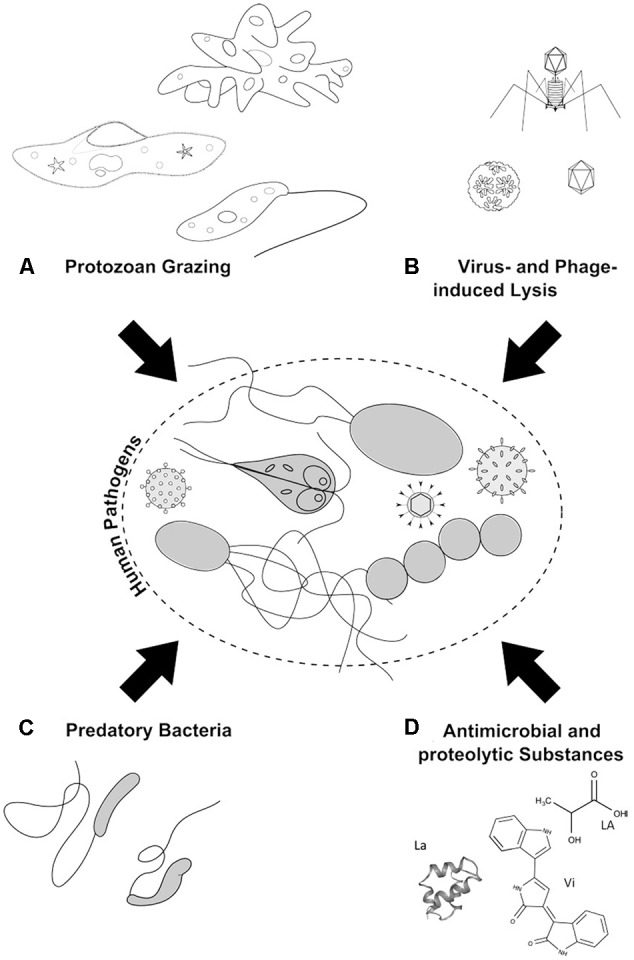
Despite the active and intense treatment of wastewater, pathogenic microorganisms and viruses are frequently introduced into the aquatic environment. For most human pathogens, however, this is a rather hostile place, where starvation, continuous inactivation, and decay generally occur, rather than successful reproduction. Nevertheless, a great diversity of the pathogenic microorganisms can be detected, in particular, in the surface waters receiving wastewater. Pathogen survival depends majorly on abiotic factors such as irradiation, changes in water ionic strength, temperature, and redox state. In addition, inactivation is enhanced by the biotic interactions in the environment. Although knowledge of the antagonistic biotic interactions has been available since a long time, certain underlying processes and mechanisms still remain unclear. Others are well-appreciated and increasingly are applied to the present research. Our review compiles and discusses the presently known biotic interactions between autochthonous microbes and pathogens introduced into the aquatic environment, including protozoan grazing, virus-induced bacterial cell lysis, antimicrobial substances, and predatory bacteria. An overview is provided on the present knowledge, as well as on the obvious research gaps. Individual processes that appear promising for future applications in the aquatic environment are presented and discussed.
尽管对废水进行了积极且深入的处理,但致病微生物和病毒仍频繁进入水生环境。然而,对于大多数人类病原体来说,这是一个相当恶劣的环境,在这里通常会发生饥饿、持续失活和腐烂,而不是成功繁殖。尽管如此,尤其是在接纳废水的地表水中,可以检测到种类繁多的致病微生物。病原体的存活主要取决于非生物因素,如辐射、水离子强度变化、温度和氧化还原状态。此外,环境中的生物相互作用会增强失活作用。虽然对拮抗生物相互作用的认识由来已久,但某些潜在过程和机制仍不清楚。其他一些则已得到充分认识,并越来越多地应用于当前的研究中。我们的综述汇编并讨论了目前已知的水生环境中本地微生物与引入的病原体之间的生物相互作用,包括原生动物捕食、病毒诱导的细菌细胞裂解、抗菌物质和捕食性细菌。本文概述了当前的知识以及明显的研究空白。还介绍并讨论了在水生环境中未来应用前景广阔的各个过程。