Hui King Lam, Balagopalan Lakshmi, Samelson Lawrence E, Upadhyaya Arpita
Department of Physics, University of Maryland, College Park, MD 20742.
Institute for Physical Sciences and Technology, University of Maryland, College Park, MD 20742.
Mol Biol Cell. 2015 Feb 15;26(4):685-95. doi: 10.1091/mbc.E14-03-0830. Epub 2014 Dec 17.
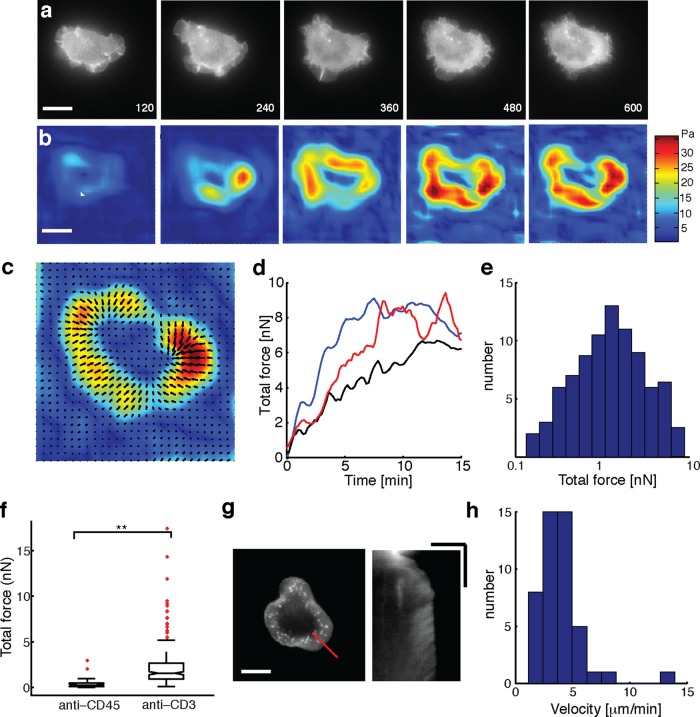
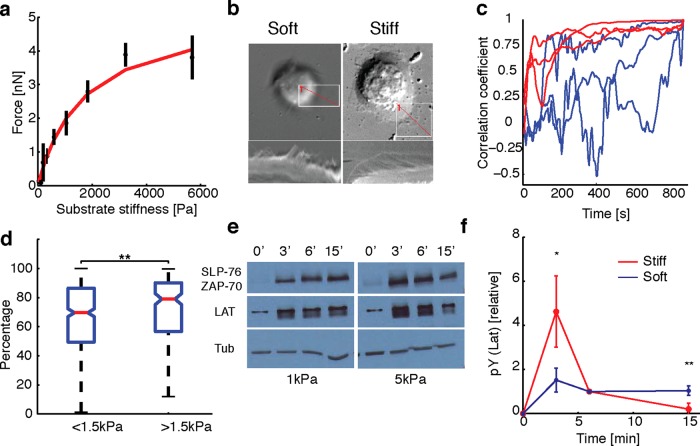
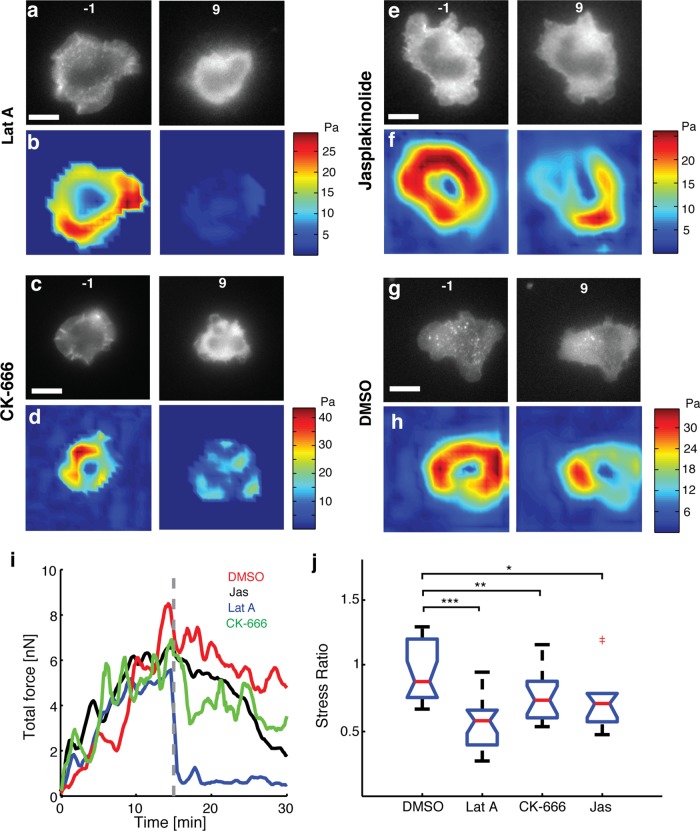
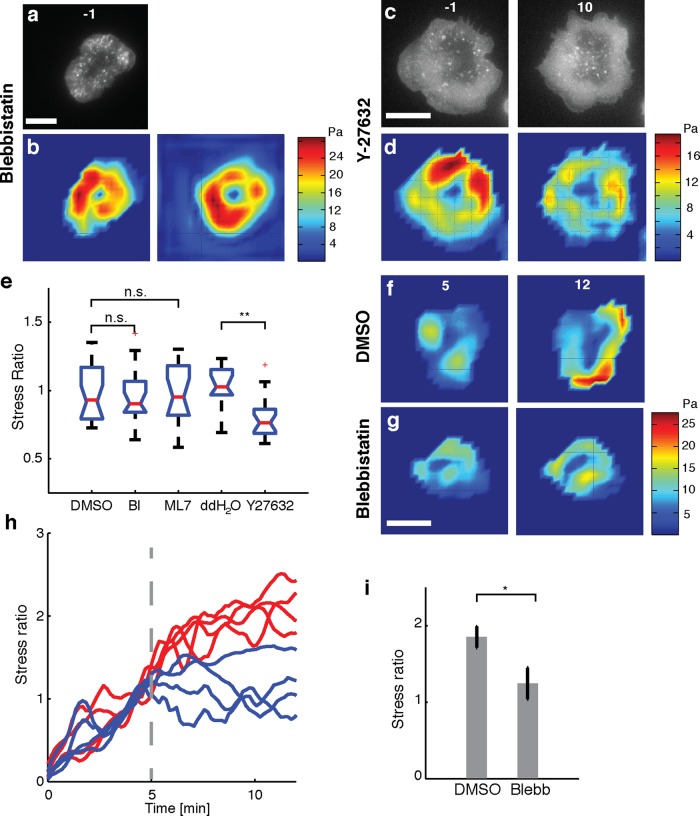
T-cells are critical for the adaptive immune response in the body. The binding of the T-cell receptor (TCR) with antigen on the surface of antigen-presenting cells leads to cell spreading and signaling activation. The underlying mechanism of signaling activation is not completely understood. Although cytoskeletal forces have been implicated in this process, the contribution of different cytoskeletal components and their spatial organization are unknown. Here we use traction force microscopy to measure the forces exerted by Jurkat T-cells during TCR activation. Perturbation experiments reveal that these forces are largely due to actin assembly and dynamics, with myosin contractility contributing to the development of force but not its maintenance. We find that Jurkat T-cells are mechanosensitive, with cytoskeletal forces and signaling dynamics both sensitive to the stiffness of the substrate. Our results delineate the cytoskeletal contributions to interfacial forces exerted by T-cells during activation.
T细胞对于机体的适应性免疫反应至关重要。T细胞受体(TCR)与抗原呈递细胞表面的抗原结合会导致细胞铺展和信号激活。信号激活的潜在机制尚未完全明确。尽管细胞骨架力参与了这一过程,但不同细胞骨架成分及其空间组织的作用尚不清楚。在此,我们使用牵引力显微镜来测量Jurkat T细胞在TCR激活过程中施加的力。扰动实验表明,这些力主要归因于肌动蛋白组装和动力学,肌球蛋白收缩性有助于力的产生但对力的维持并无作用。我们发现Jurkat T细胞具有机械敏感性,细胞骨架力和信号动力学均对底物的硬度敏感。我们的结果阐明了激活过程中细胞骨架对T细胞施加的界面力的贡献。