Benusiglio Patrick R, Giraud Sophie, Deveaux Sophie, Méjean Arnaud, Correas Jean-Michel, Joly Dominique, Timsit Marc-Olivier, Ferlicot Sophie, Verkarre Virginie, Abadie Caroline, Chauveau Dominique, Leroux Dominique, Avril Marie-Françoise, Cordier Jean-François, Richard Stéphane
Centre Expert National Cancers Rares PREDIR, Hôpital Bicêtre, AP-HP, Batiment Lasjaunias, 78 rue du Général Leclerc, Le Kremlin Bicêtre, 94275, France.
Orphanet J Rare Dis. 2014 Oct 29;9:163. doi: 10.1186/s13023-014-0163-z.
The Birt-Hogg-Dubé syndrome is a rare cancer susceptibility syndrome characterised by renal tumours, lung cysts and pneumothoraces, and fibrofolliculomas. It is caused by dominantly inherited mutations in FLCN. Our objective was to report renal tumour characteristics in a large series of patients with the Birt-Hogg-Dubé syndrome.
We studied French Birt-Hogg-Dubé patients with a history of renal tumour.
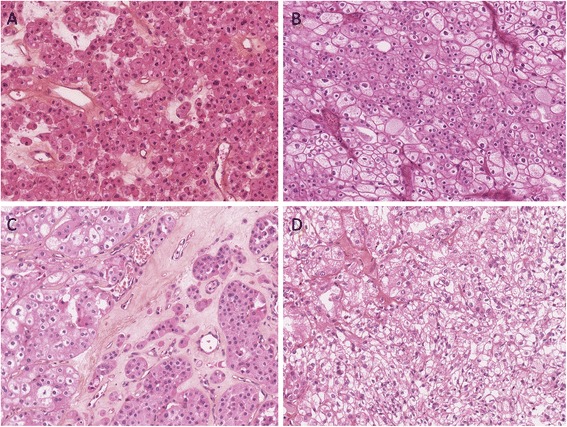
We included 33 patients with 21 distinct germline FLCN mutations. Median age at diagnosis of first renal tumour was 46, and age varied from 20 to 83. Twenty cases had one renal tumour, the remainder had two or more tumours. Most cases (23/33, 70%) had oncocytoma or renal cell carcinoma of the chromophobe or hybrid chromophobe-oncocytoma type, three had clear cell carcinoma (9%), and the other seven had carcinoma of papillary, undifferentiated or undetermined histology. Four cases had metastatic disease, although none died of it.
Age at renal tumour diagnosis was highly variable, highlighting the need for regular surveillance from young adulthood to old age. Most cases had tumour types classically associated with Birt-Hogg-Dubé, i.e. oncocytoma or renal cell carcinoma of the chromophobe or hybrid type. Nevertheless, 9% had clear cell renal cell carcinoma. Geneticists, urologists and oncologists should therefore be alert to the possibility of Birt-Hogg-Dubé in patients with renal cell carcinoma of clear cell histology, especially if there are associated manifestations. Finally, the behaviour of metastatic carcinoma seemed more indolent than in sporadic renal cancers.
Birt-Hogg-Dubé综合征是一种罕见的癌症易感综合征,其特征为肾肿瘤、肺囊肿和气胸以及纤维毛囊瘤。它由FLCN基因的显性遗传突变引起。我们的目的是报告一大系列Birt-Hogg-Dubé综合征患者的肾肿瘤特征。
我们研究了有肾肿瘤病史的法国Birt-Hogg-Dubé患者。
我们纳入了33例患者,他们有21种不同的种系FLCN突变。首次诊断肾肿瘤的中位年龄为46岁,年龄范围从20岁到83岁。20例患者有一个肾肿瘤,其余患者有两个或更多肿瘤。大多数病例(23/33,70%)有嗜酸细胞瘤或嫌色细胞或嗜酸细胞-嫌色细胞混合型肾细胞癌,3例有透明细胞癌(9%),另外7例有乳头状、未分化或组织学类型未确定的癌。4例有转移性疾病,但无一例死于该病。
肾肿瘤诊断时的年龄差异很大,这突出了从青年到老年进行定期监测的必要性。大多数病例的肿瘤类型与Birt-Hogg-Dubé综合征经典相关,即嗜酸细胞瘤或嫌色细胞或混合型肾细胞癌。然而,9%的病例有透明细胞肾细胞癌。因此,遗传学家、泌尿科医生和肿瘤学家应警惕透明细胞组织学类型的肾细胞癌患者发生Birt-Hogg-Dubé综合征的可能性,尤其是伴有相关表现时。最后,转移性癌的行为似乎比散发性肾癌更惰性。