Assaré Rufin K, Knopp Stefanie, N'Guessan Nicaise A, Yapi Ahoua, Tian-Bi Yves-Nathan T, Yao Patrick K, Coulibaly Jean T, Ouattara Mamadou, Meïté Aboulaye, Fenwick Alan, N'Goran Eliézer K, Utzinger Jürg
Department of Epidemiology and Public Health, Swiss Tropical and Public Health Institute, P,O, Box, Basel, CH-4002, Switzerland.
BMC Public Health. 2014 Dec 17;14:1290. doi: 10.1186/1471-2458-14-1290.
Schistosomiasis is a parasitic disease that occurs in the tropics and subtropics. The mainstay of control is preventive chemotherapy with praziquantel. In Africa, an estimated 230 million people require preventive chemotherapy. In western Côte d'Ivoire, infections with Schistosoma mansoni are widespread. To provide an evidence-base for programme decisions about preventive chemotherapy to sustain control of schistosomiasis, a 5-year multi-country study with different treatment arms has been designed by the Schistosomiasis Consortium for Operational Research and Evaluation (SCORE) and is currently being implemented in various African settings, including Côte d'Ivoire.
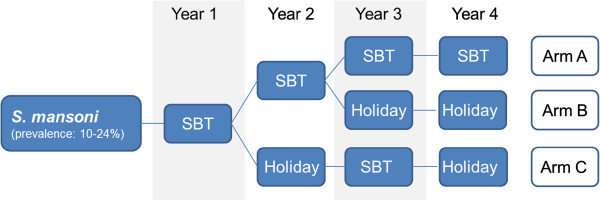
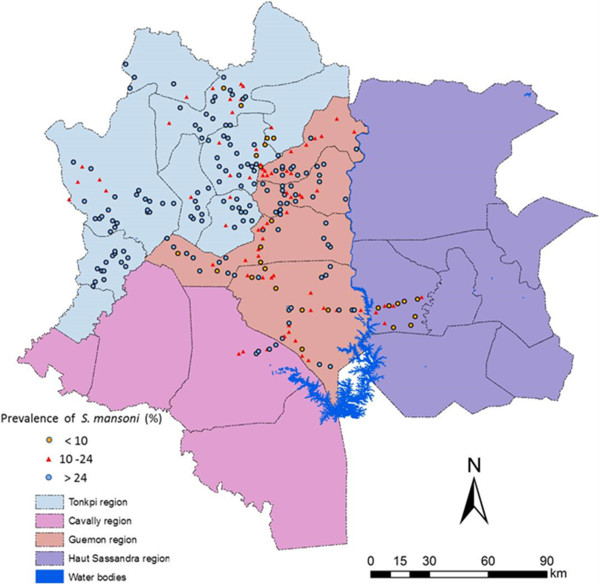
METHODS/DESIGN: We report the study protocol, including ethics statement and insight from a large-scale eligibility survey carried out in four provinces in western Côte d'Ivoire. The study protocol has been approved by the ethics committees of Basel and Côte d'Ivoire. A total of 12,110 children, aged 13-14 years, from 264 villages were screened for S. mansoni using duplicate Kato-Katz thick smears from single stool samples. Among the schools with a S. mansoni prevalence of 10-24%, 75 schools were selected and randomly assigned to one of three treatment arms. In each school, three stool samples are being collected from 100 children aged 9-12 years annually and one stool sample from 100 first-year students at baseline and in the final year and subjected to duplicate Kato-Katz thick smears. Cost and coverage data for the different intervention arms, along with environmental, political and other characteristics that might impact on the infection prevalence and intensity will be recorded in each study year, using a pretested village inventory form.
The study will document changes in S. mansoni infection prevalence and intensity according to different treatment schemes. Moreover, factors that determine the effectiveness of preventive chemotherapy will be identified. These factors will help to develop reasonable measures of force of transmission that can be used to make decisions about the most cost-effective means of lowering prevalence, intensity and transmission in a given setting. The gathered information and results will inform how to effectively sustain control of schistosomiasis at a low level in different social-ecological contexts.
ISRCTN99401114 (date assigned: 12 November 2014).
血吸虫病是一种发生在热带和亚热带地区的寄生虫病。控制该病的主要方法是使用吡喹酮进行预防性化疗。在非洲,估计有2.3亿人需要接受预防性化疗。在科特迪瓦西部,曼氏血吸虫感染十分普遍。为了为关于预防性化疗的项目决策提供证据基础,以维持对血吸虫病的控制,血吸虫病运筹学与评价联合会(SCORE)设计了一项为期5年的多国研究,设置了不同的治疗组,目前正在包括科特迪瓦在内的多个非洲地区实施。
方法/设计:我们报告该研究方案,包括伦理声明以及在科特迪瓦西部四个省份开展的大规模合格性调查的见解。该研究方案已获得巴塞尔和科特迪瓦伦理委员会的批准。使用单份粪便样本的两份重复Kato-Katz厚涂片,对来自264个村庄的12110名13 - 14岁儿童进行曼氏血吸虫筛查。在曼氏血吸虫感染率为10% - 24%的学校中,选取75所学校并随机分配到三个治疗组之一。在每所学校,每年从100名9 - 12岁儿童中收集三份粪便样本,在基线期和最后一年从100名一年级学生中收集一份粪便样本,并进行两份重复Kato-Katz厚涂片检查。使用预先测试的村庄清单表格,在每个研究年度记录不同干预组的成本和覆盖数据,以及可能影响感染率和感染强度的环境、政治和其他特征。
该研究将记录不同治疗方案下曼氏血吸虫感染率和感染强度的变化。此外,将确定决定预防性化疗效果的因素。这些因素将有助于制定合理的传播力测量方法,可用于决定在特定环境中降低感染率、感染强度和传播的最具成本效益的方法。所收集的信息和结果将为如何在不同社会生态环境中有效维持血吸虫病的低水平控制提供参考。
ISRCTN99401114(分配日期:2014年11月12日)。