Woolhouse Matthew Harold, Lai Rosemary
Digital Music Lab, School of the Arts, McMaster University Hamilton, ON, Canada ; McMaster Institute for Music and the Mind, McMaster University Hamilton, ON, Canada.
Digital Music Lab, School of the Arts, McMaster University Hamilton, ON, Canada ; Department of Psychology, Neuroscience and Behavior, McMaster University Hamilton, ON, Canada.
Front Hum Neurosci. 2014 Dec 3;8:965. doi: 10.3389/fnhum.2014.00965. eCollection 2014.
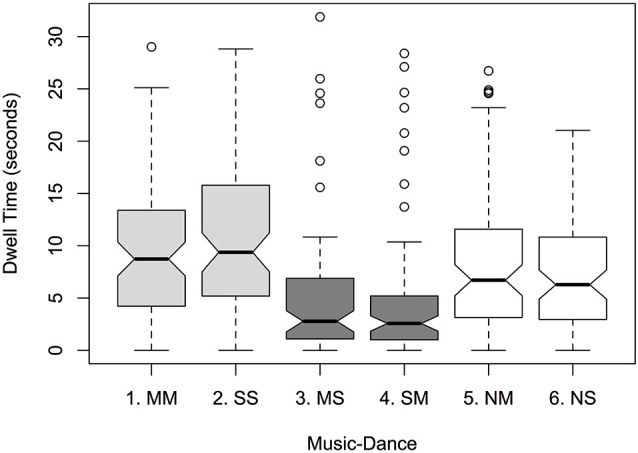
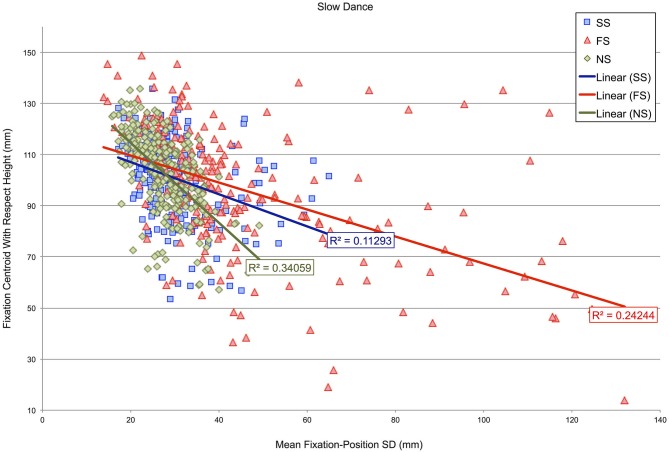
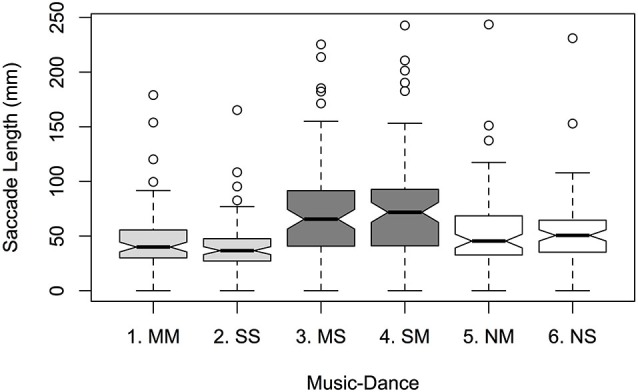
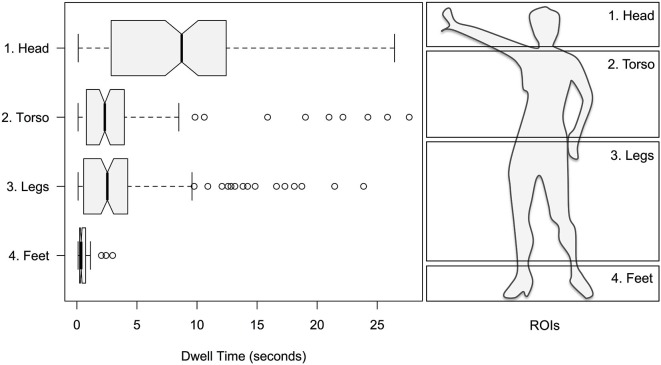
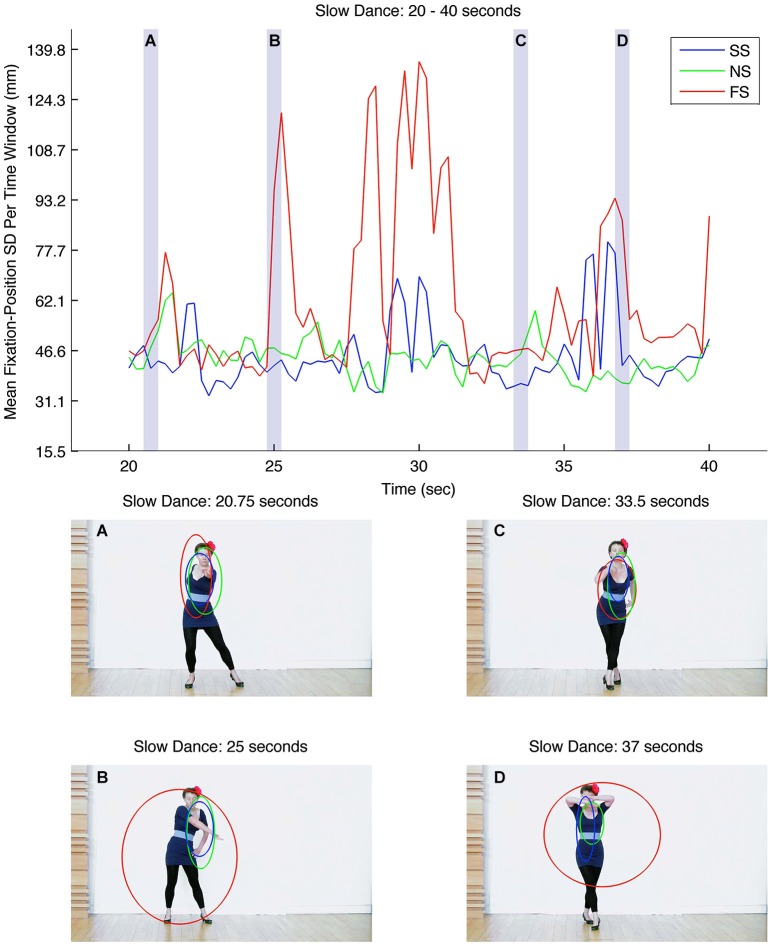
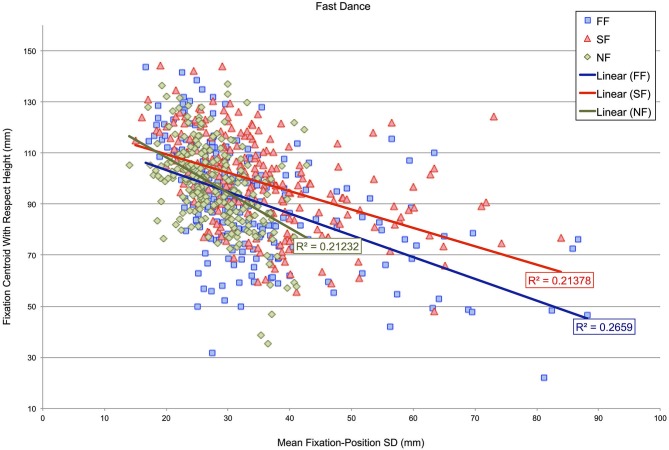
In previous studies investigating entrainment and person perception, synchronized movements were found to enhance memory for incidental person attributes. Although this effect is robust, including in dance, the process by which it is actuated are less well understood. In this study, two hypotheses are investigated: that enhanced memory for person attributes is the result of (1) increased gaze time between in-tempo dancers; and/or (2) greater attentional focus between in-tempo dancers. To explore these possible mechanisms in the context of observing dance, an eye-tracking study was conducted in which subjects watched videos of pairs of laterally positioned dancers; only one of the dancers was synchronized with the music, the other being asynchronous. The results were consistent with the first hypothesis-music-dance synchrony gives rise to increased visual inspection times. In addition, there was a preference for upper-body fixations over lower-body fixations across both synchronous and asynchronous conditions. A subsequent, single-dancer eye-tracking study investigated fixations across different body regions, including head, torso, legs and feet. Significantly greater dwell times were recorded for head than torso and legs; feet attracted significantly less dwell time than any other body region. Lastly, the study sought to identify dance gestures responsible for torso- and head-directed fixations. Specifically we asked whether there are features in dance that are specially designed to direct an observer's gaze towards the face-the main "communicative portal" with respect to the transmission of intent, affect and empathy.
在以往关于同步与人物感知的研究中,发现同步运动会增强对人物附带属性的记忆。尽管这种效应很显著,包括在舞蹈领域,但引发该效应的过程却鲜为人知。在本研究中,对两个假设进行了探究:对人物属性记忆的增强是由于(1)节奏合拍的舞者之间注视时间增加;和/或(2)节奏合拍的舞者之间注意力更集中。为了在观察舞蹈的背景下探究这些可能的机制,进行了一项眼动追踪研究,让受试者观看侧向排列的舞者双人视频;其中只有一名舞者与音乐同步,另一名则不同步。结果与第一个假设一致——音乐与舞蹈的同步导致视觉检查时间增加。此外,在同步和不同步条件下,受试者都更倾向于注视上半身而非下半身。随后的一项针对单个舞者的眼动追踪研究调查了对不同身体部位(包括头部、躯干、腿部和脚部)的注视情况。记录到对头部的停留时间显著长于躯干和腿部;脚部吸引的停留时间明显少于其他任何身体部位。最后,该研究试图找出导致对躯干和头部注视的舞蹈手势。具体而言,我们询问舞蹈中是否存在专门设计用于引导观察者注视面部的特征——面部是意图、情感和同理心传递的主要“交流门户”。