The Ohio State University, Department of Civil, Environmental and Geodetic Engineering, 2070 Neil Ave., Columbus, OH 43210 USA.
Woods Hole Research Center, 149 Woods Hole Road, Falmouth, MA 02540-1644 USA.
Mov Ecol. 2014 Jan 29;2(1):2. doi: 10.1186/2051-3933-2-2. eCollection 2014.
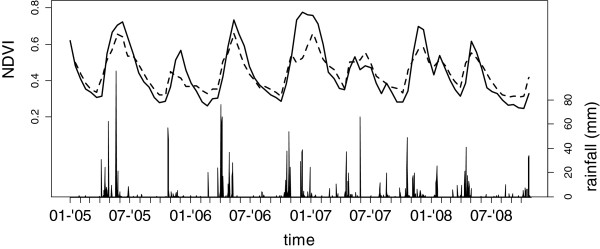
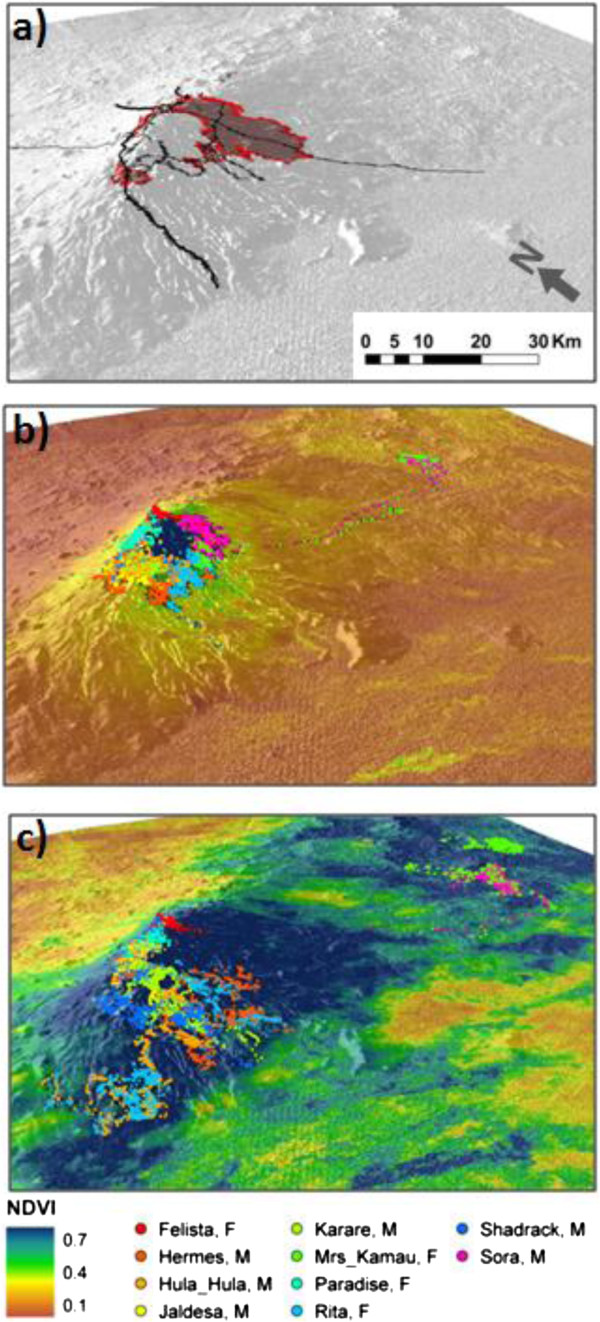
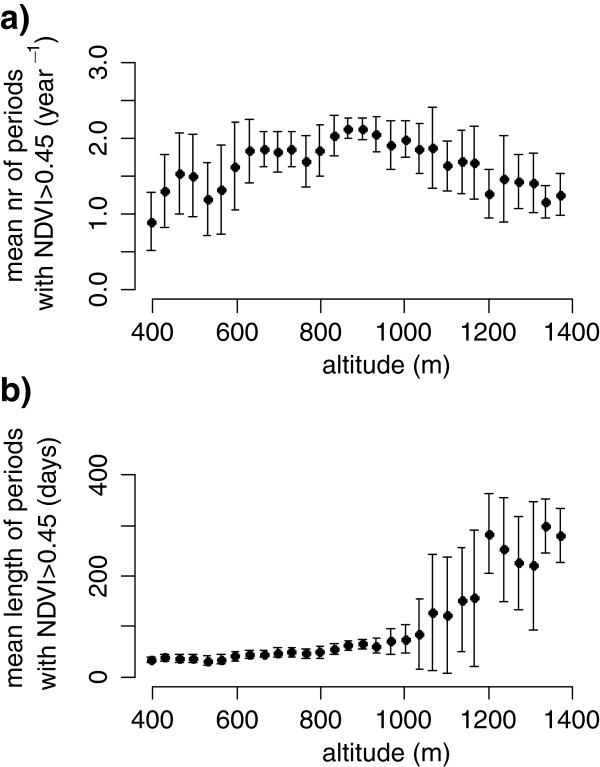
This study investigates the ranging behavior of elephants in relation to precipitation-driven dynamics of vegetation. Movement data were acquired for five bachelors and five female family herds during three years in the Marsabit protected area in Kenya and changes in vegetation were mapped using MODIS normalized difference vegetation index time series (NDVI). In the study area, elevations of 650 to 1100 m.a.s.l experience two growth periods per year, while above 1100 m.a.s.l. growth periods last a year or longer.
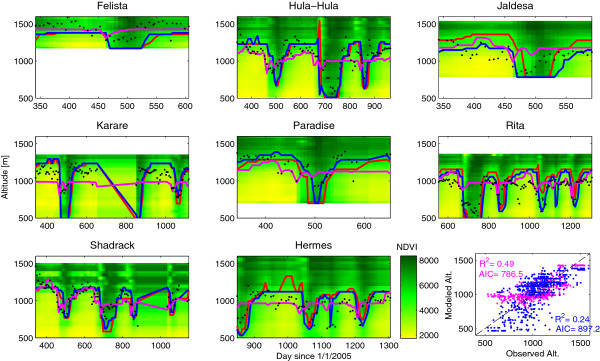
We find that elephants respond quickly to changes in forage and water availability, making migrations in response to both large and small rainfall events. The elevational migration of individual elephants closely matched the patterns of greening and senescing of vegetation in their home range. Elephants occupied lower elevations when vegetation activity was high, whereas they retreated to the evergreen forest at higher elevations while vegetation senesced. Elephant home ranges decreased in size, and overlapped less with increasing elevation.
A recent hypothesis that ungulate migrations in savannas result from countervailing seasonally driven rainfall and fertility gradients is demonstrated, and extended to shorter-distance migrations. In other words, the trade-off between the poor forage quality and accessibility in the forest with its year-round water sources on the one hand and the higher quality forage in the low-elevation scrubland with its seasonal availability of water on the other hand, drives the relatively short migrations (the two main corridors are 20 and 90 km) of the elephants. In addition, increased intra-specific competition appears to influence the animals' habitat use during the dry season indicating that the human encroachment on the forest is affecting the elephant population.
本研究调查了大象的活动范围与植被降水驱动动态的关系。在肯尼亚的马萨比特保护区,我们在三年时间里为五个单身汉和五个雌性家族群获取了移动数据,并使用 MODIS 归一化差异植被指数时间序列(NDVI)绘制了植被变化图。在研究区域,海拔 650 至 1100 米的地区每年有两个生长周期,而海拔 1100 米以上的地区每年有一个或更长的生长周期。
我们发现大象对饲料和水供应的变化反应迅速,会对大小降雨事件做出迁移反应。个别大象的海拔迁移与它们家园范围内植被的变绿和衰老模式密切匹配。当植被活动较高时,大象占据较低的海拔,而当植被衰老时,它们则退回到海拔较高的常绿森林中。大象的家园范围缩小,与海拔升高的重叠度降低。
本研究证明了最近的一个假说,即在热带稀树草原中,有蹄类动物的迁移是由季节性降雨和肥力梯度的反作用引起的,并将其扩展到较短距离的迁移。换句话说,森林中饲料质量差且难以获取,但其全年都有水源,而低海拔灌丛草地中饲料质量较高,但季节性有水供应,这两者之间的权衡关系驱动了大象的相对短距离迁移(两条主要的迁移通道分别为 20 公里和 90 公里)。此外,种内竞争的加剧似乎影响了动物在旱季的栖息地利用,这表明人类对森林的侵占正在影响大象的种群。