Liu Hsin-Ho, Tsai Yuh-Shyan, Lai Chen-Li, Tang Chih-Hsin, Lai Chih-Ho, Wu Hsi-Chin, Hsieh Jer-Tsong, Yang Che-Rei
Department of Urology, University of Texas Southwestern Medical Center, Dallas, Texas, USA ; Division of Urology, Department of Surgery, Taichung Tzu Chi General Hospital, Taichung, Taiwan ; Department of Bio-Industrial Mechatronics Engineering, National Taiwan University, Taipei, Taiwan.
Department of Urology, University of Texas Southwestern Medical Center, Dallas, Texas, USA ; Department of Urology, Medical College and Hospital, National Cheng Kung University, Tainan, Taiwan.
Biomedicine (Taipei). 2014;4(1):2. doi: 10.7603/s40681-014-0002-5. Epub 2014 Aug 5.
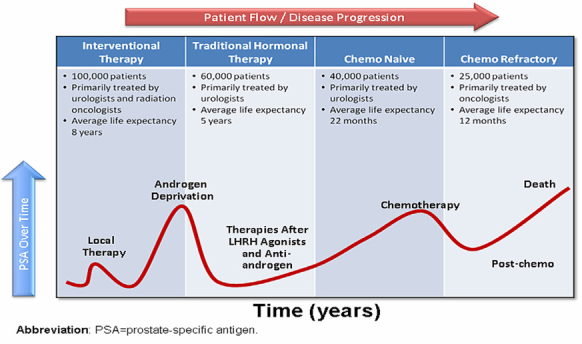
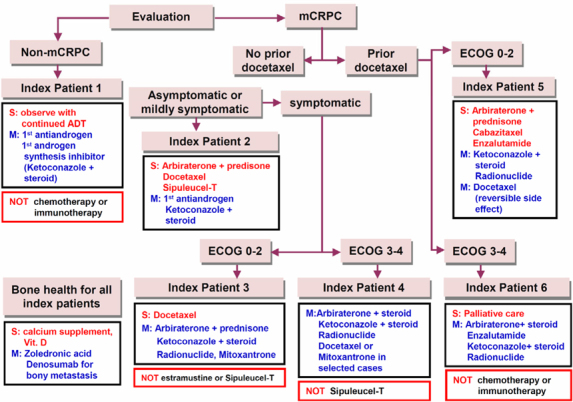
With advances in molecular biologic and genomic technology, detailed molecular mechanisms for development of castration-resistant prostate cancer (CRPC) have surfaced. Metastatic prostate cancer (PCa) no longer represents an end stage, with many emerging therapeutic agents approved as effective in prolonging survival of patients from either pre- or post-docetaxel stage. Given tumor heterogeneity in patients, a one-size-fits-all theory for curative therapy remains questionable. With the support of evidence from continuing clinical trials, each treatment modality has gradually been found suitable for selective best-fit patients: e.g., new androgen synthesis inhibitor arbiraterone, androgen receptor signaling inhibitor enzalutamide, sipuleucel-T immunotherapy, new taxane carbazitaxel, calcium-mimetic radium-223 radiopharmaceutical agent. Moreover, several emerging immunomodulating agents and circulating tumor cell enumeration and analysis showed promise in animal or early phase clinical trials. While the era of personalized therapy for CRPC patients is still in infancy, optimal therapeutic agents and their sequencing loom not far in the future.
随着分子生物学和基因组技术的进步,去势抵抗性前列腺癌(CRPC)发生发展的详细分子机制已逐渐明晰。转移性前列腺癌(PCa)不再被视为疾病终末期,许多新出现的治疗药物已获批,可有效延长多西他赛治疗前或治疗后患者的生存期。鉴于患者肿瘤的异质性,一刀切的根治性治疗理论仍值得质疑。在持续临床试验证据的支持下,逐渐发现每种治疗方式都适用于特定的最佳匹配患者:例如,新型雄激素合成抑制剂阿比特龙、雄激素受体信号抑制剂恩杂鲁胺、sipuleucel-T免疫疗法、新型紫杉烷卡巴他赛、拟钙剂镭-223放射性药物。此外,几种新出现的免疫调节药物以及循环肿瘤细胞计数和分析在动物实验或早期临床试验中显示出前景。虽然CRPC患者的个性化治疗时代仍处于起步阶段,但最佳治疗药物及其序贯治疗在不久的将来已初见端倪。