Bell Vanessa, Mitchell William A, Sigurðsson Sigurður, Westenberg Jos J M, Gotal John D, Torjesen Alyssa A, Aspelund Thor, Launer Lenore J, de Roos Albert, Gudnason Vilmundur, Harris Tamara B, Mitchell Gary F
Cardiovascular Engineering, Inc, Norwood, MA
J Am Heart Assoc. 2014 Dec;3(6):e001536. doi: 10.1161/JAHA.114.001536.
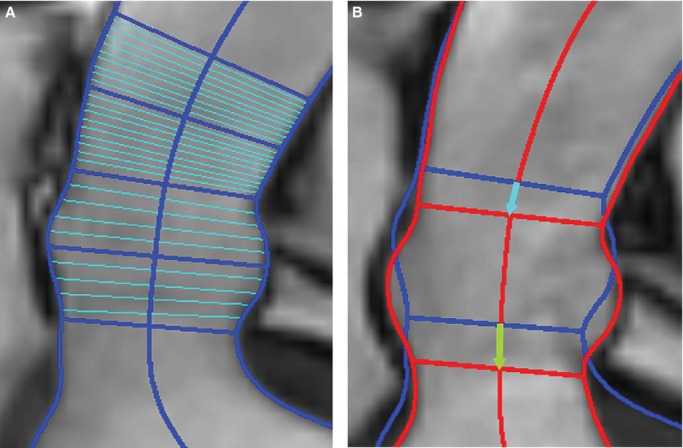
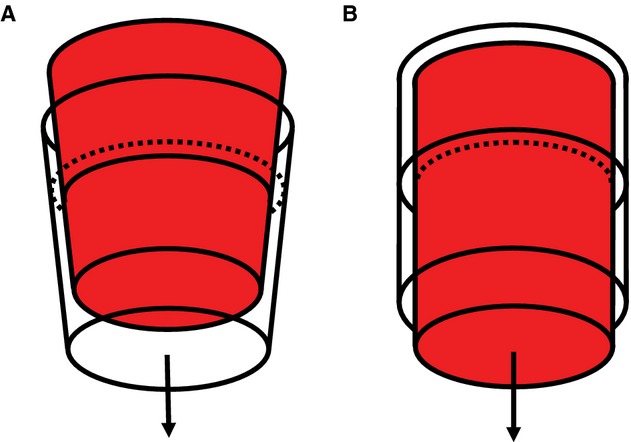
Accurate assessment of mechanical properties of the proximal aorta is a requisite first step for elucidating the pathophysiology of isolated systolic hypertension. During systole, substantial proximal aortic axial displacement produces longitudinal strain, which we hypothesize causes variable underestimation of ascending aortic circumferential strain compared to values in the longitudinally constrained descending aorta.
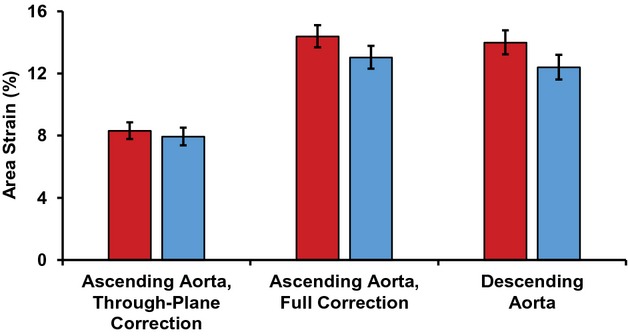
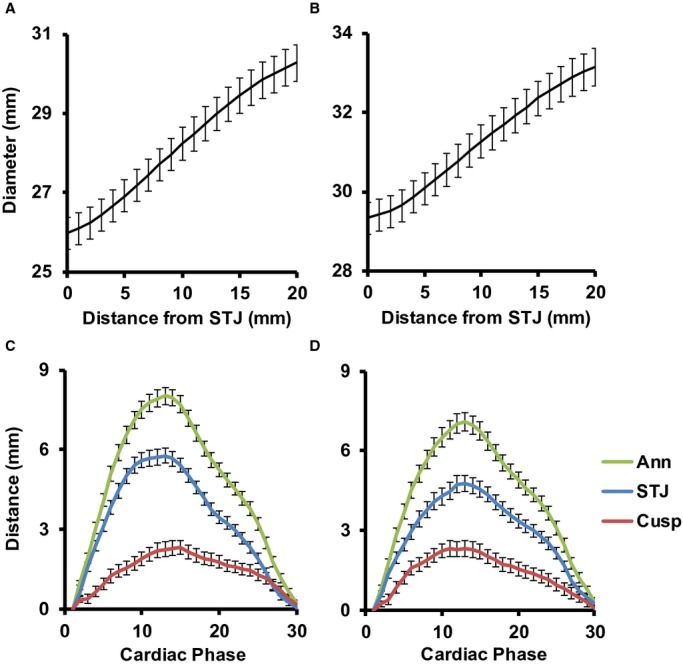
To assess effects of longitudinal strain, we performed magnetic resonance imaging in 375 participants (72 to 94 years old, 204 women) in the Age, Gene/Environment Susceptibility‐Reykjavik Study and measured aortic circumferential and longitudinal strain. Circumferential ascending aortic area strain uncorrected for longitudinal strain was comparable in women and men (mean [95% CI], 8.3 [7.8, 8.9] versus 7.9 [7.4, 8.5]%, respectively, P=0.3). However, longitudinal strain was greater in women (8.5±2.5 versus 7.0±2.5%, P<0.001), resulting in greater longitudinally corrected circumferential ascending aortic strain (14.4 [13.6, 15.2] versus 13.0 [12.4, 13.7]%, P=0.010). Observed circumferential descending aortic strain, which did not require correction (women: 14.0 [13.2, 14.8], men: 12.4 [11.6, 13.2]%, P=0.005), was larger than uncorrected (P<0.001), but comparable to longitudinally corrected (P=0.12) circumferential ascending aortic strain. Carotid‐femoral pulse wave velocity did not correlate with uncorrected ascending aortic strain (R=−0.04, P=0.5), but was inversely related to longitudinally corrected ascending and observed descending aortic strain (R=−0.15, P=0.004; R=−0.36, P<0.001, respectively). Longitudinal strain was also inversely related to carotid‐femoral pulse wave velocity and other risk factors for higher aortic stiffness including treated hypertension.
Longitudinal strain creates substantial and variable errors in circumferential ascending aortic area strain measurements, particularly in women, and should be considered to avoid misclassification of ascending aortic stiffness.
准确评估升主动脉的力学特性是阐明单纯收缩期高血压病理生理学的必要首要步骤。在收缩期,升主动脉近端显著的轴向位移会产生纵向应变,我们推测这会导致与纵向受限的降主动脉相比,升主动脉周向应变的测量值出现不同程度的低估。
为评估纵向应变的影响,我们在年龄、基因/环境易感性-雷克雅未克研究中的375名参与者(72至94岁,204名女性)中进行了磁共振成像,并测量了主动脉周向和纵向应变。未经纵向应变校正的升主动脉周向面积应变在女性和男性中相当(均值[95%CI],分别为8.3[7.8,8.9]%和7.9[7.4,8.5]%,P = 0.3)。然而,女性的纵向应变更大(8.5±2.5%对7.0±2.5%,P<0.001),导致校正纵向应变后的升主动脉周向应变更大(14.4[13.6,15.2]%对13.0[12.4,13.7]%,P = 0.010)。观察到的降主动脉周向应变不需要校正(女性:14.0[13.2,14.8],男性:12.4[11.6,13.2]%,P = 0.005),大于未校正的升主动脉周向应变(P<0.001),但与校正纵向应变后的升主动脉周向应变相当(P = 0.12)。颈股脉搏波速度与未校正的升主动脉应变无相关性(R = -0.04,P = 0.5),但与校正纵向应变后的升主动脉应变以及观察到的降主动脉应变呈负相关(分别为R = -0.15,P = 0.004;R = -0.36,P<0.001)。纵向应变也与颈股脉搏波速度以及其他导致主动脉僵硬度增加的危险因素(包括治疗后的高血压)呈负相关。
纵向应变在升主动脉周向面积应变测量中会产生显著且可变的误差,尤其是在女性中,应予以考虑以避免对升主动脉僵硬度的错误分类。