Bachmeier James D, Van Hook Jennifer, Bean Frank D
Department of Sociology, Temple University.
Population Research Institute, Pennsylvania State University.
Int Migr Rev. 2014 Summer;48(2):538-566. doi: 10.1111/imre.12059.
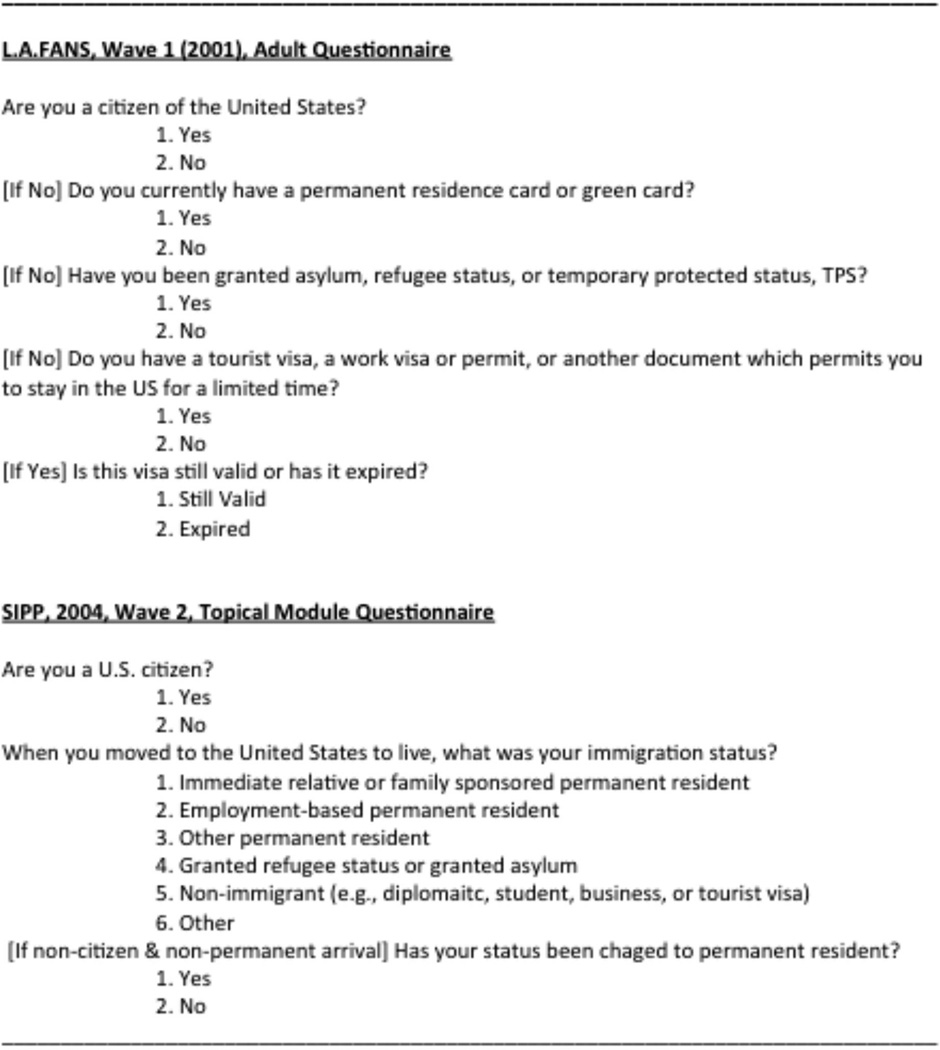
This research note examines response and allocation rates for legal status questions asked in publicly available U.S. surveys to address worries that the legal status of immigrants cannot be reliably measured. Contrary to such notions, we find that immigrants' response rates to questions about legal status are typically not higher than response rates to other immigration-related questions, such as country of birth and year of immigration. Further exploration of two particular surveys - the Los Angeles Family and Neighborhood Survey (LAFANS) and the Survey of Income and Program Participation (SIPP) - reveals that these data sources produce profiles of the unauthorized immigrant population that compare favorably to independently estimated profiles. We also find in the case of the SIPP that the introduction of legal status questions does not appear to have an appreciable "chilling effect" on the subsequent survey participation of unauthorized immigrant respondents. Based on the results, we conclude that future data collection efforts should include questions about legal status in order to (a) improve models of immigrant incorporation and (b) better position assimilation research to inform policy discussions.
本研究报告考察了美国公开调查中有关法律地位问题的回答率和数据分配率,以回应人们对移民法律地位无法可靠衡量的担忧。与这些观念相反,我们发现移民对法律地位问题的回答率通常并不高于对其他移民相关问题的回答率,比如出生国家和移民年份。对两项特定调查——《洛杉矶家庭与邻里调查》(LAFANS)和《收入与项目参与调查》(SIPP)——的进一步探究表明,这些数据源所呈现的非法移民人口概况与独立估算的概况相比具有优势。我们还发现,就SIPP而言,引入法律地位问题似乎并未对非法移民受访者随后的调查参与产生明显的“寒蝉效应”。基于这些结果,我们得出结论,未来的数据收集工作应纳入有关法律地位的问题,以便(a)改进移民融入模型,(b)使同化研究能更好地为政策讨论提供信息。