Look Amy E, McCloskey Michael S, Coccaro Emil F
Department of Psychology, Temple University, Philadelphia, PA, USA.
Department of Psychology, Temple University, Philadelphia, PA, USA.
Psychiatry Res. 2015 Feb 28;225(3):531-9. doi: 10.1016/j.psychres.2014.11.052. Epub 2014 Dec 8.
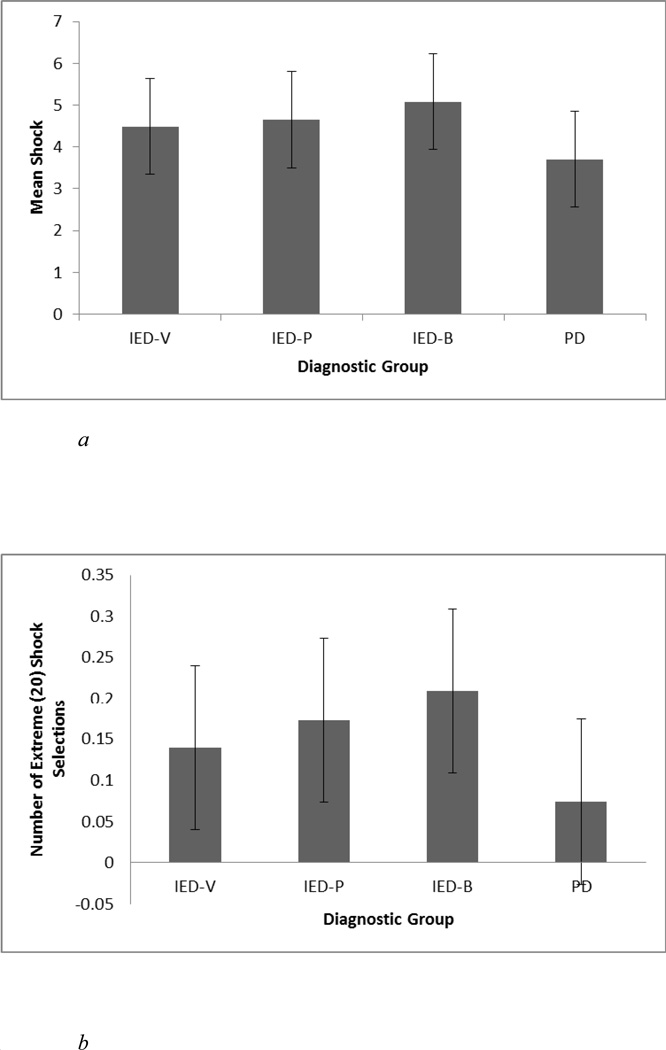
Intermittent Explosive Disorder (IED) is the only adult psychiatric diagnosis for which pathological aggression is primary. DSM-IV criteria focused on physical aggression, but Diagnostic and Statistical Manual of Mental Disorders (DSM-5) allows for an IED diagnosis in the presence of frequent verbal aggression with or without concurrent physical aggression. It remains unclear how individuals with verbal aggression differ from those with physical aggression with respect to cognitive-affective deficits and psychosocial functioning. The current study compared individuals who met IED criteria with either frequent verbal aggression without physical aggression (IED-V), physical aggression without frequent verbal aggression (IED-P), or both frequent verbal aggression and physical aggression (IED-B) as well as a non-aggressive personality-disordered (PD) comparison group using behavioral and self-report measures of aggression, anger, impulsivity, and affective lability, and psychosocial impairment. Results indicate all IED groups showed increased anger/aggression, psychosocial impairment, and affective lability relative to the PD group. The IED-B group showed greater trait anger, anger dyscontrol, and aggression compared to the IED-V and IED-P groups. Overall, the IED-V and IED-P groups reported comparable deficits and impairment. These results support the inclusion of verbal aggression within the IED criteria and suggest a more severe profile for individuals who engage in both frequent verbal arguments and repeated physical aggression.
间歇性爆发障碍(IED)是唯一一种以病理性攻击行为为主的成人精神疾病诊断。《精神疾病诊断与统计手册》第四版(DSM-IV)的标准侧重于身体攻击行为,但《精神疾病诊断与统计手册》第五版(DSM-5)允许在存在频繁言语攻击行为(无论是否伴有身体攻击行为)的情况下诊断为IED。目前尚不清楚言语攻击行为患者与身体攻击行为患者在认知情感缺陷和心理社会功能方面有何不同。本研究使用攻击行为、愤怒、冲动性和情感不稳定以及心理社会损害的行为和自我报告测量方法,比较了符合IED标准的个体,这些个体包括无身体攻击行为的频繁言语攻击(IED-V)、无频繁言语攻击行为的身体攻击(IED-P)、频繁言语攻击行为和身体攻击行为两者兼具(IED-B)以及非攻击性人格障碍(PD)对照组。结果表明,相对于PD组,所有IED组的愤怒/攻击行为、心理社会损害和情感不稳定均有所增加。与IED-V组和IED-P组相比,IED-B组表现出更高的特质愤怒、愤怒失控和攻击行为。总体而言,IED-V组和IED-P组报告的缺陷和损害相当。这些结果支持将言语攻击行为纳入IED标准,并表明对于那些既频繁进行言语争吵又反复进行身体攻击的个体,其情况更为严重。