Department of Biochemistry and Molecular Medicine, University of California Davis Davis, CA, USA ; Neuroscience Graduate Group, University of California Davis Davis, CA, USA.
Department of Biochemistry and Molecular Medicine, University of California Davis Davis, CA, USA.
Front Mol Neurosci. 2014 Dec 5;7:97. doi: 10.3389/fnmol.2014.00097. eCollection 2014.
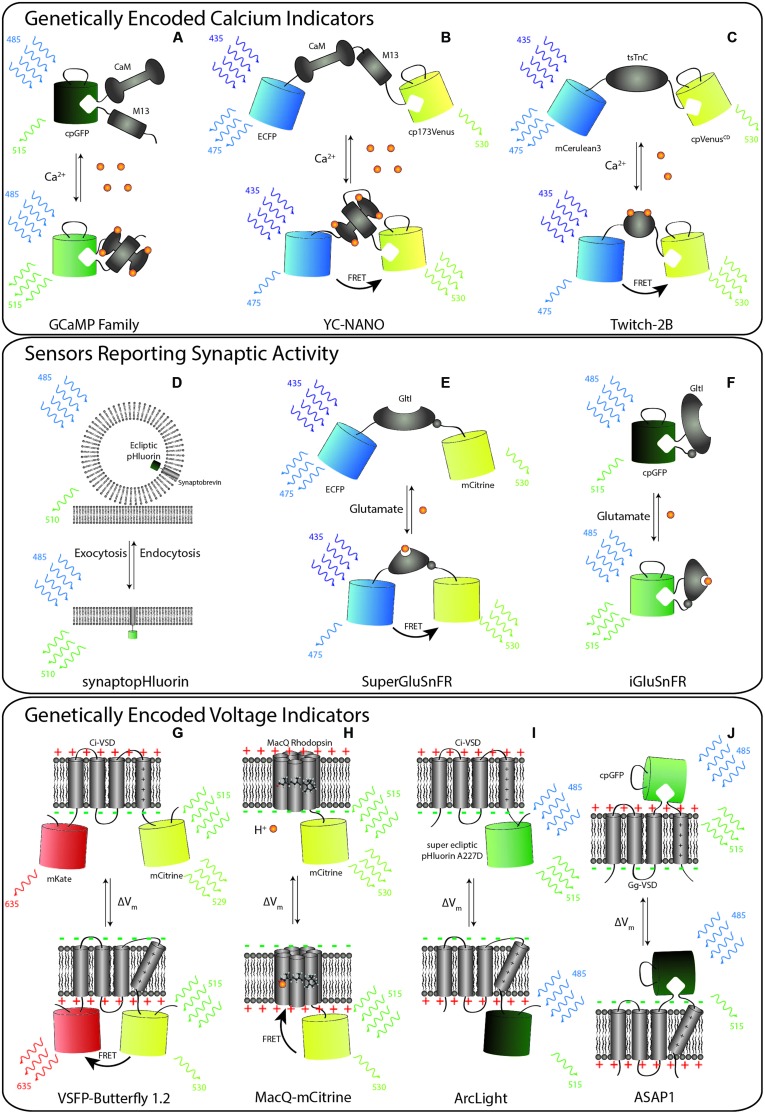
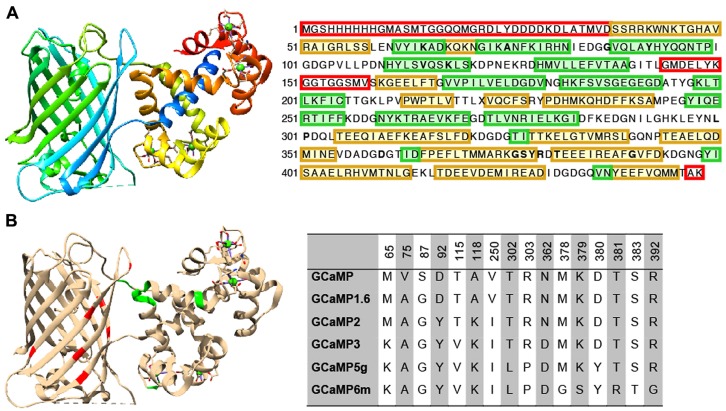
Recent developments in genetically encoded indicators of neural activity (GINAs) have greatly advanced the field of systems neuroscience. As they are encoded by DNA, GINAs can be targeted to genetically defined cellular populations. Combined with fluorescence microscopy, most notably multi-photon imaging, GINAs allow chronic simultaneous optical recordings from large populations of neurons or glial cells in awake, behaving mammals, particularly rodents. This large-scale recording of neural activity at multiple temporal and spatial scales has greatly advanced our understanding of the dynamics of neural circuitry underlying behavior-a critical first step toward understanding the complexities of brain function, such as sensorimotor integration and learning. Here, we summarize the recent development and applications of the major classes of GINAs. In particular, we take an in-depth look at the design of available GINA families with a particular focus on genetically encoded calcium indicators (GCaMPs), sensors probing synaptic activity, and genetically encoded voltage indicators. Using the family of the GCaMP as an example, we review established sensor optimization pipelines. We also discuss practical considerations for end users of GINAs about experimental methods including approaches for gene delivery, imaging system requirements, and data analysis techniques. With the growing toolbox of GINAs and with new microscopy techniques pushing beyond their current limits, the age of light can finally achieve the goal of broad and dense sampling of neuronal activity across time and brain structures to obtain a dynamic picture of brain function.
近年来,基因编码的神经活动指示剂(GINAs)的发展极大地推动了系统神经科学领域的发展。由于它们是由 DNA 编码的,因此可以将 GINAs 靶向到基因定义的细胞群体中。与荧光显微镜结合,尤其是多光子成像,GINAs 允许在清醒、行为活跃的哺乳动物(尤其是啮齿动物)中对大量神经元或神经胶质细胞进行慢性同时光学记录。这种在多个时间和空间尺度上对神经活动的大规模记录极大地促进了我们对行为背后神经回路动态的理解——这是理解大脑功能复杂性的关键第一步,例如感觉运动整合和学习。在这里,我们总结了主要 GINA 类别的最新发展和应用。特别是,我们深入研究了现有 GINA 家族的设计,特别关注基因编码钙指示剂(GCaMPs)、探测突触活动的传感器和基因编码电压指示剂。我们以 GCaMP 家族为例,回顾了已建立的传感器优化流程。我们还讨论了 GINAs 的实际考虑因素,包括实验方法,包括基因传递方法、成像系统要求和数据分析技术。随着 GINAs 工具包的不断增加和新的显微镜技术超越其当前限制,光的时代终于可以实现广泛而密集地采样神经元活动跨越时间和大脑结构的目标,以获得大脑功能的动态图景。