Rahideh Seyedeh Tayebeh, Shidfar Farzad, Khandozi Nafiseh, Rajab Asadollah, Hosseini Seyed Payam, Mirtaher Seyed Mohsen
Department of Nutrition, School of Health, Research Institute for Islamic and Complementary Medicine, Iran University of Medical Sciences, Tehran, Iran.
Department of Endocrinology, Iranian Diabetes Association, Tehran, Iran.
J Res Med Sci. 2014 Oct;19(10):933-8.
Sumac (Rhus coriaria L.) has been used in traditional treatment of some diseases. The aim of this study was to determine the effect of sumac (R. coriaria L.) powder on insulin resistance (IR), malondialdehyde (MDA), high sensitive C-reactive protein (hs-CRP), and paraoxonase 1 (PON1) activity in type 2 diabetic patients.
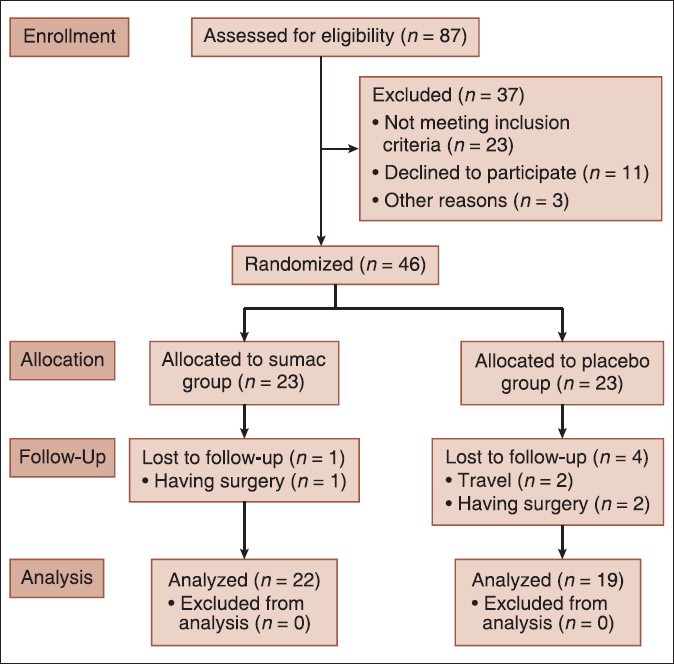
A double-blind randomized placebo controlled trial on 41 type 2 diabetic volunteers was conducted. Participants randomly assigned into 3 g per day sumac powder (n = 22) or placebo (n = 19) groups for 3 months. IR was assessed using the homeostatic model assessment of IR (HOMA-IR), which including measurement of insulin by immunoassay method and measurement of glucose by enzymatic method. MDA and PON1 activity were measured colorimetrically, hs-CRP turbidimetrically.
There were a significant increase in PON1 activity (from 84.72 ± 30.59 to 92.91 ± 32.63) and significant decrease in insulin (from 7.09 ± 4.28 to 5.32 ± 3.22), HOMA-IR (from 2.56 ± 1.58 to 1.67 ± 0.94), MDA (from 2.71 ± 0.73 to 1.97 ± 0.49), and also hs-CRP (from 18.49 ± 16.96 to 15.89 ± 16.70) in the sumac group at the end of study compared with initial values (P < 0.05). Furthermore, there were significant differences in MDA and PON1 between the two groups at the end of the study (P < 0.05). Furthermore, the mean of differences of insulin, HOMA-IR, MDA, hs-CRP and PON1 activity between groups were significant (P < 0.05).
We concluded that daily intake of 3 g sumac for 3 months may be beneficial for diabetic patients to make them less susceptible to cardiovascular disease.
漆树(盐肤木)已被用于一些疾病的传统治疗。本研究的目的是确定漆树(盐肤木)粉对2型糖尿病患者胰岛素抵抗(IR)、丙二醛(MDA)、高敏C反应蛋白(hs-CRP)和对氧磷酶1(PON1)活性的影响。
对41名2型糖尿病志愿者进行了一项双盲随机安慰剂对照试验。参与者被随机分为每天服用3克漆树粉组(n = 22)或安慰剂组(n = 19),为期3个月。使用IR的稳态模型评估(HOMA-IR)来评估IR,其中包括通过免疫测定法测量胰岛素和通过酶法测量葡萄糖。采用比色法测量MDA和PON1活性,采用比浊法测量hs-CRP。
与初始值相比,研究结束时漆树粉组的PON1活性显著增加(从84.72±30.59增至92.91±32.63),胰岛素(从7.09±4.28降至5.32±3.22)、HOMA-IR(从2.56±1.58降至1.67±0.94)、MDA(从2.71±0.73降至1.97±0.49)以及hs-CRP(从18.49±16.96降至15.89±16.70)均显著降低(P < 0.05)。此外,研究结束时两组之间的MDA和PON1存在显著差异(P < 0.05)。此外,两组之间胰岛素、HOMA-IR、MDA、hs-CRP和PON1活性的平均差异显著(P < 0.05)。
我们得出结论,2型糖尿病患者每日摄入3克漆树粉,持续3个月,可能有助于降低其患心血管疾病的易感性。