Scholz Urte, Berli Corina
Department of Psychology, University of Zurich, Applied Social Psychology, Binzmuehlestrasse 14 / Box 14, CH-8050 Zürich, Switzerland.
BMC Public Health. 2014 Dec 24;14:1321. doi: 10.1186/1471-2458-14-1321.
Enhancing physical activity in overweight and obese individuals is an important means to promote health in this target population. The Health Action Process Approach (HAPA), which was the theoretical framework of this study, focuses on individual self-regulation variables for successful health behavior change. One key self-regulation variable of this model is action control with its three subfacets awareness of intentions, self-monitoring and regulatory effort. The social context of individuals, however, is usually neglected in common health behavior change theories. In order to integrate social influences into the HAPA, this randomized controlled trial investigated the effectiveness of a dyadic conceptualization of action control for promoting physical activity.
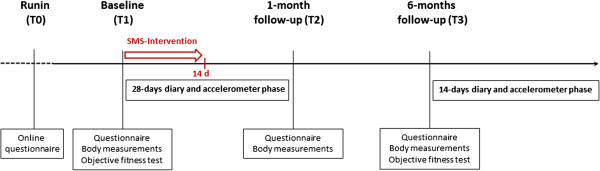
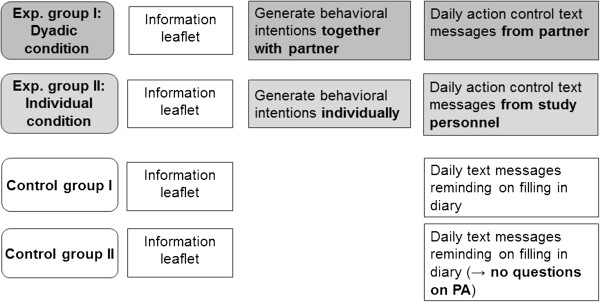
METHODS/DESIGN: This protocol describes the design of a single-blind randomized controlled trial, which comprises four experimental groups: a dyadic action control group, an individual action control group and two control groups. Participants of this study are overweight or obese, heterosexual adult couples who intend to increase their physical activity. Blocking as means of a gender-balanced randomization is used to allocate couples to conditions and partners to either being the target person of the intervention or to the partner condition. The ecological momentary intervention takes place in the first 14 days after baseline assessment and is followed by another 14 days diary phase without intervention. Follow-ups are one month and six months later. Subsequent to the six-months follow-up another 14 days diary phase takes place.The main outcome measures are self-reported and accelerometer-assessed physical activity. Secondary outcome measures are Body Mass Index (BMI), aerobic fitness and habitual physical activity.
This is the first study examining a dyadic action control intervention in comparison to an individual action control condition and two control groups applying a single-blind randomized control trial. Challenges with running couples studies as well as advantages and disadvantages of certain design-related decisions are discussed. This RCT was funded by the Swiss National Science Foundation (PP00P1_133632/1) and was registered on 27/04/2012 at http://www.isrctn.com/ISRCTN15705531.
增强超重和肥胖个体的身体活动是促进这一目标人群健康的重要手段。健康行动过程方法(HAPA)是本研究的理论框架,专注于个体自我调节变量以实现成功的健康行为改变。该模型的一个关键自我调节变量是行动控制,它有三个子方面:意图意识、自我监测和调节努力。然而,个体的社会环境在常见的健康行为改变理论中通常被忽视。为了将社会影响纳入HAPA,这项随机对照试验研究了行动控制的二元概念化对促进身体活动的有效性。
方法/设计:本方案描述了一项单盲随机对照试验的设计,该试验包括四个实验组:二元行动控制组、个体行动控制组和两个对照组。本研究的参与者是超重或肥胖的异性成年夫妇,他们打算增加身体活动。采用性别均衡随机化的区组设计将夫妇分配到不同条件下,并将伴侣分配到干预目标人群或伴侣条件。生态瞬时干预在基线评估后的前14天进行,随后是另外14天的无干预日记阶段。随访在1个月和6个月后进行。在6个月随访之后,再进行14天的日记阶段。主要结局指标是自我报告的和通过加速度计评估的身体活动。次要结局指标是体重指数(BMI)、有氧适能和习惯性身体活动。
这是第一项通过单盲随机对照试验,将二元行动控制干预与个体行动控制条件及两个对照组进行比较的研究。讨论了开展夫妇研究的挑战以及某些与设计相关决策的优缺点。这项随机对照试验由瑞士国家科学基金会(PP00P1_133632/1)资助,并于2012年4月27日在http://www.isrctn.com/ISRCTN15705531上注册。