Wong Mun-Teng, Chen Steve S-L
Institute of Biomedical Sciences, Academia Sinica, Taipei.
Ph.D. Program in Translational Medicine, Kaohsiung Medical University and Academia Sinica.
Cell Mol Immunol. 2016 Jan;13(1):11-35. doi: 10.1038/cmi.2014.127. Epub 2014 Dec 29.
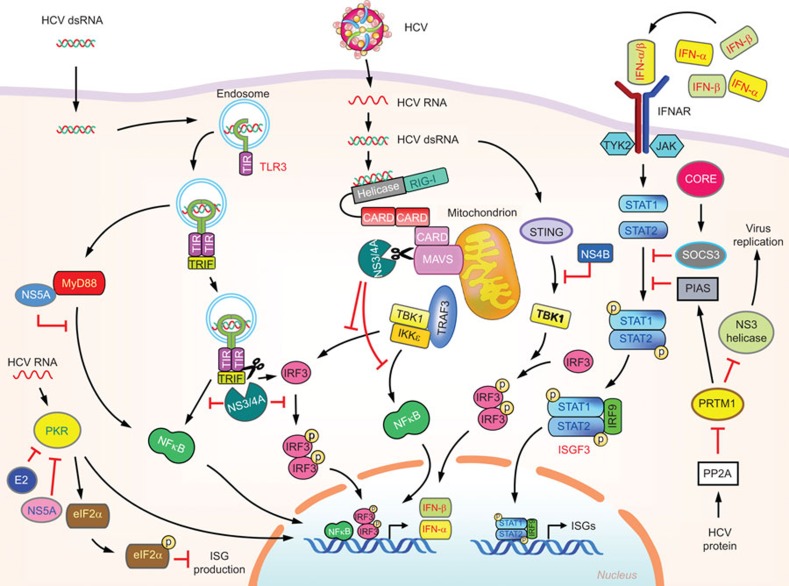
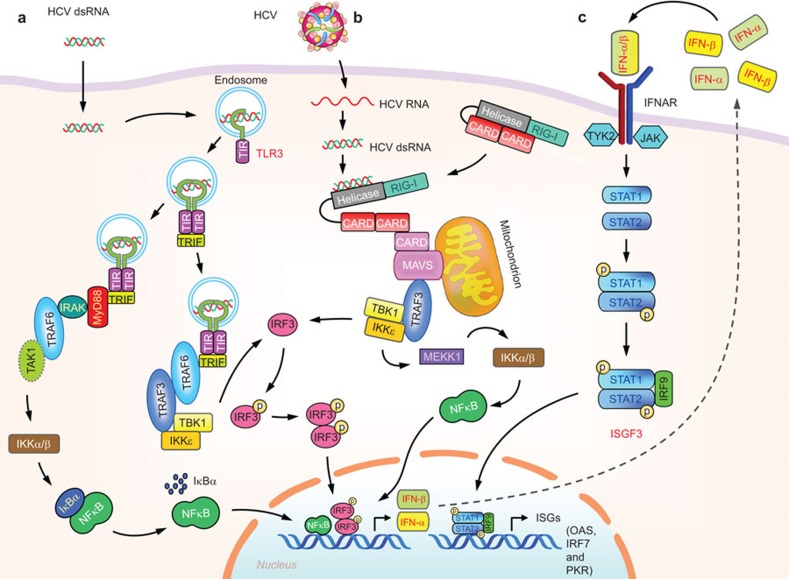
Infection with hepatitis C virus (HCV), a major viral cause of chronic liver disease, frequently progresses to steatosis and cirrhosis, which can lead to hepatocellular carcinoma. HCV infection strongly induces host responses, such as the activation of the unfolded protein response, autophagy and the innate immune response. Upon HCV infection, the host induces the interferon (IFN)-mediated frontline defense to limit virus replication. Conversely, HCV employs diverse strategies to escape host innate immune surveillance. Type I IFN elicits its antiviral actions by inducing a wide array of IFN-stimulated genes (ISGs). Nevertheless, the mechanisms by which these ISGs participate in IFN-mediated anti-HCV actions remain largely unknown. In this review, we first outline the signaling pathways known to be involved in the production of type I IFN and ISGs and the tactics that HCV uses to subvert innate immunity. Then, we summarize the effector mechanisms of scaffold ISGs known to modulate IFN function in HCV replication. We also highlight the potential functions of emerging ISGs, which were identified from genome-wide siRNA screens, in HCV replication. Finally, we discuss the functions of several cellular determinants critical for regulating host immunity in HCV replication. This review will provide a basis for understanding the complexity and functionality of the pleiotropic IFN system in HCV infection. Elucidation of the specificity and the mode of action of these emerging ISGs will also help to identify novel cellular targets against which effective HCV therapeutics can be developed.
丙型肝炎病毒(HCV)感染是慢性肝病的主要病毒病因,常进展为脂肪变性和肝硬化,进而可导致肝细胞癌。HCV感染强烈诱导宿主反应,如未折叠蛋白反应、自噬和先天免疫反应的激活。HCV感染后,宿主诱导干扰素(IFN)介导的一线防御以限制病毒复制。相反,HCV采用多种策略逃避宿主先天免疫监视。I型干扰素通过诱导大量干扰素刺激基因(ISG)发挥其抗病毒作用。然而,这些ISG参与IFN介导的抗HCV作用的机制在很大程度上仍不清楚。在本综述中,我们首先概述已知参与I型干扰素和ISG产生的信号通路以及HCV用于颠覆先天免疫的策略。然后,我们总结已知在HCV复制中调节IFN功能的支架ISG的效应机制。我们还强调了从全基因组siRNA筛选中鉴定出的新兴ISG在HCV复制中的潜在功能。最后,我们讨论了几种对调节HCV复制中的宿主免疫至关重要的细胞决定因素的功能。本综述将为理解HCV感染中多效性IFN系统的复杂性和功能提供基础。阐明这些新兴ISG的特异性和作用方式也将有助于确定可开发有效HCV治疗药物的新细胞靶点。