Cecere Roberto, Rees Geraint, Romei Vincenzo
Centre for Brain Science, Department of Psychology, University of Essex, Wivenhoe Park, Colchester CO4 3SQ, UK; Institute of Neuroscience and Psychology, University of Glasgow, 58 Hillhead Street, Glasgow G12 8QB, UK.
UCL Institute of Cognitive Neuroscience, University College London, 17 Queen Square, London WC1N 3AR, UK; Wellcome Trust Centre for Neuroimaging at UCL, University College London, 12 Queen Square, London WC1N 3BG, UK.
Curr Biol. 2015 Jan 19;25(2):231-235. doi: 10.1016/j.cub.2014.11.034. Epub 2014 Dec 24.
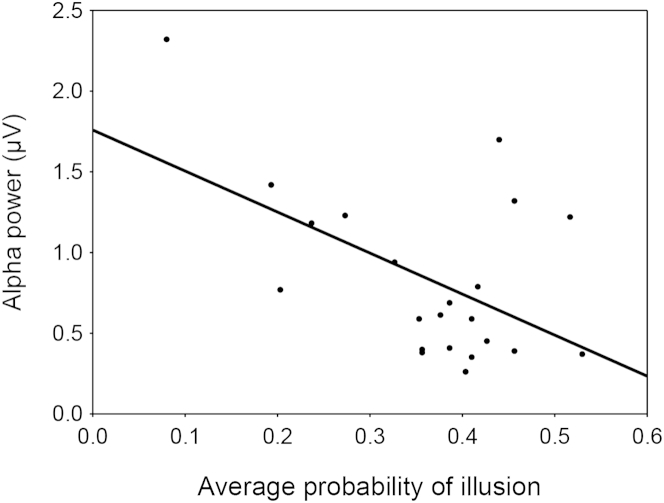
Perception routinely integrates inputs from different senses. Stimulus temporal proximity critically determines whether or not these inputs are bound together. Despite the temporal window of integration being a widely accepted notion, its neurophysiological substrate remains unclear. Many types of common audio-visual interactions occur within a time window of ∼100 ms. For example, in the sound-induced double-flash illusion, when two beeps are presented within ∼100 ms together with one flash, a second illusory flash is often perceived. Due to their intrinsic rhythmic nature, brain oscillations are one candidate mechanism for gating the temporal window of integration. Interestingly, occipital alpha band oscillations cycle on average every ∼100 ms, with peak frequencies ranging between 8 and 14 Hz (i.e., 120-60 ms cycle). Moreover, presenting a brief tone can phase-reset such oscillations in visual cortex. Based on these observations, we hypothesized that the duration of each alpha cycle might provide the temporal unit to bind audio-visual events. Here, we first recorded EEG while participants performed the sound-induced double-flash illusion task and found positive correlation between individual alpha frequency (IAF) peak and the size of the temporal window of the illusion. Participants then performed the same task while receiving occipital transcranial alternating current stimulation (tACS), to modulate oscillatory activity either at their IAF or at off-peak alpha frequencies (IAF±2 Hz). Compared to IAF tACS, IAF-2 Hz and IAF+2 Hz tACS, respectively, enlarged and shrunk the temporal window of illusion, suggesting that alpha oscillations might represent the temporal unit of visual processing that cyclically gates perception and the neurophysiological substrate promoting audio-visual interactions.
感知通常会整合来自不同感官的输入信息。刺激的时间接近性是决定这些输入信息能否被绑定在一起的关键因素。尽管整合的时间窗口这一概念已被广泛接受,但其神经生理基础仍不清楚。许多常见的视听交互作用都发生在约100毫秒的时间窗口内。例如,在声音诱发的双闪光错觉中,当两个蜂鸣声在约100毫秒内与一次闪光同时出现时,人们常常会感觉到第二次错觉闪光。由于其固有的节律性,脑振荡是调节整合时间窗口的一种可能机制。有趣的是,枕叶α波段振荡平均每约100毫秒循环一次,峰值频率在8至14赫兹之间(即周期为120 - 60毫秒)。此外,呈现一个简短的音调可以使视觉皮层中的这种振荡发生相位重置。基于这些观察结果,我们推测每个α周期的持续时间可能为绑定视听事件提供时间单元。在这里,我们首先在参与者执行声音诱发的双闪光错觉任务时记录脑电图,发现个体α频率(IAF)峰值与错觉时间窗口的大小之间存在正相关。然后,参与者在接受枕叶经颅交流电刺激(tACS)的同时执行相同任务,以调节其IAF或非峰值α频率(IAF±2赫兹)处的振荡活动。与IAF tACS相比,IAF - 2赫兹和IAF + 2赫兹的tACS分别扩大和缩小了错觉的时间窗口,这表明α振荡可能代表视觉处理的时间单元,它周期性地调节感知以及促进视听交互作用的神经生理基础。