Snead David, Eliezer David
Department of Biochemistry, Weill Cornell Medical College, New York, NY 10065, USA.
Exp Neurobiol. 2014 Dec;23(4):292-313. doi: 10.5607/en.2014.23.4.292. Epub 2014 Dec 12.
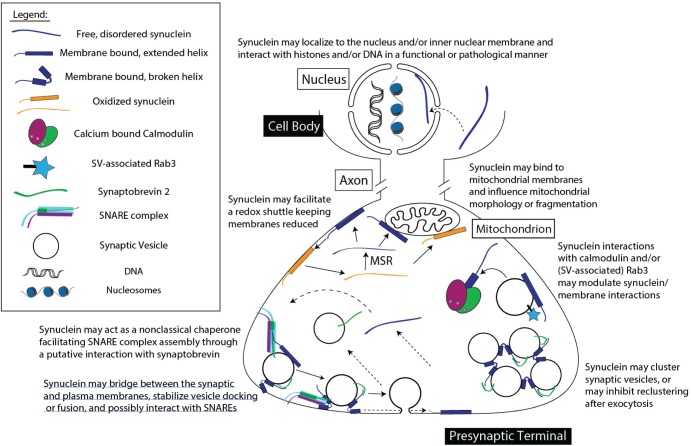
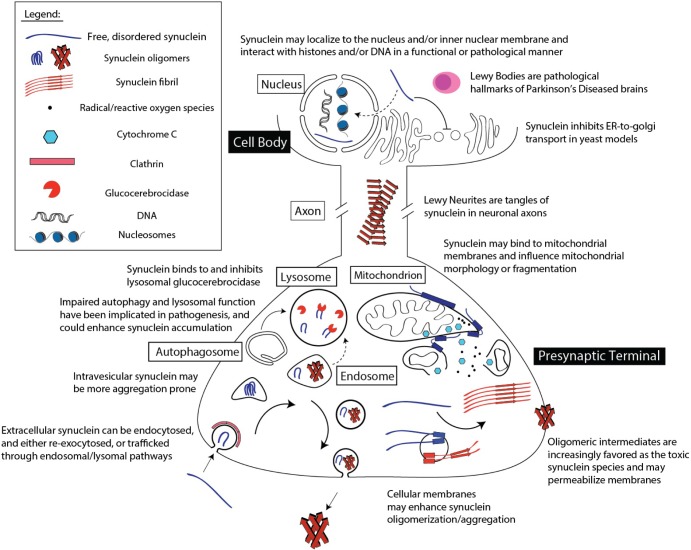
Alpha-synuclein is a small neuronal protein that is closely associated with the etiology of Parkinson's disease. Mutations in and alterations in expression levels of alpha-synuclein cause autosomal dominant early onset heredity forms of Parkinson's disease, and sporadic Parkinson's disease is defined in part by the presence of Lewy bodies and Lewy neurites that are composed primarily of alpha-synuclein deposited in an aggregated amyloid fibril state. The normal function of alpha-synuclein is poorly understood, and the precise mechanisms by which it leads to toxicity and cell death are also unclear. Although alpha-synuclein is a highly soluble, cytoplasmic protein, it binds to a variety of cellular membranes of different properties and compositions. These interactions are considered critical for at least some normal functions of alpha-synuclein, and may well play critical roles in both the aggregation of the protein and its mechanisms of toxicity. Here we review the known features of alpha-synuclein membrane interactions in the context of both the putative functions of the protein and of its pathological roles in disease.
α-突触核蛋白是一种与帕金森病病因密切相关的小神经元蛋白。α-突触核蛋白的突变和表达水平改变会导致常染色体显性早发性遗传性帕金森病,散发性帕金森病部分是由路易小体和路易神经突的存在所定义的,这些主要由以聚集淀粉样纤维状态沉积的α-突触核蛋白组成。α-突触核蛋白的正常功能了解甚少,其导致毒性和细胞死亡的确切机制也不清楚。尽管α-突触核蛋白是一种高度可溶的细胞质蛋白,但它能与多种性质和组成不同的细胞膜结合。这些相互作用被认为对α-突触核蛋白的至少一些正常功能至关重要,并且很可能在该蛋白的聚集及其毒性机制中都发挥关键作用。在此,我们在该蛋白的假定功能及其在疾病中的病理作用的背景下,综述α-突触核蛋白膜相互作用的已知特征。