Li Zhi, Hao Youjin, Wang Linling, Xiang Heng, Zhou Zeyang
College of Life Sciences, Chongqing Normal University, Chongqing, China.
College of Animal Science and Technology, Southwest University, Chongqing, China.
PLoS One. 2014 Dec 30;9(12):e115890. doi: 10.1371/journal.pone.0115890. eCollection 2014.
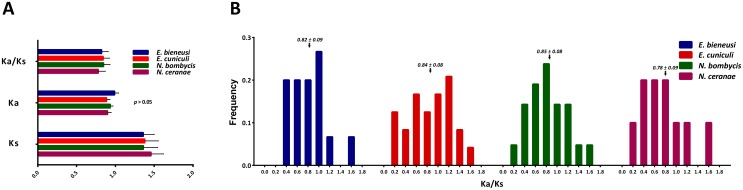
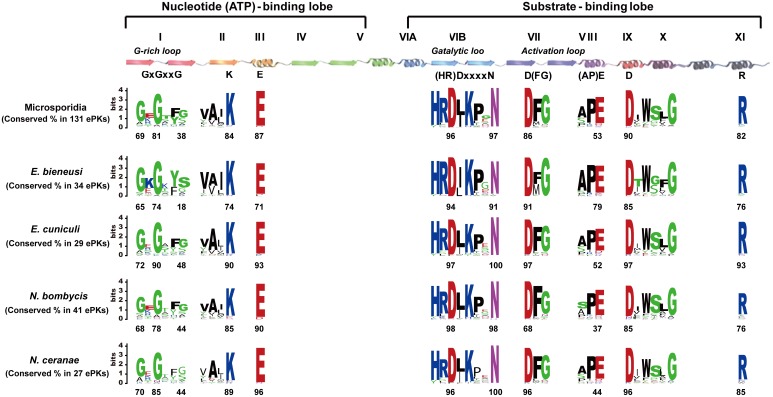
Microsporidia have attracted considerable attention because they infect a wide range of hosts, from invertebrates to vertebrates, and cause serious human diseases and major economic losses in the livestock industry. There are no prospective drugs to counteract this pathogen. Eukaryotic protein kinases (ePKs) play a central role in regulating many essential cellular processes and are therefore potential drug targets. In this study, a comprehensive summary and comparative analysis of the protein kinases in four microsporidia—Enterocytozoon bieneusi, Encephalitozoon cuniculi, Nosema bombycis and Nosema ceranae—was performed. The results show that there are 34 ePKs and 4 atypical protein kinases (aPKs) in E. bieneusi, 29 ePKs and 6 aPKs in E. cuniculi, 41 ePKs and 5 aPKs in N. bombycis, and 27 ePKs and 4 aPKs in N. ceranae. These data support the previous conclusion that the microsporidian kinome is the smallest eukaryotic kinome. Microsporidian kinomes contain only serine-threonine kinases and do not contain receptor-like and tyrosine kinases. Many of the kinases related to nutrient and energy signaling and the stress response have been lost in microsporidian kinomes. However, cell cycle-, development- and growth-related kinases, which are important to parasites, are well conserved. This reduction of the microsporidian kinome is in good agreement with genome compaction, but kinome density is negatively correlated with proteome size. Furthermore, the protein kinases in each microsporidian genome are under strong purifying selection pressure. No remarkable differences in kinase family classification, domain features, gain and/or loss, and selective pressure were observed in these four species. Although microsporidia adapt to different host types, the coevolution of microsporidia and their hosts was not clearly reflected in the protein kinases. Overall, this study enriches and updates the microsporidian protein kinase database and may provide valuable information and candidate targets for the design of treatments for pathogenic diseases.
微孢子虫因其感染从无脊椎动物到脊椎动物的广泛宿主,并导致严重的人类疾病和畜牧业的重大经济损失而备受关注。目前尚无对抗这种病原体的前瞻性药物。真核蛋白激酶(ePKs)在调节许多基本细胞过程中起核心作用,因此是潜在的药物靶点。在本研究中,对四种微孢子虫——微小隐孢子虫(Enterocytozoon bieneusi)、兔脑炎微孢子虫(Encephalitozoon cuniculi)、家蚕微孢子虫(Nosema bombycis)和中华蜜蜂微孢子虫(Nosema ceranae)中的蛋白激酶进行了全面总结和比较分析。结果表明,微小隐孢子虫中有34种ePKs和4种非典型蛋白激酶(aPKs),兔脑炎微孢子虫中有29种ePKs和6种aPKs,家蚕微孢子虫中有41种ePKs和5种aPKs,中华蜜蜂微孢子虫中有27种ePKs和4种aPKs。这些数据支持了先前的结论,即微孢子虫的激酶组是最小的真核激酶组。微孢子虫的激酶组仅包含丝氨酸 - 苏氨酸激酶,不包含受体样激酶和酪氨酸激酶。许多与营养和能量信号传导以及应激反应相关的激酶在微孢子虫的激酶组中已经丢失。然而,对寄生虫很重要的细胞周期、发育和生长相关激酶却保存得很好。微孢子虫激酶组的这种减少与基因组压缩非常吻合,但激酶组密度与蛋白质组大小呈负相关。此外,每个微孢子虫基因组中的蛋白激酶都受到强烈的纯化选择压力。在这四个物种中,未观察到激酶家族分类、结构域特征、获得和/或丢失以及选择压力方面的显著差异。尽管微孢子虫适应不同的宿主类型,但微孢子虫与其宿主的共同进化在蛋白激酶中并未得到明显体现。总体而言,本研究丰富和更新了微孢子虫蛋白激酶数据库,并可能为致病性疾病治疗方案的设计提供有价值的信息和候选靶点。