
Three-month treatment response and exacerbation in chronic obstructive pulmonary disease.
作者信息
Lee Jung Su, Rhee Chin Kook, Yoo Kwang Ha, Lee Ji-Hyun, Yoon Ho Il, Kim Tae-Hyung, Kim Woo Jin, Lee JinHwa, Lim Seong Yong, Park Tai Sun, Lee Jae Seung, Lee Sei Won, Lee Sang-Do, Oh Yeon-Mok
机构信息
Department of Pulmonary and Critical Care Medicine, and Clinical Research Center for Chronic Obstructive Airway Diseases, Asan Medical Center, University of Ulsan College of Medicine, Seoul, Korea.
Department of Internal Medicine, Seoul St. Mary's Hospital, The Catholic University of Korea, Seoul, Korea.
出版信息
J Korean Med Sci. 2015 Jan;30(1):54-9. doi: 10.3346/jkms.2015.30.1.54. Epub 2014 Dec 23.
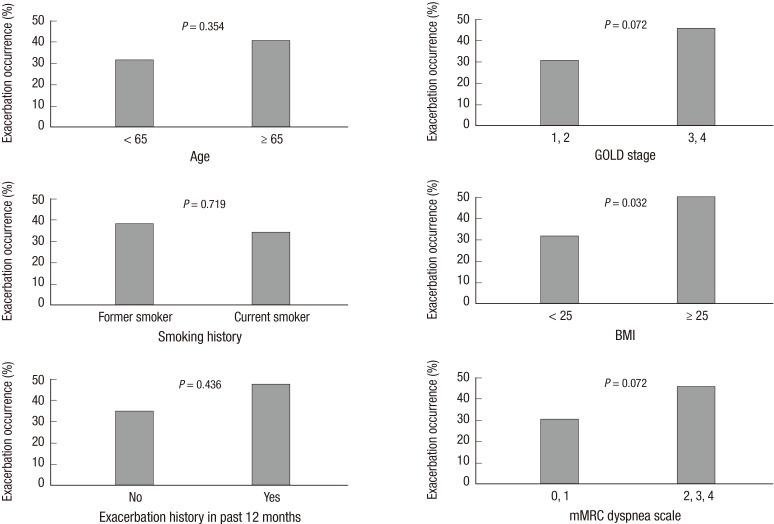
The aim of this study was to investigate relationships between acute exacerbation and Forced Expiratory Volume 1 second (FEV1) improvement after treatment with combined long-acting beta-agonist (LABA) and inhaled corticosteroid (ICS) in patients with chronic obstructive pulmonary disease (COPD). A total of 137 COPD patients were classified as responders or nonresponders according to FEV1 improvement after 3 months of LABA/ICS treatment in fourteen referral hospitals in Korea. Exacerbation occurrence in these two subgroups was compared over a period of 1 yr. Eighty of the 137 COPD patients (58.4%) were classified as responders and 57 (41.6%) as nonresponders. Acute exacerbations occurred in 25 patients (31.3%) in the responder group and in 26 patients (45.6%) in the nonresponder group (P=0.086). FEV1 improvement after LABA/ICS treatment was a significant prognostic factor for fewer acute exacerbations in a multivariate Cox proportional hazard model adjusted for age, sex, FEV1, smoking history, 6 min walk distance, body mass index, exacerbation history in the previous year, and dyspnea scale.Three-month treatment response to LABA/ICS might be a prognostic factor for the occurrence of acute exacerbation in COPD patients.

 Zotero 插件