Rieder Leila E, Savva Yiannis A, Reyna Matthew A, Chang Yao-Jen, Dorsky Jacquelyn S, Rezaei Ali, Reenan Robert A
BMC Biol. 2015 Jan 3;13:1. doi: 10.1186/s12915-014-0111-3.
Adenosine-to-inosine RNA editing is a highly conserved process that post-transcriptionally modifies mRNA, generating proteomic diversity, particularly within the nervous system of metazoans. Transcripts encoding proteins involved in neurotransmission predominate as targets of such modifications. Previous reports suggest that RNA editing is responsive to environmental inputs in the form of temperature alterations. However, the molecular determinants underlying temperature-dependent RNA editing responses are not well understood.
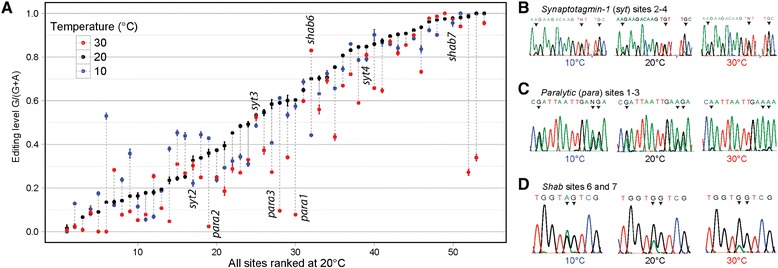
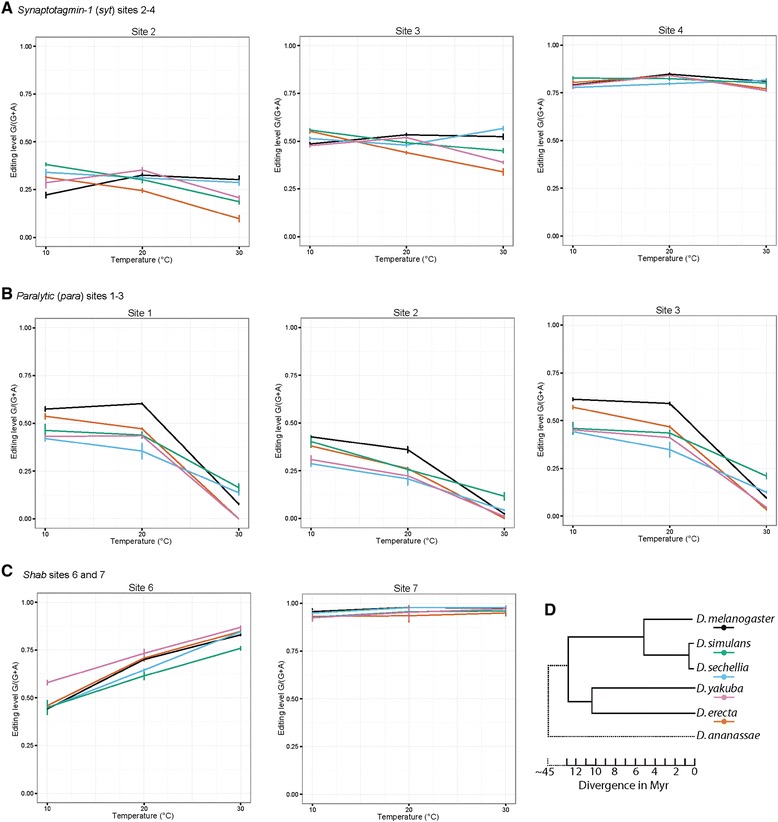
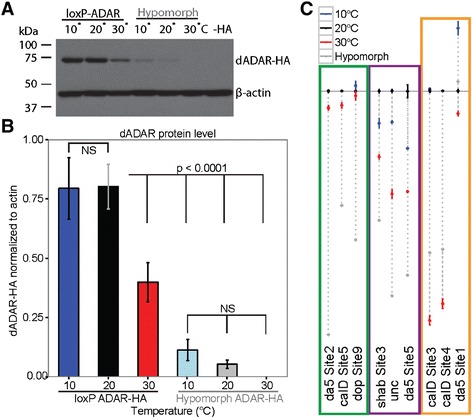
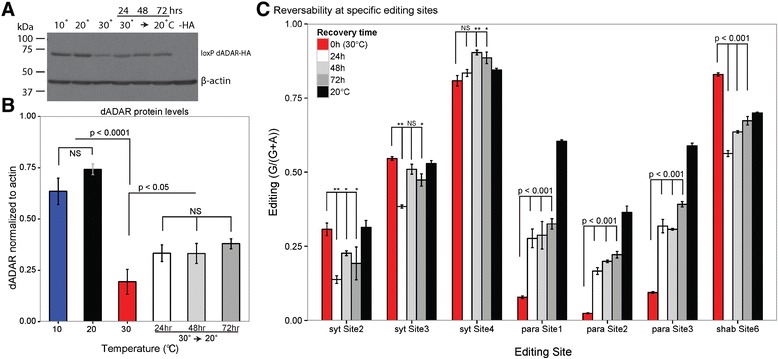
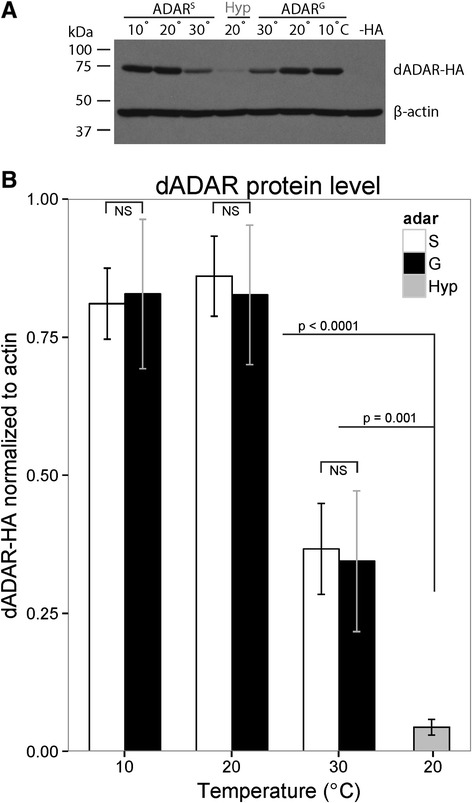
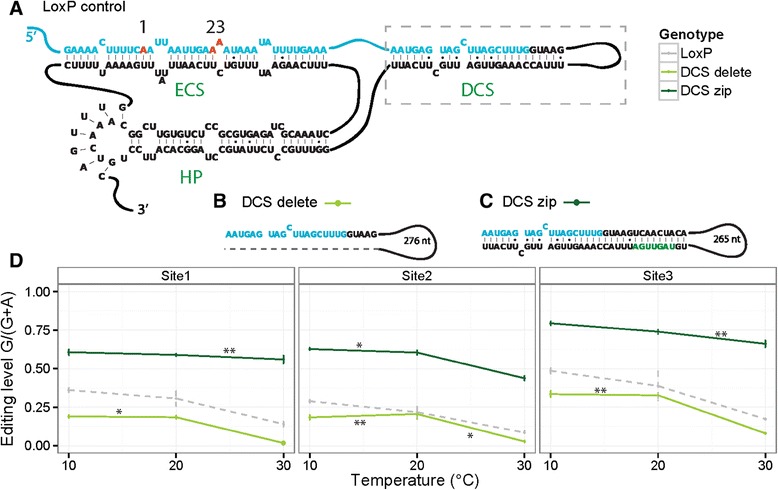
Using the poikilotherm Drosophila, we show that acute temperature alterations within a normal physiological range result in substantial changes in RNA editing levels. Our examination of particular sites reveals diversity in the patterns with which editing responds to temperature, and these patterns are conserved across five species of Drosophilidae representing over 10 million years of divergence. In addition, we show that expression of the editing enzyme, ADAR (adenosine deaminase acting on RNA), is dramatically decreased at elevated temperatures, partially, but not fully, explaining some target responses to temperature. Interestingly, this reduction in editing enzyme levels at elevated temperature is only partially reversed by a return to lower temperatures. Lastly, we show that engineered structural variants of the most temperature-sensitive editing site, in a sodium channel transcript, perturb thermal responsiveness in RNA editing profile for a particular RNA structure.
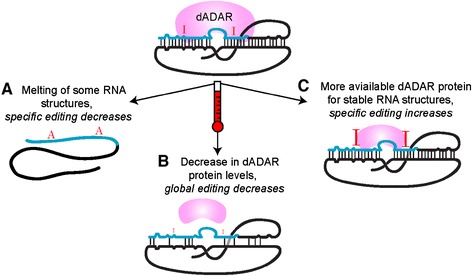
Our results suggest that the RNA editing process responds to temperature alterations via two distinct molecular mechanisms: through intrinsic thermo-sensitivity of the RNA structures that direct editing, and due to temperature sensitive expression or stability of the RNA editing enzyme. Environmental cues, in this case temperature, rapidly reprogram the Drosophila transcriptome through RNA editing, presumably resulting in altered proteomic ratios of edited and unedited proteins.
腺苷到肌苷的RNA编辑是一个高度保守的过程,它在转录后修饰mRNA,产生蛋白质组多样性,尤其是在后生动物的神经系统中。编码参与神经传递的蛋白质的转录本是此类修饰的主要靶点。先前的报告表明,RNA编辑以温度变化的形式对环境输入做出反应。然而,温度依赖性RNA编辑反应背后的分子决定因素尚不清楚。
使用变温动物果蝇,我们表明正常生理范围内的急性温度变化会导致RNA编辑水平的显著变化。我们对特定位点的研究揭示了编辑对温度反应模式的多样性,并且这些模式在代表超过1000万年分化的五种果蝇科物种中是保守的。此外,我们表明,编辑酶ADAR(作用于RNA的腺苷脱氨酶)的表达在高温下显著降低,部分但不完全解释了一些靶点对温度的反应。有趣的是,高温下编辑酶水平的这种降低在恢复到较低温度时仅部分逆转。最后,我们表明,在钠通道转录本中最温度敏感的编辑位点的工程结构变体扰乱了特定RNA结构的RNA编辑谱中的热反应性。
我们的结果表明,RNA编辑过程通过两种不同的分子机制对温度变化做出反应:通过指导编辑的RNA结构的内在热敏感性,以及由于RNA编辑酶的温度敏感性表达或稳定性。在这种情况下,环境线索即温度,通过RNA编辑迅速重新编程果蝇转录组,可能导致编辑和未编辑蛋白质的蛋白质组比例发生变化。