Banwell Helen A, Mackintosh Shylie, Thewlis Dominic, Landorf Karl B
International Centre for Allied Health Evidence (iCAHE), School of Health Sciences, University of South Australia, Adelaide, South Australia 5001 Australia.
International Centre for Allied Health Evidence (iCAHE), School of Health Sciences, University of South Australia, Adelaide, South Australia 5001 Australia ; Sansom Institute for Health Research, University of South Australia, Adelaide, South Australia 5001 Australia.
J Foot Ankle Res. 2014 Nov 25;7(1):49. doi: 10.1186/s13047-014-0049-2. eCollection 2014.
Foot orthoses are commonly used for symptomatic flexible pes planus in adults. However, there are no clinical guidelines for the prescription of customised foot orthoses that are specific to this population. The aim of this study was to investigate prescription habits of Australian podiatrists for customised foot orthoses for symptomatic flexible pes planus in adults and to develop consensus-based practice recommendations for the prescription of these foot orthoses.
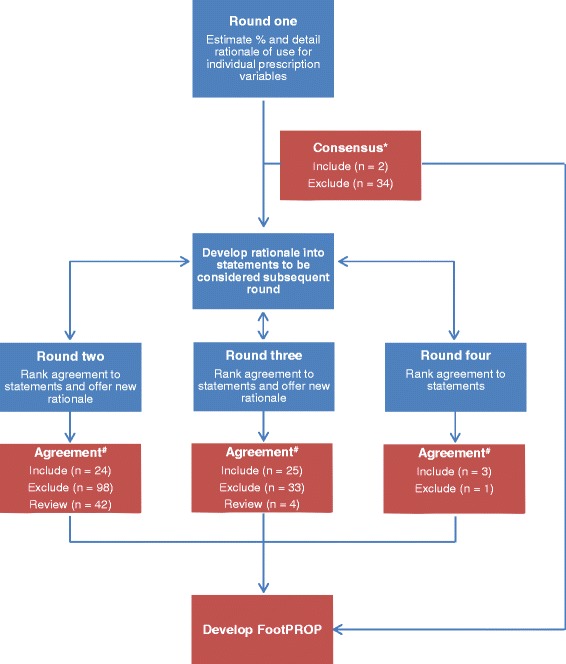
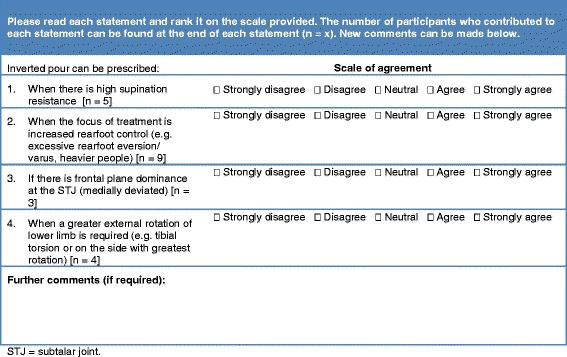
A four round Delphi survey was undertaken with 24 podiatric experts to establish current use and rationale for individual prescription variables of customised foot orthoses for symptomatic flexible pes planus in adults. Round one determined prescription use (consensus) and rounds two, three and four determined the rationale for use (agreement) of prescription variables across the rearfoot, midfoot, forefoot, as well as accommodation and materials used. For consensus and agreement to be accepted, 70% of the respondents were required to use or agree on the rationale for use of individual prescription variables.
Consensus was reached in round one for two variables, choice of shell material (polyolefin) and when to prescribe a forefoot post balanced to perpendicular. In rounds two, three and four, agreement was reached for 52 statements related to the rationale for use of individual prescription variables, including when to prescribe: an inverted cast pour [heel in an inverted position], an inverted rearfoot post, a medial heel (Kirby) skive, minimal/maximum arch fill, a medial flange, a forefoot post and common orthotic accommodations.
This study found consensus or agreement for the use of several prescription variables for customised foot orthoses for symptomatic flexible pes planus in adults. The findings were used to develop the Foot orthosis Prescription Recommendations for symptOmatic flexible Pes planus in adults (FootPROP) proforma, to guide clinicians and researchers in the prescription of customised foot orthoses for this population.
足矫形器常用于治疗成人有症状的柔韧性扁平足。然而,针对该人群定制足矫形器的处方尚无临床指南。本研究的目的是调查澳大利亚足病医生针对成人有症状的柔韧性扁平足定制足矫形器的处方习惯,并制定基于共识的这些足矫形器处方的实践建议。
对24名足病专家进行了四轮德尔菲调查,以确定成人有症状的柔韧性扁平足定制足矫形器个体处方变量的当前使用情况和依据。第一轮确定处方使用情况(共识),第二、三、四轮确定后足、中足、前足处方变量使用的依据(一致性),以及所使用的适配和材料。为使共识和一致性被接受,要求70%的受访者使用或同意个体处方变量使用的依据。
在第一轮中,对于两个变量达成了共识,即外壳材料的选择(聚烯烃)以及何时开具平衡至垂直的前足支撑。在第二、三、四轮中,就与个体处方变量使用依据相关的52条陈述达成了一致,包括何时开具:内翻石膏灌注[足跟处于内翻位置]、内翻后足支撑、内侧足跟(柯比)削薄、最小/最大足弓填充、内侧凸缘、前足支撑以及常见的矫形适配。
本研究发现了针对成人有症状的柔韧性扁平足定制足矫形器使用几个处方变量的共识或一致意见。这些结果被用于制定成人有症状的柔韧性扁平足足矫形器处方建议(FootPROP)表格,以指导临床医生和研究人员为该人群开具定制足矫形器。