Mo Chu-Fan, Wu Fang-Chun, Tai Kang-Yu, Chang Wei-Chun, Chang Kai-Wei, Kuo Hung-Chih, Ho Hong-Nerng, Chen Hsin-Fu, Lin Shau-Ping
Institute of Biotechnology, National Taiwan University, Taipei, 106, Taiwan.
Department of Obstetrics & Gynecology, College of Medicine and the Hospital, National Taiwan University Hospital, Taipei, 100, Taiwan.
Stem Cell Res Ther. 2015 Jan 5;6(1):1. doi: 10.1186/scrt535.
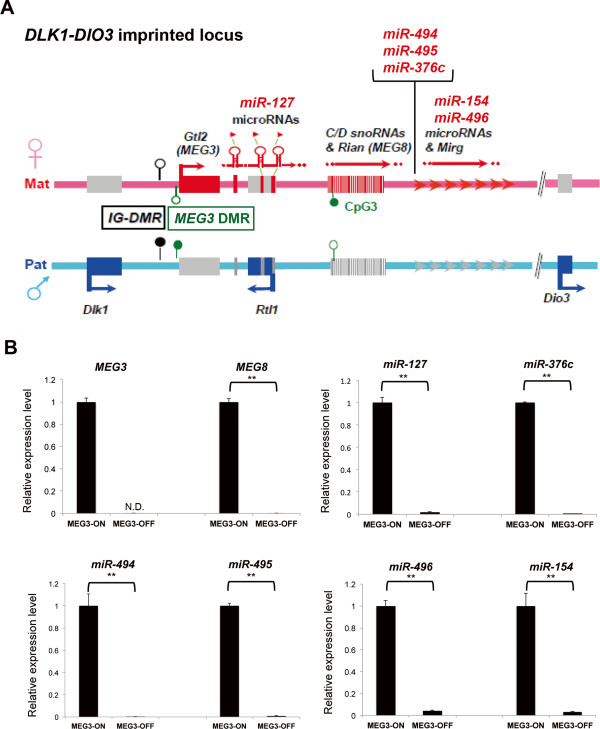
Pluripotent stem cells are increasingly used to build therapeutic models, including the transplantation of neural progenitors derived from human embryonic stem cells (hESCs). Recently, long non-coding RNAs (lncRNAs), including delta-like homolog 1 gene and the type III iodothyronine deiodinase gene (DLK1-DIO3) imprinted locus-derived maternally expressed gene 3 (MEG3), were found to be expressed during neural development. The deregulation of these lncRNAs is associated with various neurological diseases. The imprinted locus DLK1-DIO3 encodes abundant non-coding RNAs (ncRNAs) that are regulated by differential methylation of the locus. We aim to study the correlation between the DLK1-DIO3-derived ncRNAs and the capacity of hESCs to differentiate into neural lineages.
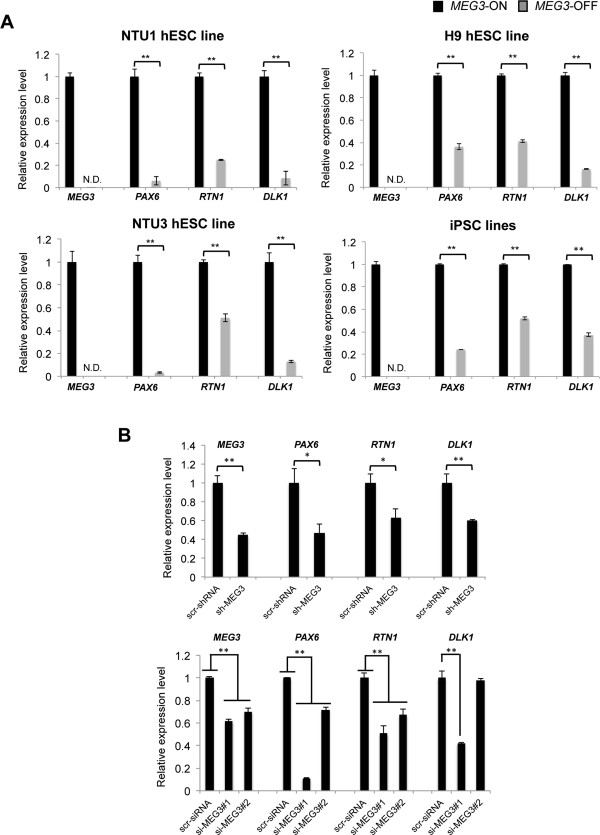
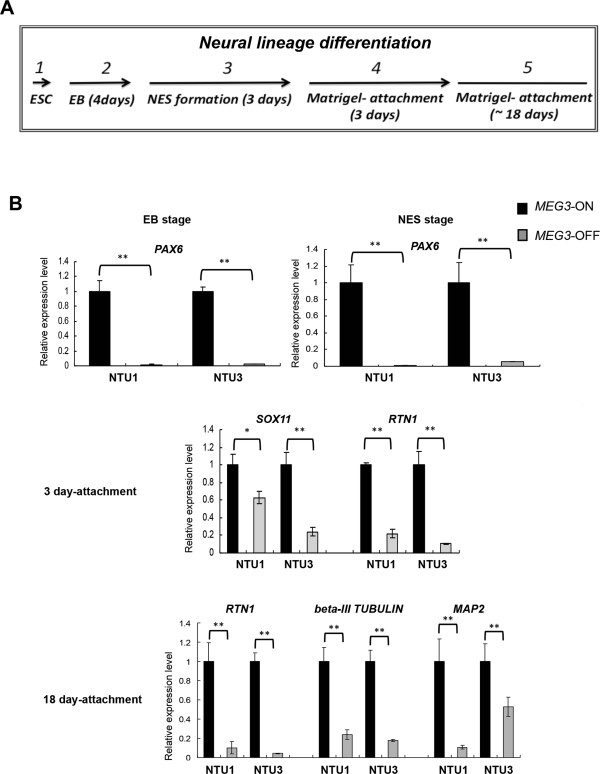
We classified hESC sublines into MEG3-ON and MEG3-OFF based on the expression levels of MEG3 and its downstream microRNAs as detected by quantitative reverse transcription-polymerase chain reaction (qRT-PCR). A cDNA microarray was used to analyze the gene expression profiles of hESCs. To investigate the capacity of neural differentiation in MEG3-ON and MEG3-OFF hESCs, we performed neural lineage differentiation followed by neural lineage marker expression and neurite formation analyses via qRT-PCR and immunocytochemistry, respectively. MEG3-knockdown via small interfering RNA (siRNA) and small hairpin RNA (shRNA) was used to investigate the potential causative effect of MEG3 in regulating neural lineage-related gene expression.
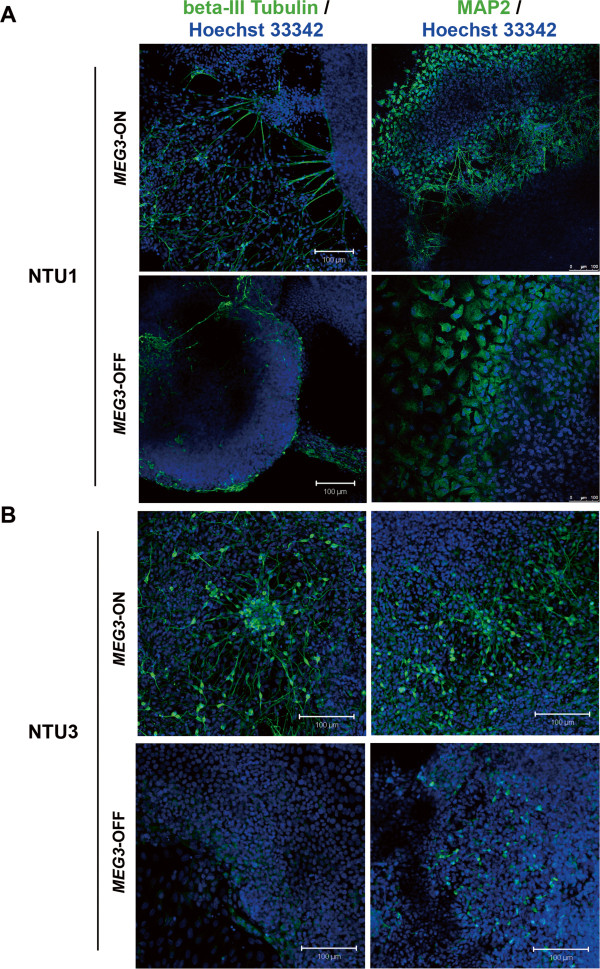
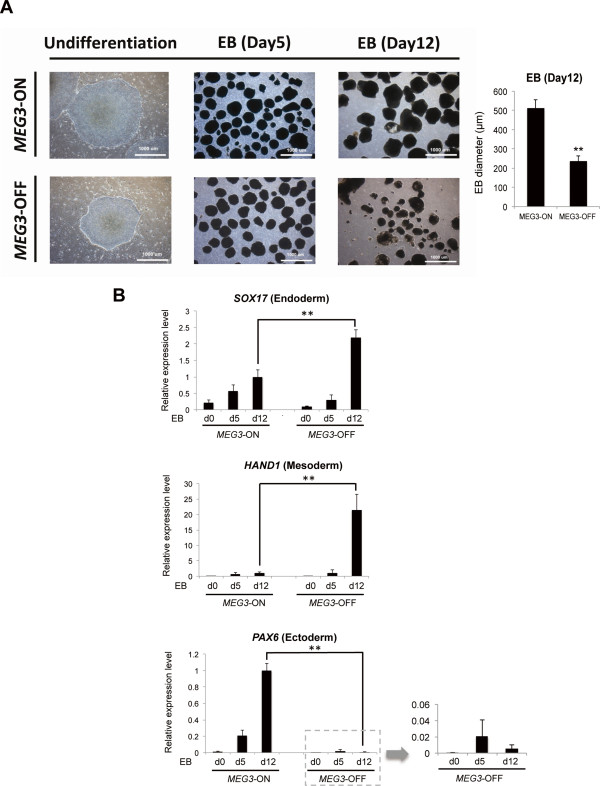
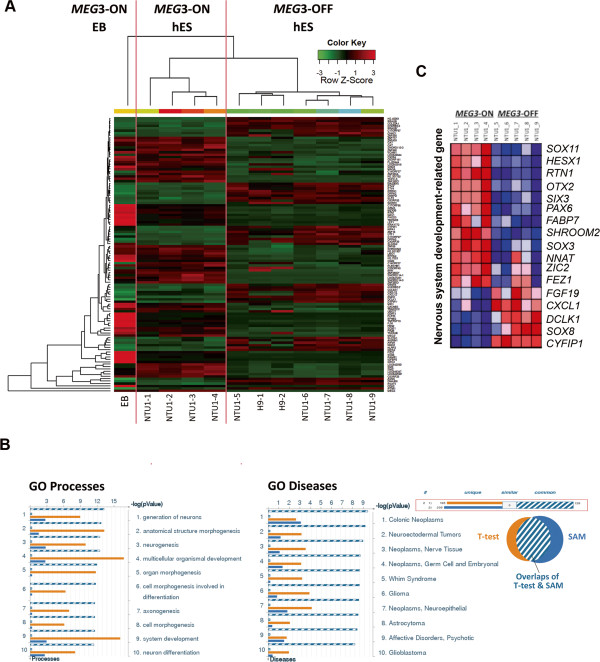
DLK1-DIO3-derived ncRNAs were repressed in MEG3-OFF hESCs compared with those in the MEG3-ON hESCs. The transcriptome profile indicated that many genes related to nervous system development and neural-type tumors were differentially expressed in MEG3-OFF hESCs. Three independent MEG3-knockdown assays using different siRNA and shRNA constructs consistently resulted in downregulation of some neural lineage genes. Lower expression levels of stage-specific neural lineage markers and reduced neurite formation were observed in neural lineage-like cells derived from MEG3-OFF-associated hESCs compared with those in the MEG3-ON groups at the same time points after differentiation.
Repression of ncRNAs derived from the DLK1-DIO3 imprinted locus is associated with reduced neural lineage differentiation potential in hESCs.
多能干细胞越来越多地被用于构建治疗模型,包括移植源自人类胚胎干细胞(hESC)的神经祖细胞。最近,发现包括δ样同源物1基因和III型碘甲状腺原氨酸脱碘酶基因(DLK1-DIO3)印记位点衍生的母源表达基因3(MEG3)在内的长链非编码RNA(lncRNA)在神经发育过程中表达。这些lncRNA的失调与多种神经系统疾病有关。印记位点DLK1-DIO3编码大量受该位点差异甲基化调控的非编码RNA(ncRNA)。我们旨在研究DLK1-DIO3衍生的ncRNA与hESC分化为神经谱系能力之间的相关性。
我们根据通过定量逆转录-聚合酶链反应(qRT-PCR)检测到的MEG3及其下游微小RNA的表达水平,将hESC亚系分为MEG3-ON和MEG3-OFF。使用cDNA微阵列分析hESC的基因表达谱。为了研究MEG3-ON和MEG3-OFF hESC的神经分化能力,我们分别通过qRT-PCR和免疫细胞化学进行神经谱系分化,随后进行神经谱系标记物表达和神经突形成分析。通过小干扰RNA(siRNA)和小发夹RNA(shRNA)敲低MEG3,以研究MEG3在调节神经谱系相关基因表达中的潜在因果作用。
与MEG3-ON hESC相比,MEG3-OFF hESC中DLK1-DIO3衍生的ncRNA受到抑制。转录组谱表明,许多与神经系统发育和神经型肿瘤相关的基因在MEG3-OFF hESC中差异表达。使用不同的siRNA和shRNA构建体进行的三次独立MEG3敲低试验一致导致一些神经谱系基因的下调。在分化后相同时间点,与MEG3-ON组相比,源自MEG3-OFF相关hESC的神经谱系样细胞中阶段特异性神经谱系标记物的表达水平较低,神经突形成减少。
DLK1-DIO3印记位点衍生的ncRNA的抑制与hESC中神经谱系分化潜能降低有关。