Rispens Sietse M, van Schooten Kimberley S, Pijnappels Mirjam, Daffertshofer Andreas, Beek Peter J, van Dieën Jaap H
MOVE Research Institute Amsterdam, Faculty of Human Movement Sciences, VU University Amsterdam, Amsterdam, Netherlands.
JMIR Res Protoc. 2015 Jan 5;4(1):e4. doi: 10.2196/resprot.3931.
Gait characteristics estimated from daily-life trunk accelerations reflect gait quality and are associated with fall incidence in older adults. While associations are based on median values of these gait characteristics, their extreme values may reflect either high-risk situations or steady-state gait and may thus be more informative in relation to fall risk.
The objective of this study was to improve fall-risk prediction models by examining whether the use of extreme values strengthens the associations with falls.
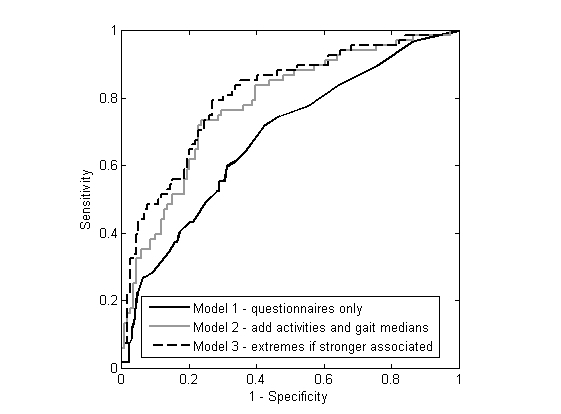
Trunk acceleration data (Dynaport MoveMonitor) were collected from 202 older adults over a full week. From all walking episodes, we estimated the median and, as reliable estimates of the extremes, the 10th and 90th percentiles of gait characteristics, all over 10-second epochs. In addition, the amount of daily activities was derived from the acceleration data, and participants completed fall-risk questionnaires. Participants were classified as fallers based on one or more falls during 6 months of follow-up. Univariate analyses were performed to investigate whether associations with falls were stronger for the extremes than for the medians. Subsequently, three fall-risk models were compared: (1) using questionnaire data only, (2) adding the amount of activities and medians of gait characteristics, and (3) using extreme values instead of medians in the case of stronger univariate associations of the extremes.
Stronger associations were found for the extreme characteristics reflecting high regularity, low frequency variability, and low local instability in anterior-posterior direction, for high symmetry in all directions and for low entropy in anterior-posterior and vertical directions. The questionnaire-only model improved significantly by adding activities and gait characteristics' medians. Replacing medians by extremes with stronger associations did improve the fall prediction model, but not significantly.
Associations were stronger for extreme values, indicating "high gait quality" situations (ie, 10th and 90th percentiles in case of positive and negative associations, respectively) and not for "low gait quality" situations. This suggests that gait characteristics during optimal performance gait provide more information about the risk of falling than high-risk situations. However, their added value over medians in prediction is limited.
从日常生活中的躯干加速度估计出的步态特征反映了步态质量,并且与老年人的跌倒发生率相关。虽然这些关联是基于这些步态特征的中位数,但它们的极值可能反映高风险情况或稳态步态,因此在跌倒风险方面可能更具信息价值。
本研究的目的是通过检查使用极值是否能加强与跌倒的关联来改进跌倒风险预测模型。
在整整一周的时间里,从202名老年人中收集了躯干加速度数据(Dynaport MoveMonitor)。从所有步行片段中,我们估计了步态特征的中位数,以及作为极值可靠估计的第10和第90百分位数,所有这些都是在10秒的时间段内进行的。此外,从加速度数据中得出每日活动量,参与者完成了跌倒风险问卷。根据随访6个月期间的一次或多次跌倒情况,将参与者分类为跌倒者。进行单变量分析以调查与跌倒的关联对于极值是否比中位数更强。随后,比较了三种跌倒风险模型:(1)仅使用问卷数据,(2)添加活动量和步态特征的中位数,以及(3)在极值的单变量关联更强的情况下使用极值代替中位数。
对于反映高规律性、低频率变异性和前后方向低局部不稳定性、所有方向高对称性以及前后和垂直方向低熵的极值特征,发现了更强的关联。仅问卷模型通过添加活动量和步态特征的中位数有显著改善。用关联更强的极值代替中位数确实改进了跌倒预测模型,但改进不显著。
极值的关联更强,表明是“高步态质量”情况(即分别在正相关和负相关情况下的第10和第90百分位数),而不是“低步态质量”情况。这表明最佳表现步态期间的步态特征比高风险情况提供了更多关于跌倒风险的信息。然而,它们在预测中相对于中位数的附加值是有限的。