Cripton Peter A, Shen Hui, Brubacher Jeff R, Chipman Mary, Friedman Steven M, Harris M Anne, Winters Meghan, Reynolds Conor C O, Cusimano Michael D, Babul Shelina, Teschke Kay
Department of Mechanical Engineering, University of British Columbia, Vancouver, Canada.
School of Population and Public Health, University of British Columbia, Vancouver, Canada.
BMJ Open. 2015 Jan 5;5(1):e006654. doi: 10.1136/bmjopen-2014-006654.
To examine the relationship between cycling injury severity and personal, trip, route and crash characteristics.
Data from a previous study of injury risk, conducted in Toronto and Vancouver, Canada, were used to classify injury severity using four metrics: (1) did not continue trip by bike; (2) transported to hospital by ambulance; (3) admitted to hospital; and (4) Canadian Triage and Acuity Scale (CTAS). Multiple logistic regression was used to examine associations with personal, trip, route and crash characteristics.
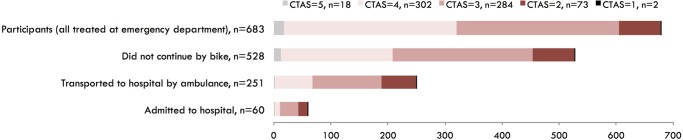
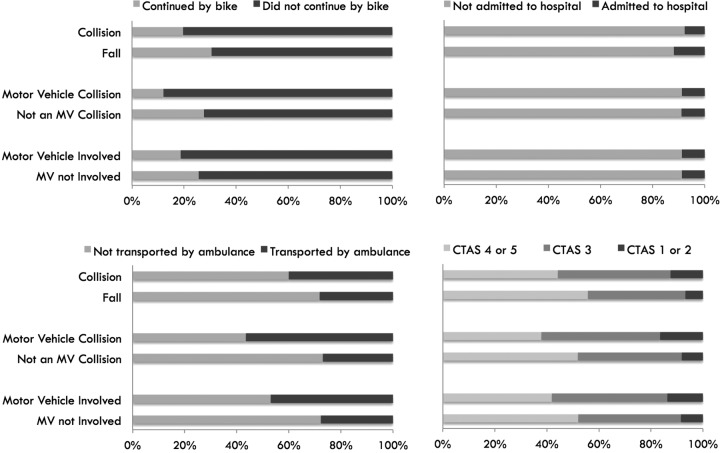
Of 683 adults injured while cycling, 528 did not continue their trip by bike, 251 were transported by ambulance and 60 were admitted to hospital for further treatment. Treatment urgencies included 75 as CTAS=1 or 2 (most medically urgent), 284 as CTAS=3, and 320 as CTAS=4 or 5 (least medically urgent). Older age and collision with a motor vehicle were consistently associated with increased severity in all four metrics and statistically significant in three each (both variables with ambulance transport and CTAS; age with hospital admission; and motor vehicle collision with did not continue by bike). Other factors were consistently associated with more severe injuries, but statistically significant in one metric each: downhill grades; higher motor vehicle speeds; sidewalks (these significant for ambulance transport); multiuse paths and local streets (both significant for hospital admission).
In two of Canada's largest cities, about one-third of the bicycle crashes were collisions with motor vehicles and the resulting injuries were more severe than in other crash circumstances, underscoring the importance of separating cyclists from motor vehicle traffic. Our results also suggest that bicycling injury severity and injury risk would be reduced on facilities that minimise slopes, have lower vehicle speeds, and that are designed for bicycling rather than shared with pedestrians.
研究自行车骑行损伤严重程度与个人、出行、路线及碰撞特征之间的关系。
利用此前在加拿大多伦多和温哥华开展的一项损伤风险研究的数据,采用四种指标对损伤严重程度进行分类:(1) 未继续骑行;(2) 由救护车送往医院;(3) 入院治疗;(4) 加拿大分诊及 acuity 量表 (CTAS)。采用多元逻辑回归分析与个人、出行、路线及碰撞特征的关联。
在 683 名骑行时受伤的成年人中,528 人未继续骑行,251 人由救护车运送,60 人入院接受进一步治疗。治疗紧急程度包括 CTAS = 1 或 2(医学上最紧急)的 75 人、CTAS = 3 的 284 人以及 CTAS = 4 或 5(医学上最不紧急)的 320 人。年龄较大以及与机动车碰撞在所有四种指标中均始终与损伤严重程度增加相关,在其中三种指标中具有统计学意义(这两个变量与救护车运送和 CTAS 相关;年龄与入院相关;机动车碰撞与未继续骑行相关)。其他因素始终与更严重的损伤相关,但在每种指标中仅在一种指标上具有统计学意义:下坡坡度;机动车较高速度;人行道(这些对救护车运送具有显著意义);多用途道路和当地街道(两者对入院均具有显著意义)。
在加拿大两个最大的城市中,约三分之一的自行车碰撞事故是与机动车的碰撞,由此导致的损伤比其他碰撞情况更严重,这凸显了将骑自行车者与机动车交通分隔开的重要性。我们的结果还表明,如果设施能尽量减少坡度、降低车辆速度并且专为自行车设计而非与行人共享,那么自行车骑行损伤严重程度和损伤风险将会降低。