Rozhok Andrii I, Salstrom Jennifer L, DeGregori James
Department of Biochemistry and Molecular Genetics, University of Colorado School of Medicine, Aurora, CO 80045, USA.
Department of Biochemistry and Molecular Genetics, University of Colorado School of Medicine, Aurora, CO 80045, USA. Department of Pediatrics, University of Colorado School of Medicine, Aurora, CO 80045, USA.
Aging (Albany NY). 2014 Dec;6(12):1033-48. doi: 10.18632/aging.100707.
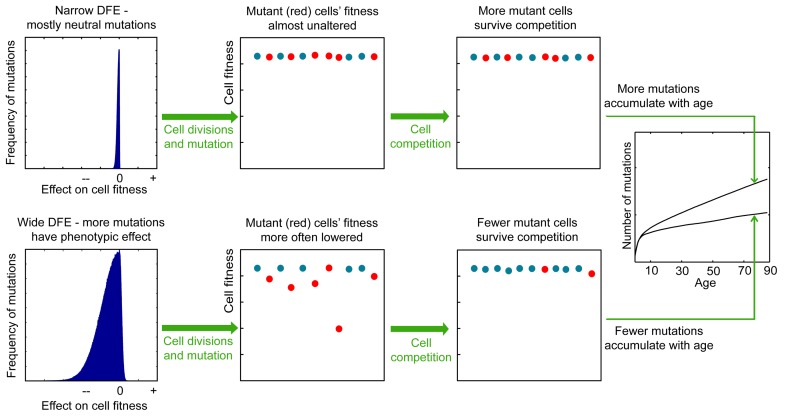
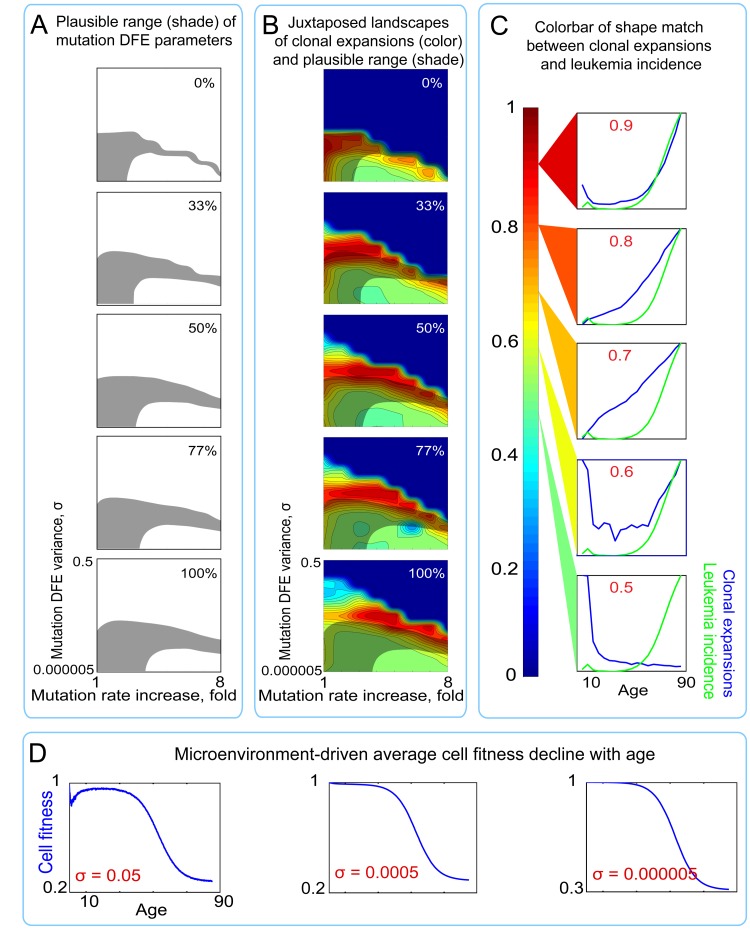
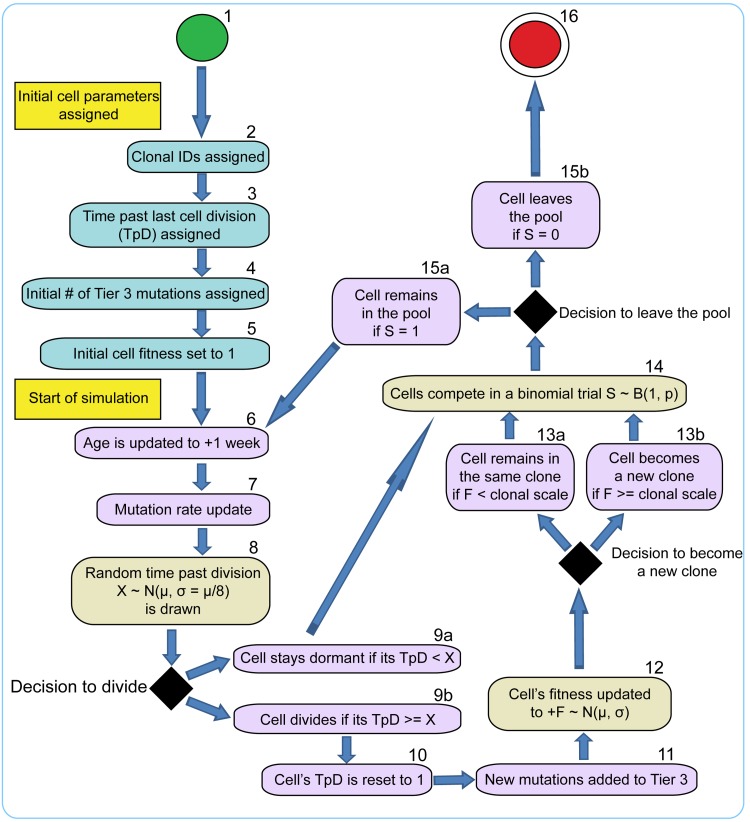
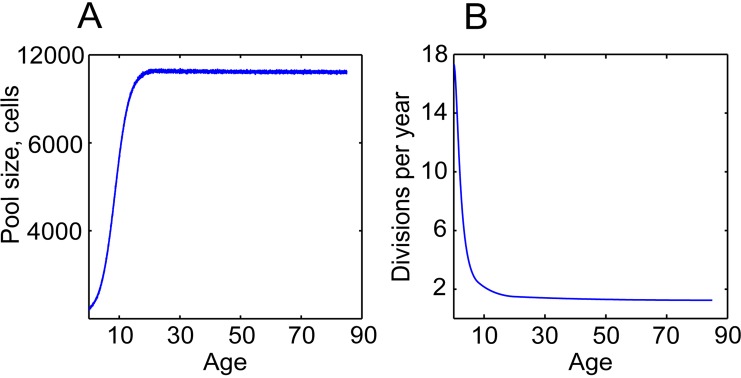
Age-dependent tissue decline and increased cancer incidence are widely accepted to be rate-limited by the accumulation of somatic mutations over time. Current models of carcinogenesis are dominated by the assumption that oncogenic mutations have defined advantageous fitness effects on recipient stem and progenitor cells, promoting and rate-limiting somatic evolution. However, this assumption is markedly discrepant with evolutionary theory, whereby fitness is a dynamic property of a phenotype imposed upon and widely modulated by environment. We computationally modeled dynamic microenvironment-dependent fitness alterations in hematopoietic stem cells (HSC) within the Sprengel-Liebig system known to govern evolution at the population level. Our model for the first time integrates real data on age-dependent dynamics of HSC division rates, pool size, and accumulation of genetic changes and demonstrates that somatic evolution is not rate-limited by the occurrence of mutations, but instead results from aged microenvironment-driven alterations in the selective/fitness value of previously accumulated genetic changes. Our results are also consistent with evolutionary models of aging and thus oppose both somatic mutation-centric paradigms of carcinogenesis and tissue functional decline. In total, we demonstrate that aging directly promotes HSC fitness decline and somatic evolution via non-cell-autonomous mechanisms.
年龄依赖性组织衰退和癌症发病率增加被广泛认为是受体细胞突变随时间积累的速率限制。当前的致癌模型主要基于这样一种假设,即致癌突变对受体干细胞和祖细胞具有明确的有利适应性效应,促进并限制体细胞进化。然而,这一假设与进化理论明显不符,根据进化理论,适应性是一种表型的动态属性,由环境施加并受到环境的广泛调节。我们在已知在种群水平上控制进化的施普伦格尔 - 利比希系统内,对造血干细胞(HSC)中依赖微环境的动态适应性变化进行了计算建模。我们的模型首次整合了关于造血干细胞分裂率、库大小和基因变化积累的年龄依赖性动态的真实数据,并表明体细胞进化不受突变发生的速率限制,而是由衰老微环境驱动的先前积累的基因变化的选择性/适应性值改变所导致。我们的结果也与衰老的进化模型一致,因此反对以体细胞突变为中心的致癌和组织功能衰退范式。总体而言,我们证明衰老通过非细胞自主机制直接促进造血干细胞适应性下降和体细胞进化。