Blaha Milan, Nemcova Lucie, Prochazka Radek
Laboratory of Developmental Biology, Institute of Animal Physiology and Genetics, Academy of Sciences of the Czech Republic, Rumburska 89, 277 21 Libechov, Czech Republic.
Reprod Biol Endocrinol. 2015 Jan 7;13:1. doi: 10.1186/1477-7827-13-1.
Recent results indicate a key role for cyclic guanosine monophosphate (cGMP) in the regulation of oocyte meiotic arrest in preovulatory mammalian follicles. The aim of our study was to determine whether the resumption of oocyte meiosis and expansion of cumulus cells in isolated pig cumulus-oocyte complexes (COCs) can be blocked by a high intracellular concentration of cGMP, and whether this effect is mediated by a cGMP-dependent inhibition of mitogen-activated protein kinase 3/1 (MAPK3/1).
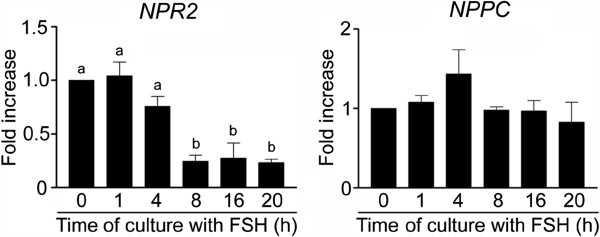
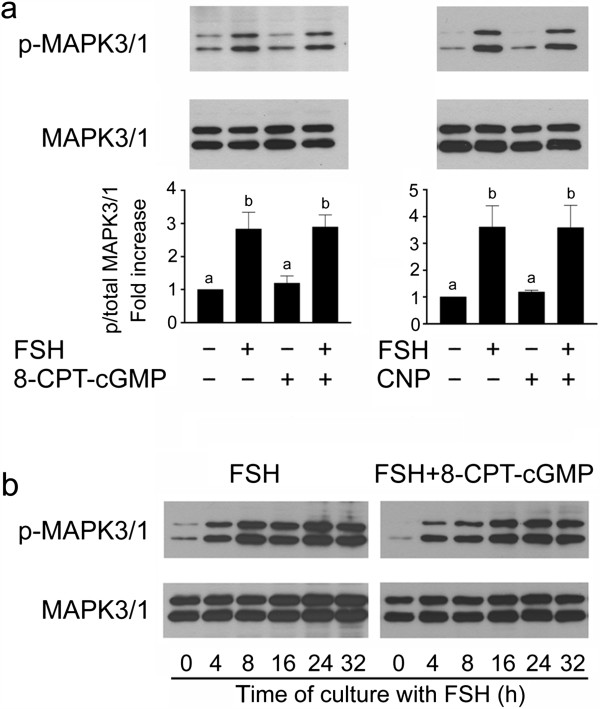
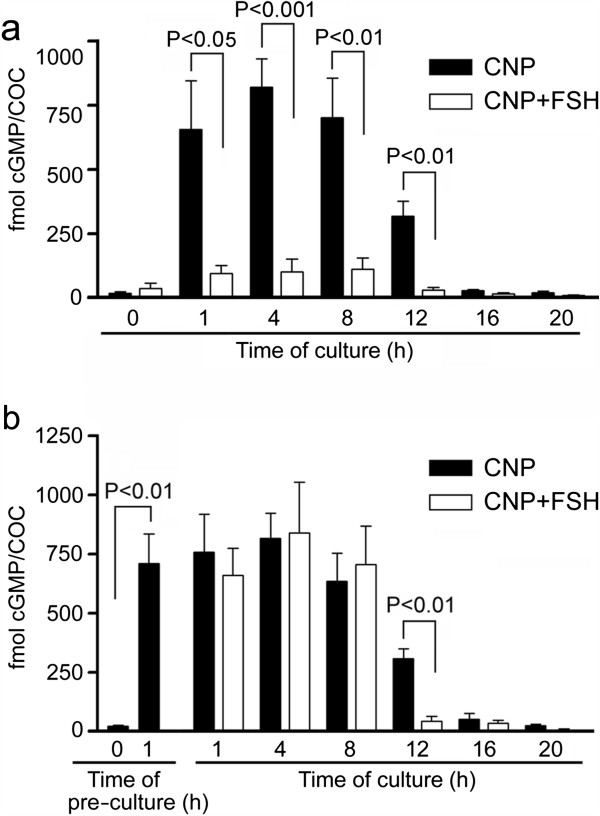
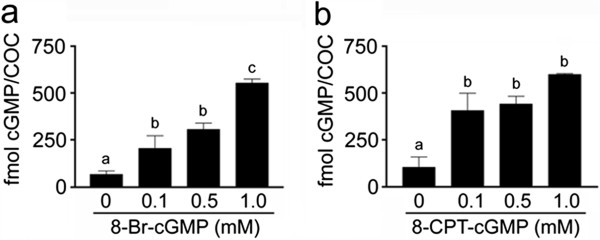
The COCs were isolated from ovaries of slaughtered gilts and cultured in vitro in M199 supplemented with 5% fetal calf serum. The expression levels of the C-type natriuretic peptide (CNP) precursor (NPPC) and its receptor (NPR2) mRNAs during the culture of COCs were determined by real-time RT-PCR. To control the intracellular concentration of cGMP in the COCs, the culture medium was further supplemented with CNP or various concentrations of synthetic cGMP analogues; the concentration of cGMP in COCs was then assessed by ELISA. The effect of the drugs on oocyte maturation was assessed after 24 and 44 h of culture by determining nuclear maturation. The expansion of cumulus cells was assessed by light microscopy and the expression of cumulus expansion-related genes by real-time RT-PCR. A possible effect of cGMP on FSH-induced activation of MAPK3/1 was assessed by immunoblotting the COC proteins with phospho-specific and total anti-Erk1/2 antibodies.
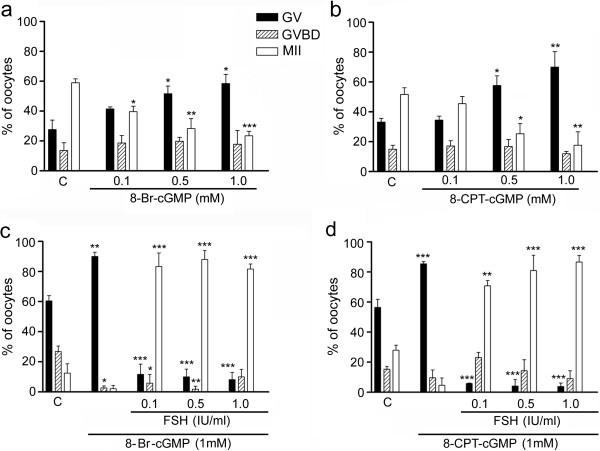
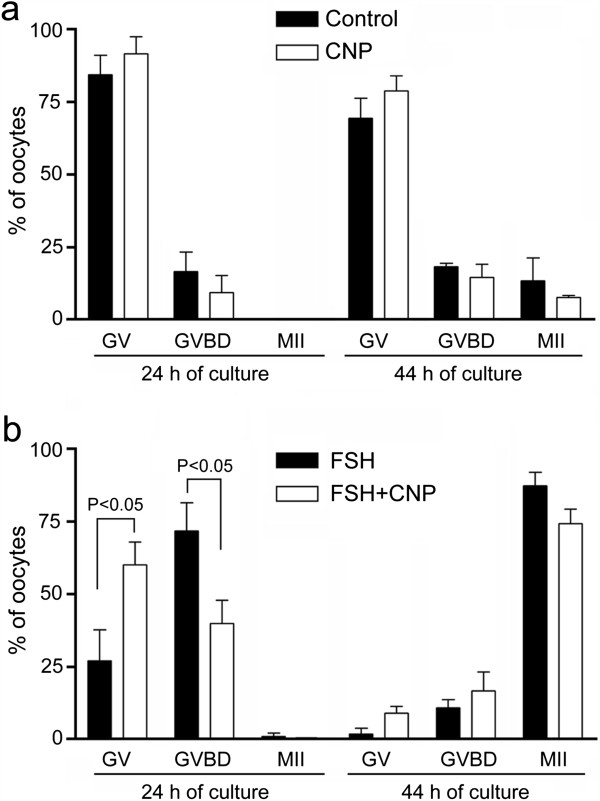
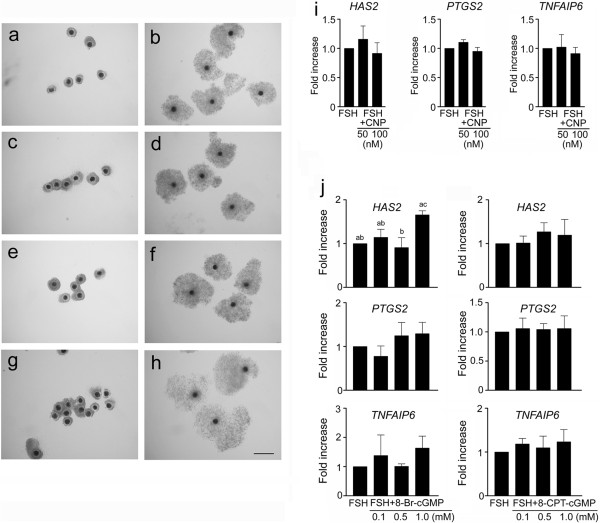
The COCs expressed NPPC and NPR2, the key components of cGMP synthesis, and produced a large amount of cGMP upon stimulation with exogenous CNP, which lead to a significant (P < 0.05) delay in oocyte meiotic resumption. The COCs also responded to cGMP analogues by inhibiting the resumption of oocyte meiosis. The inhibitory effect of cGMP on meiotic resumption was reversed by stimulating the COCs with FSH. However, high concentration of intracellular cGMP was not able to suppress FSH-induced activation of MAPK3/1 in cumulus cells, cumulus expansion and expression of expansion-related genes (P > 0.05).
The findings of this study indicate that high cGMP concentrations inhibit the maturation of pig oocytes in vitro but the inhibitory mechanism does not involve the suppression of MAPK3/1 activation in cumulus cells.
近期研究结果表明,环磷酸鸟苷(cGMP)在调控排卵前哺乳动物卵泡中卵母细胞减数分裂停滞方面发挥关键作用。我们研究的目的是确定在分离的猪卵丘 - 卵母细胞复合体(COCs)中,高细胞内浓度的cGMP是否能够阻断卵母细胞减数分裂的恢复以及卵丘细胞的扩展,以及这种效应是否由cGMP依赖性抑制丝裂原活化蛋白激酶3/1(MAPK3/1)介导。
从屠宰的后备母猪卵巢中分离出COCs,并在添加5%胎牛血清的M199培养基中进行体外培养。通过实时逆转录聚合酶链反应(RT-PCR)测定COCs培养过程中C型利钠肽(CNP)前体(NPPC)及其受体(NPR2)mRNA的表达水平。为了控制COCs中cGMP的细胞内浓度,在培养基中进一步添加CNP或不同浓度的合成cGMP类似物;然后通过酶联免疫吸附测定(ELISA)评估COCs中cGMP的浓度。在培养24小时和44小时后,通过测定核成熟来评估药物对卵母细胞成熟的影响。通过光学显微镜评估卵丘细胞的扩展,并通过实时RT-PCR评估卵丘扩展相关基因的表达。通过用磷酸化特异性和总抗Erk1/2抗体对COC蛋白进行免疫印迹,评估cGMP对促卵泡激素(FSH)诱导的MAPK3/1激活的可能影响。
COCs表达cGMP合成的关键成分NPPC和NPR2,并在受到外源性CNP刺激后产生大量cGMP,这导致卵母细胞减数分裂恢复显著延迟(P < 0.05)。COCs对cGMP类似物也有反应,抑制了卵母细胞减数分裂的恢复。用FSH刺激COCs可逆转cGMP对减数分裂恢复的抑制作用。然而,高浓度的细胞内cGMP无法抑制FSH诱导的卵丘细胞中MAPK3/1的激活、卵丘扩展以及扩展相关基因的表达(P > 0.05)。
本研究结果表明,高浓度的cGMP在体外抑制猪卵母细胞的成熟,但抑制机制不涉及抑制卵丘细胞中MAPK3/1 的激活。