Hooftman Danny A P, Flavell Andrew J, Jansen Hans, den Nijs Hans C M, Syed Naeem H, Sørensen Anker P, Orozco-Ter Wengel Pablo, van de Wiel Clemens C M
Institute for Biodiversity and Ecosystem Dynamics, University of Amsterdam Amsterdam, The Netherlands ; Centre for Ecology and Hydrology Wallingford, UK.
University of Dundee at SCRI Dundee, UK.
Evol Appl. 2011 Sep;4(5):648-59. doi: 10.1111/j.1752-4571.2011.00188.x. Epub 2011 Apr 27.
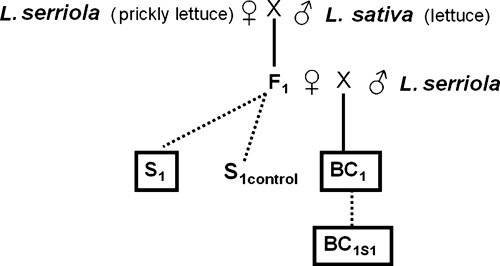
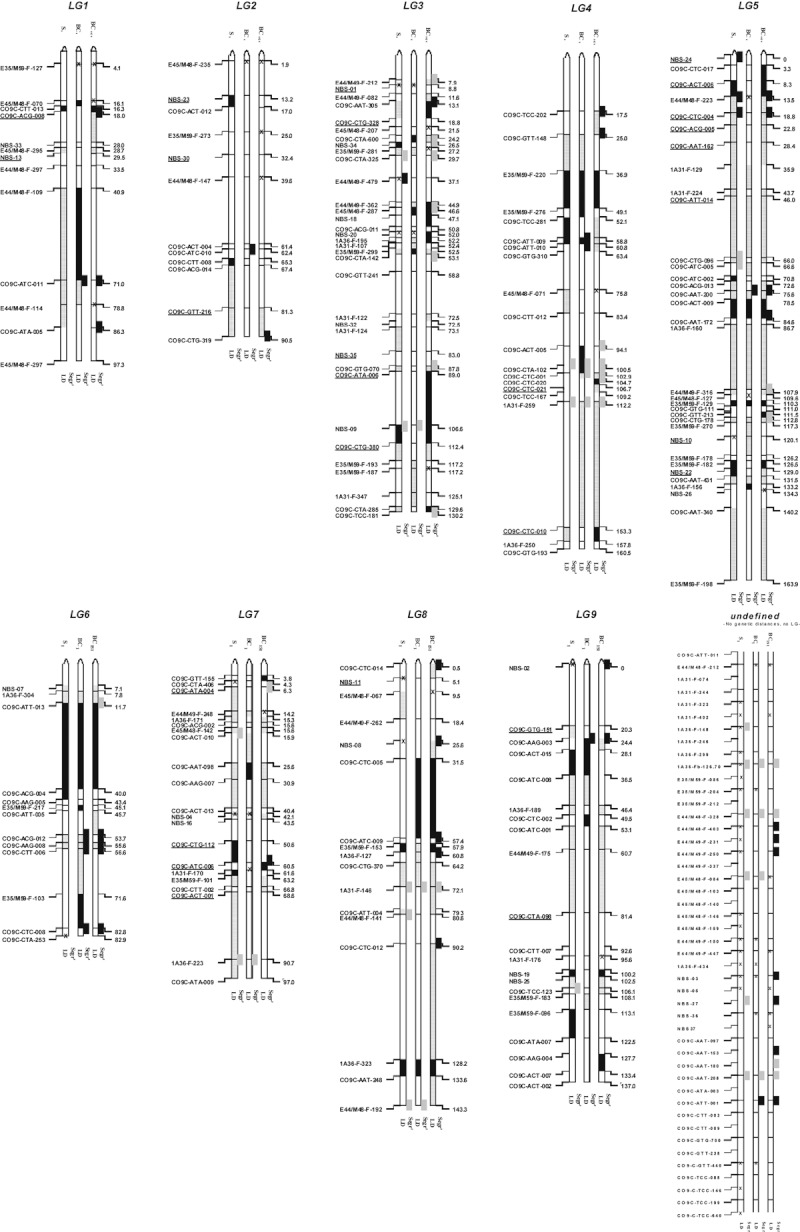
Gene escape from crops has gained much attention in the last two decades, as transgenes introgressing into wild populations could affect the latter's ecological characteristics. However, different genes have different likelihoods of introgression. The mixture of selective forces provided by natural conditions creates an adaptive mosaic of alleles from both parental species. We investigated segregation patterns after hybridization between lettuce (Lactuca sativa) and its wild relative, L. serriola. Three generations of hybrids (S1, BC1, and BC1S1) were grown in habitats mimicking the wild parent's habitat. As control, we harvested S1 seedlings grown under controlled conditions, providing very limited possibility for selection. We used 89 AFLP loci, as well as more recently developed dominant markers, 115 retrotransposon markers (SSAP), and 28 NBS loci linked to resistance genes. For many loci, allele frequencies were biased in plants exposed to natural field conditions, including over-representation of crop alleles for various loci. Furthermore, Linkage disequilibrium was locally changed, allegedly by selection caused by the natural field conditions, providing ample opportunity for genetic hitchhiking. Our study indicates that when developing genetically modified crops, a judicious selection of insertion sites, based on knowledge of selective (dis)advantages of the surrounding crop genome under field conditions, could diminish transgene persistence.
在过去二十年中,作物基因逃逸备受关注,因为导入野生种群的转基因可能会影响后者的生态特征。然而,不同基因的渗入可能性不同。自然条件提供的选择压力混合作用形成了来自两个亲本物种的适应性等位基因镶嵌体。我们研究了生菜(Lactuca sativa)与其野生近缘种L. serriola杂交后的分离模式。三代杂交种(S1、BC1和BC1S1)在模拟野生亲本栖息地的环境中生长。作为对照,我们收获了在可控条件下生长的S1幼苗,其选择可能性非常有限。我们使用了89个AFLP位点,以及最近开发的显性标记、115个反转录转座子标记(SSAP)和28个与抗性基因相关的NBS位点。对于许多位点,在暴露于自然田间条件的植株中,等位基因频率存在偏差,包括各种位点的作物等位基因过度呈现。此外,连锁不平衡在局部发生了变化,据推测是由自然田间条件引起的选择导致的,这为遗传搭车提供了充足的机会。我们的研究表明,在开发转基因作物时,基于对田间条件下周围作物基因组的选择(不)优势的了解,明智地选择插入位点,可以减少转基因的持久性。