Weinert Lucy A, Depledge Daniel P, Kundu Samit, Gershon Anne A, Nichols Richard A, Balloux Francois, Welch John J, Breuer Judith
Department of Veterinary Medicine, University of Cambridge, Cambridge, United Kingdom Department of Genetics, Evolution and Environment, UCL, London, United Kingdom
Division of Infection and Immunity, MRC Centre for Medical Molecular Virology, UCL, London, United Kingdom.
Mol Biol Evol. 2015 Apr;32(4):1020-8. doi: 10.1093/molbev/msu406. Epub 2015 Jan 6.
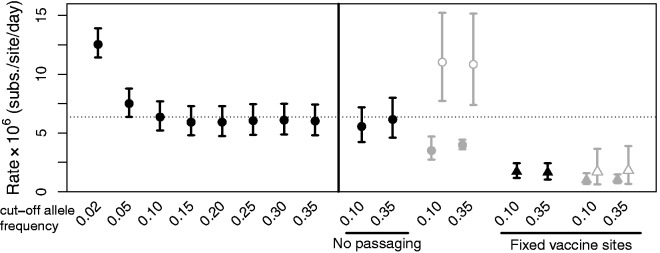
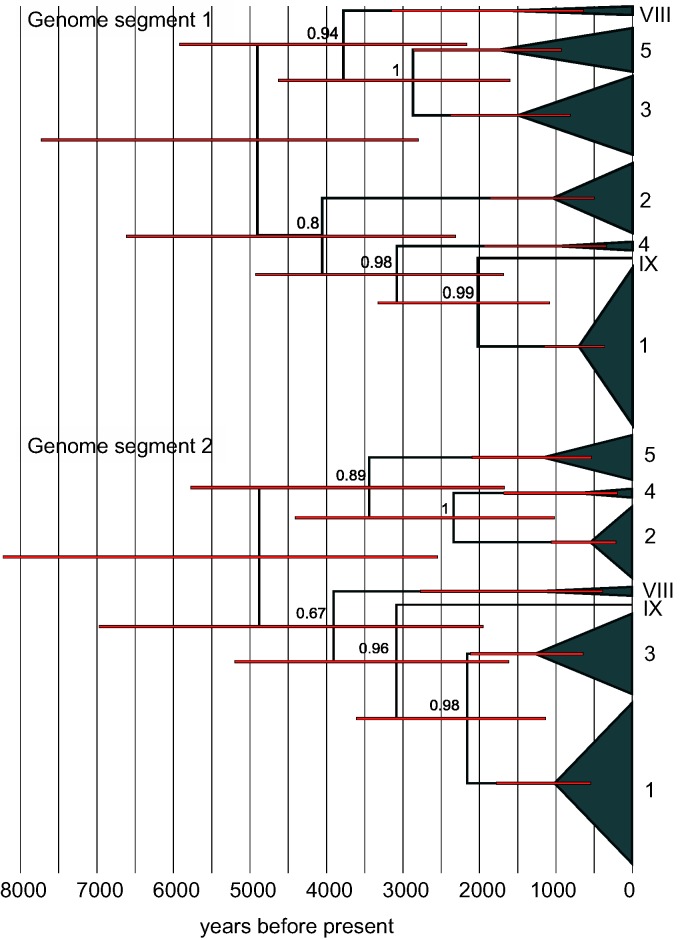
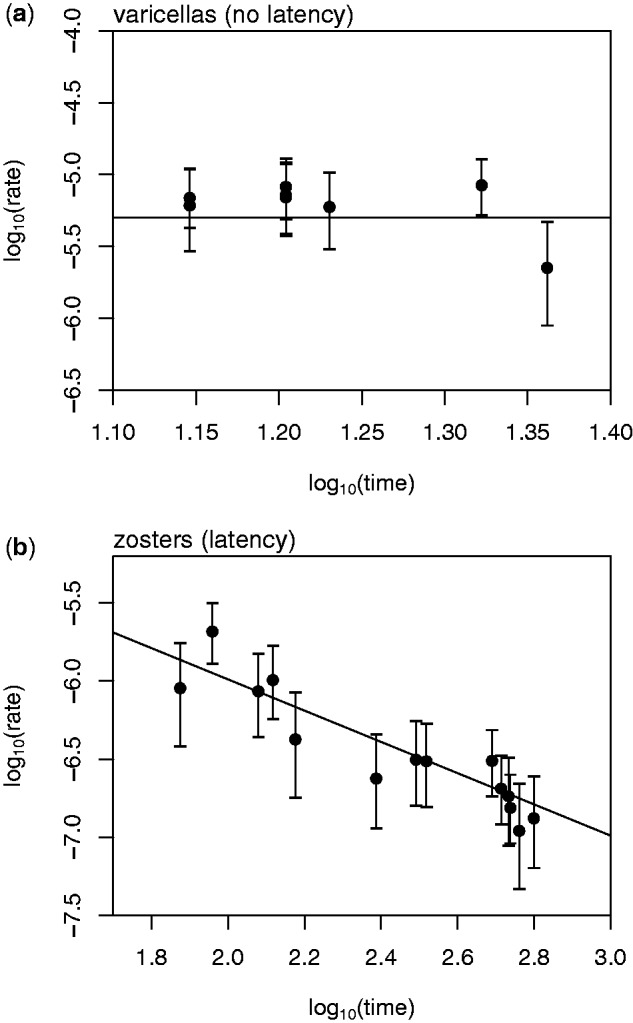
Varicella-zoster virus (VZV) causes chickenpox and shingles, and is found in human populations worldwide. The lack of temporal signal in the diversity of VZV makes substitution rate estimates unreliable, which is a barrier to understanding the context of its global spread. Here, we estimate rates of evolution by studying live attenuated vaccines, which evolved in 22 vaccinated patients for known periods of time, sometimes, but not always undergoing latency. We show that the attenuated virus evolves rapidly (∼ 10(-6) substitutions/site/day), but that rates decrease dramatically when the virus undergoes latency. These data are best explained by a model in which viral populations evolve for around 13 days before becoming latent, but then undergo no replication during latency. This implies that rates of viral evolution will depend strongly on transmission patterns. Nevertheless, we show that implausibly long latency periods are required to date the most recent common ancestor of extant VZV to an "out-of-Africa" migration with humans, as has been previously suggested.
水痘带状疱疹病毒(VZV)可引发水痘和带状疱疹,在全球人群中均有发现。VZV多样性中缺乏时间信号,使得替代率估计不可靠,这成为理解其全球传播背景的一个障碍。在此,我们通过研究减毒活疫苗来估计进化速率,这些疫苗在22名接种疫苗的患者体内经过了已知时长的进化,有时会进入潜伏期,但并非总是如此。我们发现减毒病毒进化迅速(约10⁻⁶ 替换/位点/天),但当病毒进入潜伏期时,进化速率会大幅下降。这些数据最好用一种模型来解释,即病毒群体在进入潜伏期前进化约13天,但在潜伏期内不进行复制。这意味着病毒进化速率将强烈依赖于传播模式。然而,正如之前所提出的,我们表明要将现存VZV的最近共同祖先追溯到人类“走出非洲”的迁徙,需要极长且不合理的潜伏期。