Department of Psychiatry, Jawaharlal Nehru Medical College, AMU, Aligarh, Uttar Pradesh, India.
Department of Biochemistry, Jawaharlal Nehru Medical College, AMU, Aligarh, Uttar Pradesh, India.
Indian J Psychiatry. 2014 Oct;56(4):344-9. doi: 10.4103/0019-5545.146516.
Schizophrenia is a chronic illness having varied etiology which affects cognition, emotion, perception, and other aspects of behavior. There are data which show possible role of oxidative stress and disturbance in antioxidant mechanisms in various neurological and neuropsychiatric disorders.
Fifty drug-naive schizophrenic patients, who attended psychiatry outpatient department/inpatient department for the 1(st) time, were selected and compared with 50 age-sex matched healthy controls. The erythrocyte level of malondialdehyde (MDA) - a lipid peroxidation product and marker of oxidative stress, antioxidant enzymes - superoxide dismutase (SOD), glutathione peroxidase (GPX) was estimated. We also correlated the sociodemographic parameters and severity of illness (positive and negative syndrome scale score) with oxidative stress (MDA) and level of antioxidant enzymes (SOD, GPX).
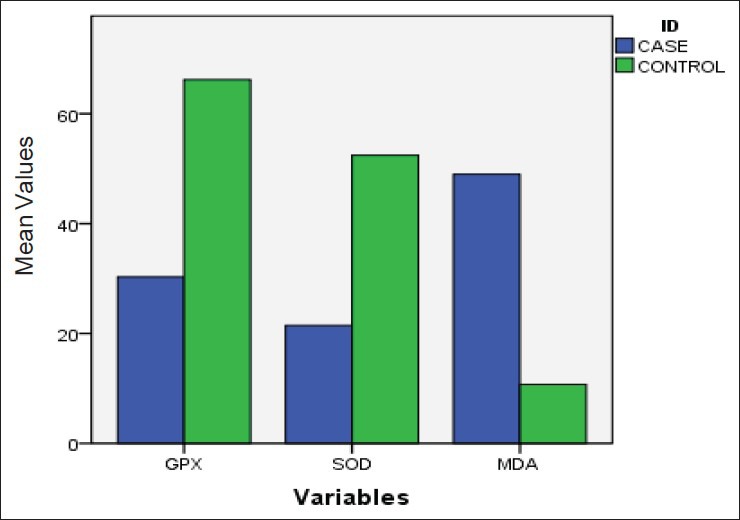
The level of oxidative stress (MDA) was increased, and the levels of antioxidative enzymes (GPX and SOD) were decreased in schizophrenic patients as compared to normal healthy controls and the difference was statistically significant. No significant relationships of age, sex, educational status, marital status, and PANNS score with oxidative stress (MDA) and antioxidative enzymes (GPX and SOD) level in schizophrenic patients was found; but there was significant relationship of locality with oxidative stress (MDA) and antioxidative enzymes (GPX and SOD) level in schizophrenic patients was found. Urban population have a higher level of MDA, GPX, and SOD than the rural population.
Our findings put great emphasis on the weak pro/antioxidant defense mechanisms and its role in the pathophysiology of schizophrenia. We can make recommendations of dietary nutritional supplementation and adjunct antioxidants therapy with antipsychotics to treat schizophrenics.
精神分裂症是一种病因复杂的慢性疾病,会影响认知、情绪、感知和行为的其他方面。有数据表明,氧化应激和抗氧化机制紊乱可能在各种神经和神经精神疾病中起作用。
选择 50 名首次就诊于精神科门诊/病房的未经药物治疗的精神分裂症患者,并与 50 名年龄和性别匹配的健康对照进行比较。评估红细胞丙二醛(MDA)水平-脂质过氧化产物和氧化应激标志物,以及抗氧化酶-超氧化物歧化酶(SOD)和谷胱甘肽过氧化物酶(GPX)。我们还将社会人口统计学参数和疾病严重程度(阳性和阴性综合征量表评分)与氧化应激(MDA)和抗氧化酶(SOD、GPX)水平相关联。
与正常健康对照组相比,精神分裂症患者的氧化应激(MDA)水平升高,抗氧化酶(GPX 和 SOD)水平降低,差异具有统计学意义。未发现年龄、性别、教育程度、婚姻状况和 PANSS 评分与精神分裂症患者的氧化应激(MDA)和抗氧化酶(GPX 和 SOD)水平有显著关系;但发现精神分裂症患者的居住地与氧化应激(MDA)和抗氧化酶(GPX 和 SOD)水平有显著关系。城市人口的 MDA、GPX 和 SOD 水平高于农村人口。
我们的研究结果强调了弱的促/抗氧化防御机制及其在精神分裂症病理生理学中的作用。我们可以建议在抗精神病药物治疗中补充膳食营养和辅助抗氧化剂治疗精神分裂症。