Johnston Calum, Mortier-Barrière Isabelle, Granadel Chantal, Polard Patrice, Martin Bernard, Claverys Jean-Pierre
Centre National de la Recherche Scientifique, Laboratoire de Microbiologie et Génétique Moléculaires, Toulouse, France; Université de Toulouse, Université Paul Sabatier, Laboratoire de Microbiologie et Génétique Moléculaires, Toulouse, France.
PLoS Genet. 2015 Jan 8;11(1):e1004934. doi: 10.1371/journal.pgen.1004934. eCollection 2015 Jan.
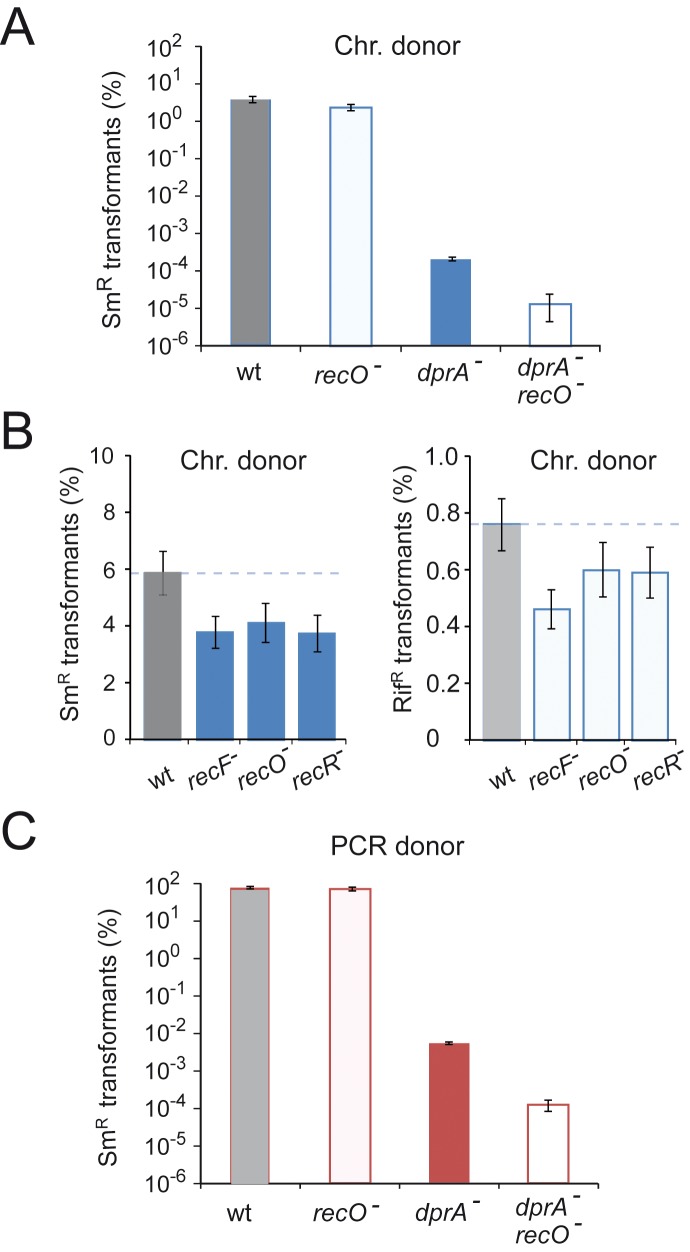
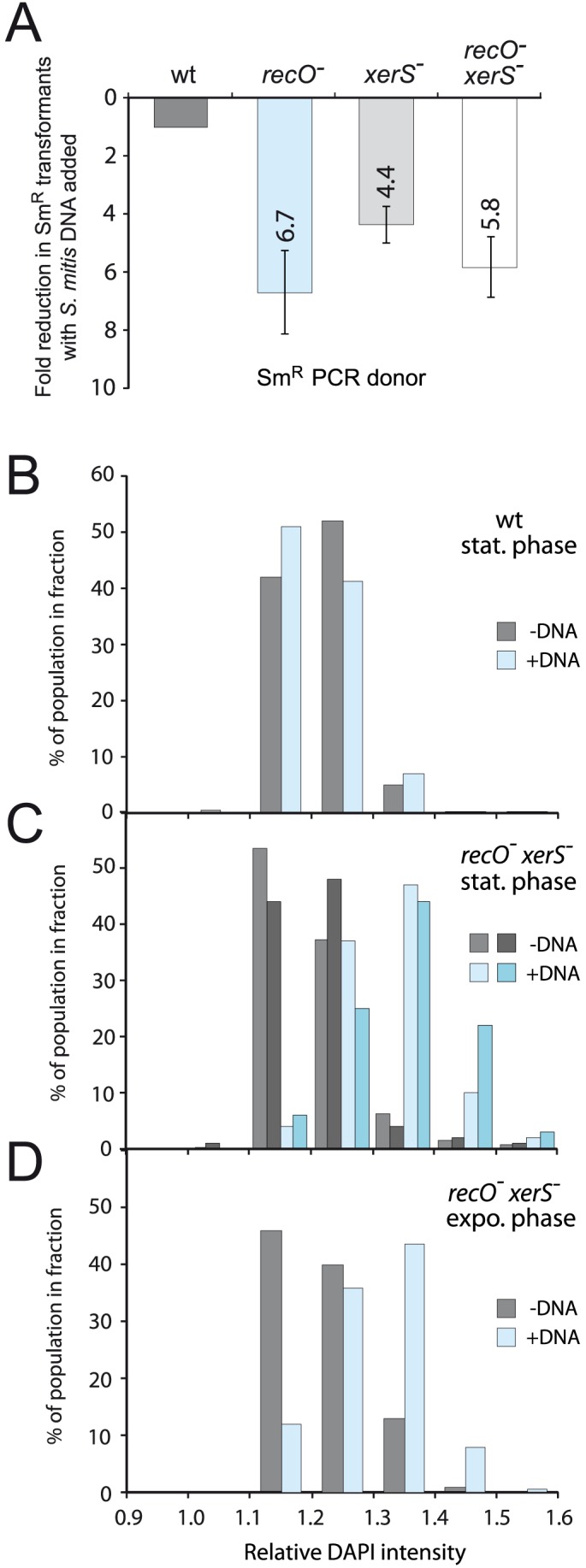
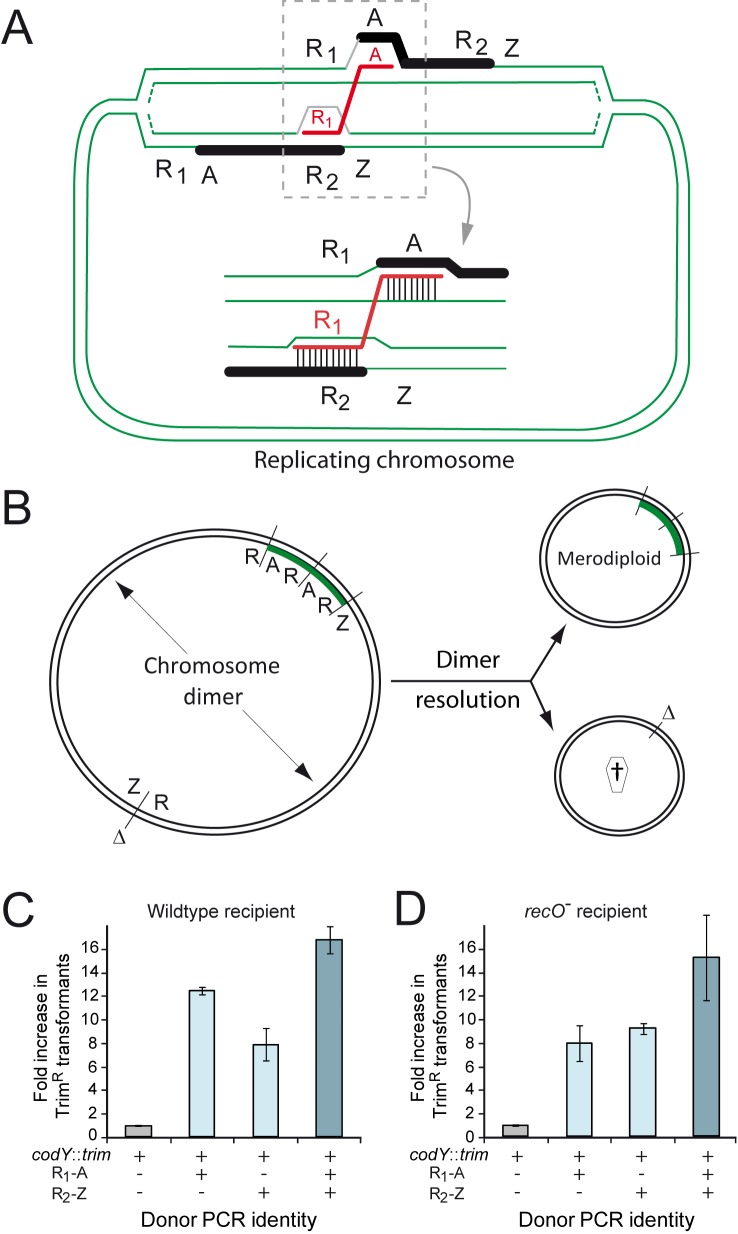
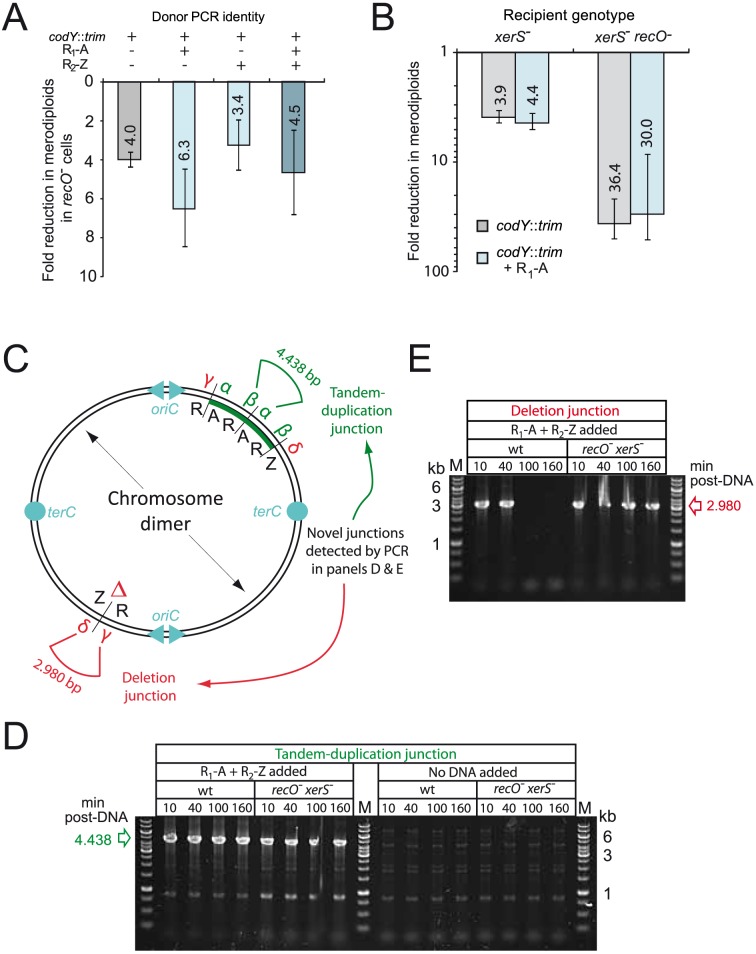
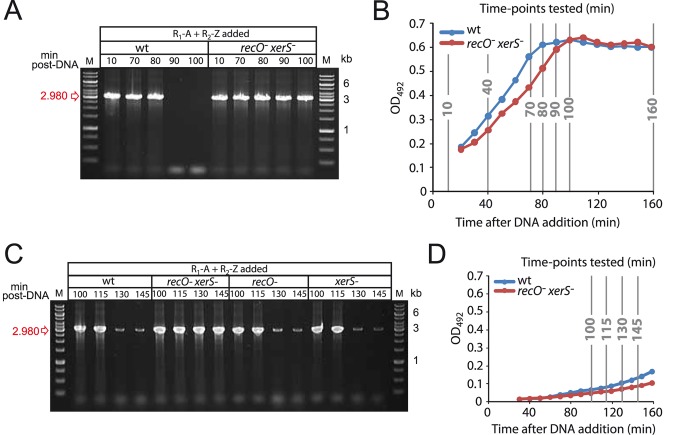
Homologous recombination (HR) is required for both genome maintenance and generation of diversity in eukaryotes and prokaryotes. This process initiates from single-stranded (ss) DNA and is driven by a universal recombinase, which promotes strand exchange between homologous sequences. The bacterial recombinase, RecA, is loaded onto ssDNA by recombinase loaders, RecBCD and RecFOR for genome maintenance. DprA was recently proposed as a third loader dedicated to genetic transformation. Here we assessed the role of RecFOR in transformation of the human pathogen Streptococcus pneumoniae. We firstly established that RecFOR proteins are not required for plasmid transformation, strongly suggesting that DprA ensures annealing of plasmid single-strands internalized in the process. We then observed no reduction in chromosomal transformation using a PCR fragment as donor, contrasting with the 10,000-fold drop in dprA- cells and demonstrating that RecFOR play no role in transformation. However, a ∼1.45-fold drop in transformation was observed with total chromosomal DNA in recFOR mutants. To account for this limited deficit, we hypothesized that transformation with chromosomal DNA stimulated unexpectedly high frequency (>30% of cells) formation of chromosome dimers as an intermediate in the generation of tandem duplications, and that RecFOR were crucial for dimer resolution. We validated this hypothesis, showing that the site-specific recombinase XerS was also crucial for dimer resolution. An even higher frequency of dimer formation (>80% of cells) was promoted by interspecies transformation with Streptococcus mitis chromosomal DNA, which contains numerous inversions compared to pneumococcal chromosome, each potentially promoting dimerization. In the absence of RecFOR and XerS, dimers persist, as confirmed by DAPI staining, and can limit the efficiency of transformation, since resulting in loss of transformant chromosome. These findings strengthen the view that different HR machineries exist for genome maintenance and transformation in pneumococci. These observations presumably apply to most naturally transformable species.
同源重组(HR)在真核生物和原核生物的基因组维持及多样性产生过程中均不可或缺。这一过程起始于单链(ss)DNA,并由一种通用的重组酶驱动,该重组酶促进同源序列之间的链交换。细菌重组酶RecA通过重组酶加载蛋白RecBCD和RecFOR加载到ssDNA上,以维持基因组的稳定性。最近,DprA被提出是专门负责遗传转化的第三种加载蛋白。在此,我们评估了RecFOR在人类病原体肺炎链球菌转化过程中的作用。我们首先确定,质粒转化不需要RecFOR蛋白,这有力地表明DprA确保了该过程中内化的质粒单链的退火。然后,我们观察到,以PCR片段作为供体时,染色体转化没有降低,这与dprA缺失菌株中10000倍的下降形成对比,表明RecFOR在转化过程中不起作用。然而,在recFOR突变体中,使用总染色体DNA进行转化时,观察到转化下降了约1.45倍。为了解释这种有限的缺陷,我们推测,用染色体DNA进行转化意外地刺激了染色体二聚体的高频形成(>30%的细胞),作为串联重复产生过程中的一个中间体,并且RecFOR对于二聚体的分解至关重要。我们验证了这一假设,表明位点特异性重组酶XerS对于二聚体的分解也至关重要。与肺炎链球菌染色体相比,缓症链球菌染色体DNA含有大量倒位,每个倒位都可能促进二聚化,种间转化用缓症链球菌染色体DNA促进了更高频率的二聚体形成(>80%的细胞)。如DAPI染色所证实的,在没有RecFOR和XerS的情况下,二聚体持续存在,并且会限制转化效率,因为会导致转化体染色体的丢失。这些发现强化了这样一种观点,即肺炎链球菌中存在不同的同源重组机制用于基因组维持和转化。这些观察结果大概适用于大多数自然可转化的物种。