Duncombe Chris, Rosenblum Scott, Hellmann Nicholas, Holmes Charles, Wilkinson Lynne, Biot Marc, Bygrave Helen, Hoos David, Garnett Geoff
The Bill and Melinda Gates Foundation, Seattle, WA, USA.
Trop Med Int Health. 2015 Apr;20(4):430-47. doi: 10.1111/tmi.12460. Epub 2015 Feb 16.
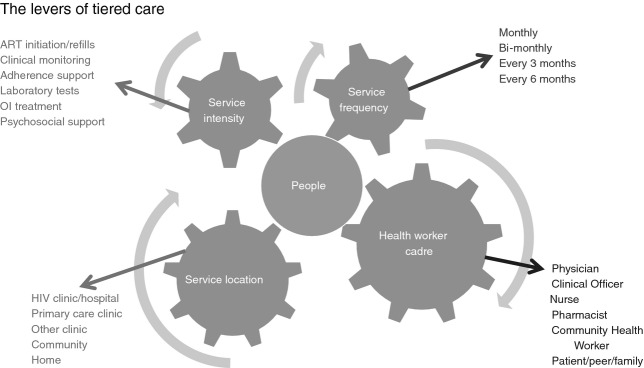
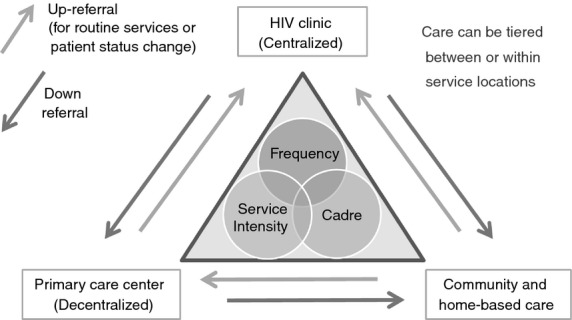
The delivery of HIV care in the initial rapid scale-up of HIV care and treatment was based on existing clinic-based models, which are common in highly resourced settings and largely undifferentiated for individual needs. A new framework for treatment based on variable intensities of care tailored to the specific needs of different groups of individuals across the cascade of care is proposed here. Service intensity is characterised by four delivery components: (i) types of services delivered, (ii) location of service delivery, (iii) provider of health services and (iv) frequency of health services. How these components are developed into a service delivery framework will vary across countries and populations, with the intention being to improve acceptability and care outcomes. The goal of getting more people on treatment before they become ill will necessitate innovative models of delivering both testing and care. As HIV programmes expand treatment eligibility, many people entering care will not be 'patients' but healthy, active and productive members of society. To take the framework to scale, it will be important to: (i) define which individuals can be served by an alternative delivery framework; (ii) strengthen health systems that support decentralisation, integration and task shifting; (iii) make the supply chain more robust; and (iv) invest in data systems for patient tracking and for programme monitoring and evaluation.
在艾滋病护理与治疗最初快速扩大规模的过程中,艾滋病护理的提供是基于现有的门诊模式,这种模式在资源高度丰富的环境中很常见,并且在很大程度上没有针对个体需求进行区分。本文提出了一个新的治疗框架,该框架基于不同护理强度,针对护理流程中不同个体群体的特定需求进行量身定制。服务强度由四个提供要素来界定:(i)所提供服务的类型;(ii)服务提供的地点;(iii)卫生服务提供者;(iv)卫生服务的频率。这些要素如何发展成为一个服务提供框架,会因国家和人群而异,目的是提高可接受性和护理效果。要实现让更多人在患病前接受治疗的目标,就需要创新的检测和护理提供模式。随着艾滋病项目扩大治疗资格范围,许多开始接受护理的人将不是“患者”,而是社会中健康、活跃且有生产力的成员。要推广这一框架,以下几点将很重要:(i)界定哪些个体可以由替代的提供框架来服务;(ii)加强支持权力下放、整合和任务转移的卫生系统;(iii)使供应链更加强健;(iv)投资于用于患者追踪以及项目监测与评估的数据系统。