Khan Hassan, Kunutsor Setor, Kalogeropoulos Andreas P, Georgiopoulou Vasiliki V, Newman Anne B, Harris Tamara B, Bibbins-Domingo Kirsten, Kauhanen Jussi, Gheorghiade Mihai, Fonarow Gregg C, Kritchevsky Stephen B, Laukkanen Jari A, Butler Javed
Department of Medicine, Emory University, Atlanta, GA (H.K., A.P.K., V.V.G.).
Department of Public Health and Primary Care, University of Cambridge, Cambridge, UK (S.K.).
J Am Heart Assoc. 2015 Jan 14;4(1):e001364. doi: 10.1161/JAHA.114.001364.
The relationship between resting heart rate (RHR) and incident heart failure (HF) has been questioned.
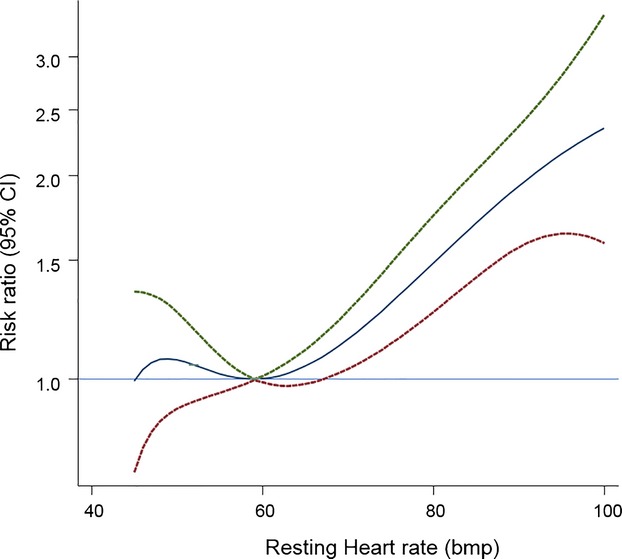
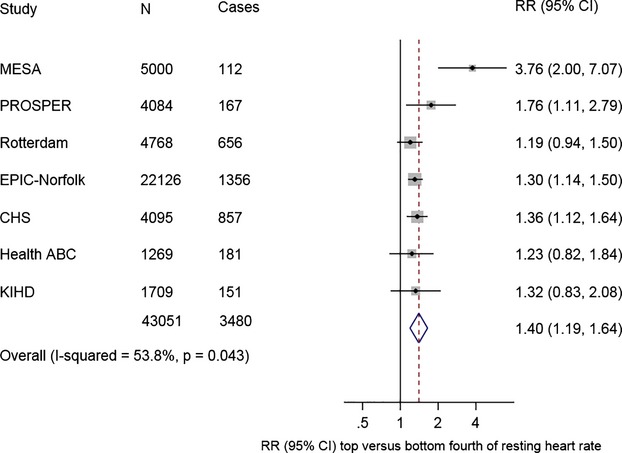
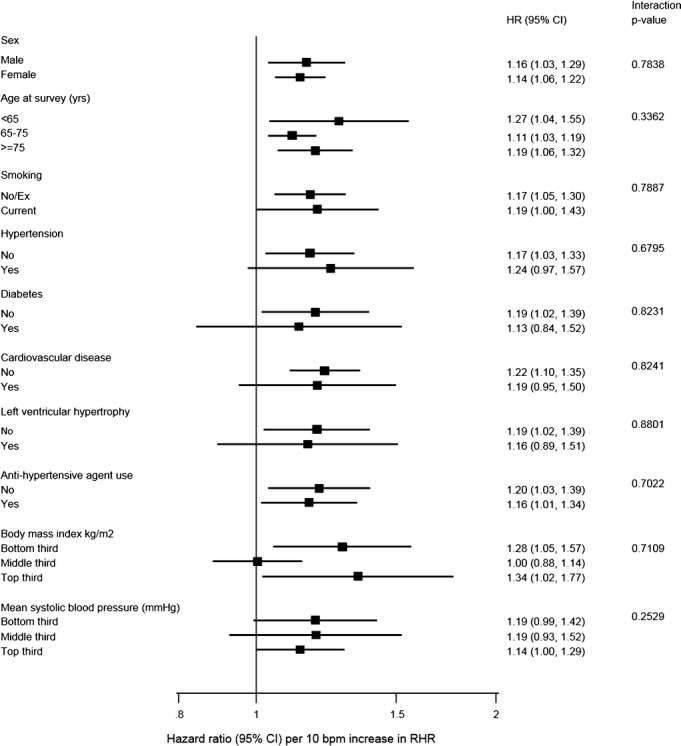
RHR was assessed at baseline in 7073 participants in 3 prospective cohorts (Cardiovascular Health Study, Health ABC study and Kuopio Ischemic Heart Disease Study) that recorded 1189 incident HF outcomes during 92 702 person-years of follow-up. Mean age of participants was 67 (9.9) years and mean RHR was 64.6 (11.1) bpm. Baseline RHR correlated (P<0.001) positively with body mass index (r=0.10), fasting glucose (r=0.18), and C-reactive protein (r=0.20); and inversely with serum creatinine (r=-0.05) and albumin (r=-0.05). Baseline RHR was non-linearly associated with HF risk. The age and sex-adjusted hazard ratio for HF comparing the top (>72 bpm) versus the bottom (<57 bpm) quartile of baseline RHR was 1.48 (95% confidence interval [CI] 1.26 to 1.74) and was modestly attenuated (1.30, 95% CI 1.10 to 1.53) with further adjustment for body mass index, history of diabetes, hypertension, smoking status, serum creatinine, and left ventricular hypertrophy. These findings remained consistent in analyses accounting for incident coronary heart disease, excluding individuals with prior cardiovascular events, or those taking beta-blockers; and in subgroups defined by several individual participant characteristics. In a pooled random effects meta-analysis of 7 population-based studies (43 051 participants and 3476 HF events), the overall hazard ratio comparing top versus bottom fourth of RHR was 1.40 (95% CI: 1.19 to 1.64).
There is a non-linear association between RHR and incident HF. Further research is needed to understand the physiologic foundations of this association.
静息心率(RHR)与新发心力衰竭(HF)之间的关系一直受到质疑。
在3项前瞻性队列研究(心血管健康研究、健康ABC研究和库奥皮奥缺血性心脏病研究)的7073名参与者中,于基线时评估RHR,这些队列在92702人年的随访期间记录了1189例新发HF事件。参与者的平均年龄为67(9.9)岁,平均RHR为64.6(11.1)次/分钟。基线RHR与体重指数(r = 0.10)、空腹血糖(r = 0.18)和C反应蛋白(r = 0.20)呈正相关(P<0.001);与血清肌酐(r = -0.05)和白蛋白(r = -0.05)呈负相关。基线RHR与HF风险呈非线性关联。比较基线RHR最高四分位数(>72次/分钟)与最低四分位数(<57次/分钟)时,HF的年龄和性别调整后风险比为1.48(95%置信区间[CI] 1.26至1.74),在进一步调整体重指数、糖尿病史、高血压、吸烟状况、血清肌酐和左心室肥厚后略有减弱(1.30,95%CI 1.10至1.53)。在考虑新发冠心病、排除既往有心血管事件的个体或正在服用β受体阻滞剂的个体的分析中,以及在由几个个体参与者特征定义的亚组中,这些发现仍然一致。在一项对7项基于人群的研究(43051名参与者和3476例HF事件)的汇总随机效应荟萃分析中,比较RHR最高四分位数与最低四分位数的总体风险比为1.40(95%CI:1.19至1.64)。
RHR与新发HF之间存在非线性关联。需要进一步研究以了解这种关联的生理基础。