Singh Niharika, Mishra Ramesh K
Centre of Behavioural and Cognitive Sciences, University of Allahabad Allahabad, India.
Centre of Behavioural and Cognitive Sciences, University of Allahabad Allahabad, India ; Centre of Neural and Cognitive Sciences, University of Hyderabad Hyderabad, India.
Front Psychol. 2015 Jan 5;5:1481. doi: 10.3389/fpsyg.2014.01481. eCollection 2014.
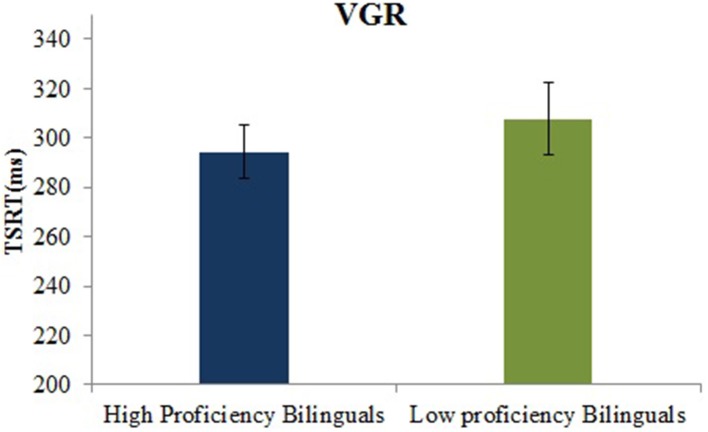
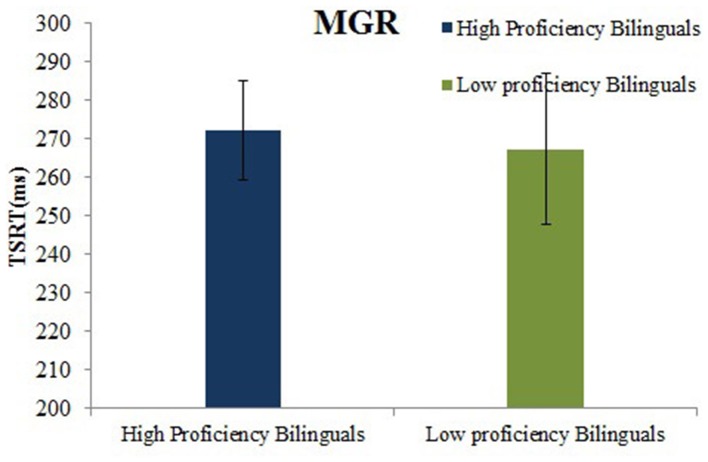
We compared Hindi-English bilinguals differing in their L2 proficiency on a saccadic countermanding task which taps inhibitory control as well as monitoring. We particularly explored whether response inhibition and performance monitoring within the oculomotor domain are affected by language proficiency in bilinguals. There were two different oculomotor redirect tasks: Visually Guided Redirect (VGR) task (Experiment1) and Memory Guided Redirect (MGR) task (Experiment 2). In the redirect task, typically a target is presented and the subject is required to make a saccade (no-step trials), unless a new target appears on a different location after some delay from the first target onset (step trials). On such trials participants are required to inhibit and cancel the saccade to the first target and programme a saccade to the new target. Using trial switch reaction time (TSRT), the time taken to inhibit the initiated saccade to the first target as a measure of response inhibition and post-step slowing as a measure of performance monitoring. The results showed the high proficient bilinguals displayed more post-step slowing on the no-step trials as compared to the low proficient bilinguals for both VGR and MGR versions of the task. Secondly, both the high and low proficient bilinguals exhibited comparable TSRT in both VGR and MGR task, showing no modulatory effects of language proficiency on the response inhibition. These results suggest that language proficiency may have an effect on performance monitoring, but not the inhibitory control per se. Thus, we infer that higher proficiency may lead to superior cognitive flexibility and an ability to adjust behavior that facilitates the attainment of the cognitive goal. These findings are in consonance with other current studies that suggest a top-down effect of bilingualism on action control systems.
我们比较了印地语 - 英语双语者在一项扫视反指令任务中的表现,该任务涉及抑制控制和监控,他们的第二语言(L2)熟练程度有所不同。我们特别探讨了眼动领域内的反应抑制和表现监控是否会受到双语者语言熟练程度的影响。有两种不同的眼动重定向任务:视觉引导重定向(VGR)任务(实验1)和记忆引导重定向(MGR)任务(实验2)。在重定向任务中,通常会呈现一个目标,要求受试者进行扫视(无步长试验),除非在第一个目标出现后的一段时间后,另一个新目标出现在不同位置(步长试验)。在这类试验中,参与者需要抑制并取消对第一个目标的扫视,并计划对新目标进行扫视。使用试验切换反应时间(TSRT),即抑制对第一个目标发起的扫视所需的时间,作为反应抑制的指标,以及步长后减慢作为表现监控的指标。结果显示,对于VGR和MGR版本的任务,高熟练程度的双语者在无步长试验中比低熟练程度的双语者表现出更多的步长后减慢。其次,高熟练程度和低熟练程度的双语者在VGR和MGR任务中的TSRT相当,表明语言熟练程度对反应抑制没有调节作用。这些结果表明,语言熟练程度可能会对表现监控产生影响,但对抑制控制本身没有影响。因此,我们推断,更高的熟练程度可能会导致更好的认知灵活性和调整行为的能力,从而有助于实现认知目标。这些发现与其他当前研究一致,这些研究表明双语对动作控制系统具有自上而下的影响。